
Opportunity, hazards ahead after Macron triumph

The world has changed since he was first elected in 2017, and he needs to act accordingly.

Bloomberg Opinion
April 25, 2022 at 10:40PM
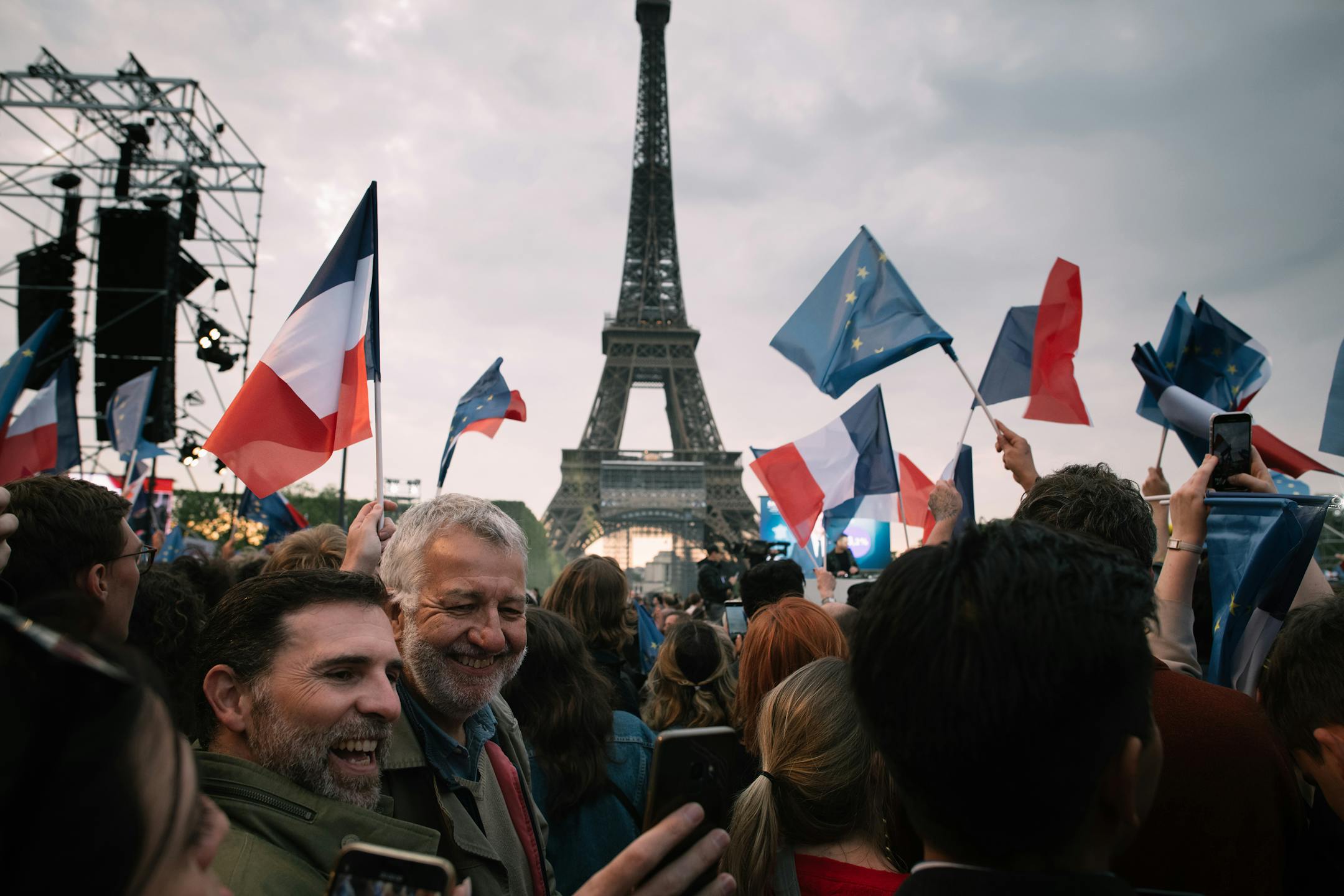
Supporters of President Emmanuel Macron celebrate on the Champ de Mars in Paris after it was announced that Macron won the presidential election on April 24. Macron won a second term as president of France, triumphing on Sunday over Marine Le Pen, his far-right challenger, after a campaign where his promise of stability prevailed over the strong temptation of an extremist lurch. (Dmitry Kostyukov, New York Times/The Minnesota Star Tribune)

Opinion editor's note: Star Tribune Opinion publishes a mix of national and local commentaries online and in print each day. To contribute, click here.

•••

In 2017, France bucked the populist trend by voting for Emmanuel Macron against europhobic Marine Le Pen. In 2022, it has done so again — just as Slovenia looks set to eject its nationalist leader.

An overwhelming display of pro-E.U. values? Not quite. Macron's lead is narrower than last time — around 58%, rather than 66% — and turnout was at its lowest in decades. Voter fatigue runs high.

Yet visions of an anti-elite "domino" effect after Brexit and Donald Trump are increasingly fading in a post-Ukraine, post-COVID world. The French have voted for a France at the heart, not the fringes, of Europe — albeit one that has to better protect its people.

There is opportunity here for Macron. France has strategic weight as the E.U.'s only nuclear power, with an economy that's outperforming Germany's and that is less dependent on Russian gas in a time of war and surging energy prices. But it needs better direction.

The banker-turned-president knows he has to change his governing style at home. His liberal reform agenda is no longer in tune with French support for an enlarged post-COVID state, and will require cooperation with rival parties and trade unions, and burnished green and left-wing credentials.

Even if voters ultimately rejected Le Pen's call for a shredding of European cooperation and a rapprochement with Russia, her economically left-wing campaign earned her a better score than in 2017. An estimated 17% of far-left firebrand Jean-Luc Melenchon's first-round voters backed her in the runoff, according to Ipsos.

Macron's recent talking points and victory speech reflect a willingness to build a bigger political tent. Provided he navigates the next few months with the right government in tow, he should be able to cobble together a (likely reduced) majority after parliamentary elections in June. Saxo Bank's Christopher Dembik reckons there's a less-than 25% chance he'll fail to do so.

While no guarantee against protests or strikes, securing a majority or coalition would lessen the chance of legislative gridlock at a time when France is juggling a debt-to-GDP load of 113% and is under pressure to improve pay and performance in sectors like health and education.

On the European stage, Macron will also have to strike a new balance of humility and outreach. Unity on sanctions against Russia is fraying, more E.U. members are set to join NATO (which he once called "brain-dead") and the political center of gravity is shifting eastward, where Paris has in the past failed to build diplomatic capital. The climate transition, regulating tech platforms and closing corporate-tax loopholes are other items on the agenda.

Here too, there's an opportunity. France's geopolitical weight is vital to bolstering a pro-Ukraine stance when it comes to supporting Kyiv financially and militarily, as well as cutting European reliance on Russian oil and gas. Paris's ability to prod Berlin on these issues will be vital, given that German Chancellor Olaf Scholz — the first foreign leader to call Macron after re-election — is under pressure from his coalition to take a clearer line on Vladimir Putin.

Unpicking the region's energy ties while simultaneously ramping up its defense capabilities will bring costs. A re-elected Macron should use his political momentum to recapture the spirit of the E.U.'s $1 trillion pandemic recovery plan and push for more spending and solidarity via joint borrowing, as previously proposed in partnership with Italy's Mario Draghi.

French far-right and far-left parties aren't going anywhere, meanwhile. They will likely command a bigger political presence as two of three big voting blocs (alongside Macron's centrists) emerge from the rubble of 20th-century Left-Right divides. With Macron unable to serve a third term, the risk of another polarizing standoff in 2027 remains.

Still, Le Pen faces serious pressures of her own, according to Catherine Fieschi, director of Counterpoint. Le Pen bet the farm on a normalization strategy that excised the toxic policy of Frexit and airbrushed her party's fascist past in favor of cat videos and budget giveaways. Her score just above 40% suggests that, failing a surprise outperformance in June, she has peaked as a presidential contender.

Macron has made history as the first French president to win re-election since 2002. Despite evidence of deep cracks in society, and a reluctance to embrace the president's pitch for a liberal "revolution," that still means something. If he fails to deliver on his promise of more protection at home and more projection abroad, it will be a huge missed opportunity.

about the writer

about the writer

Lionel Laurent

More from Commentaries

See More
card image
Anthony Souffle/The Minnesota Star Tribune

Pursuing criminal investigations for political and retaliatory motives is anathema to generations of federal prosecutors like us.

card image
card image