

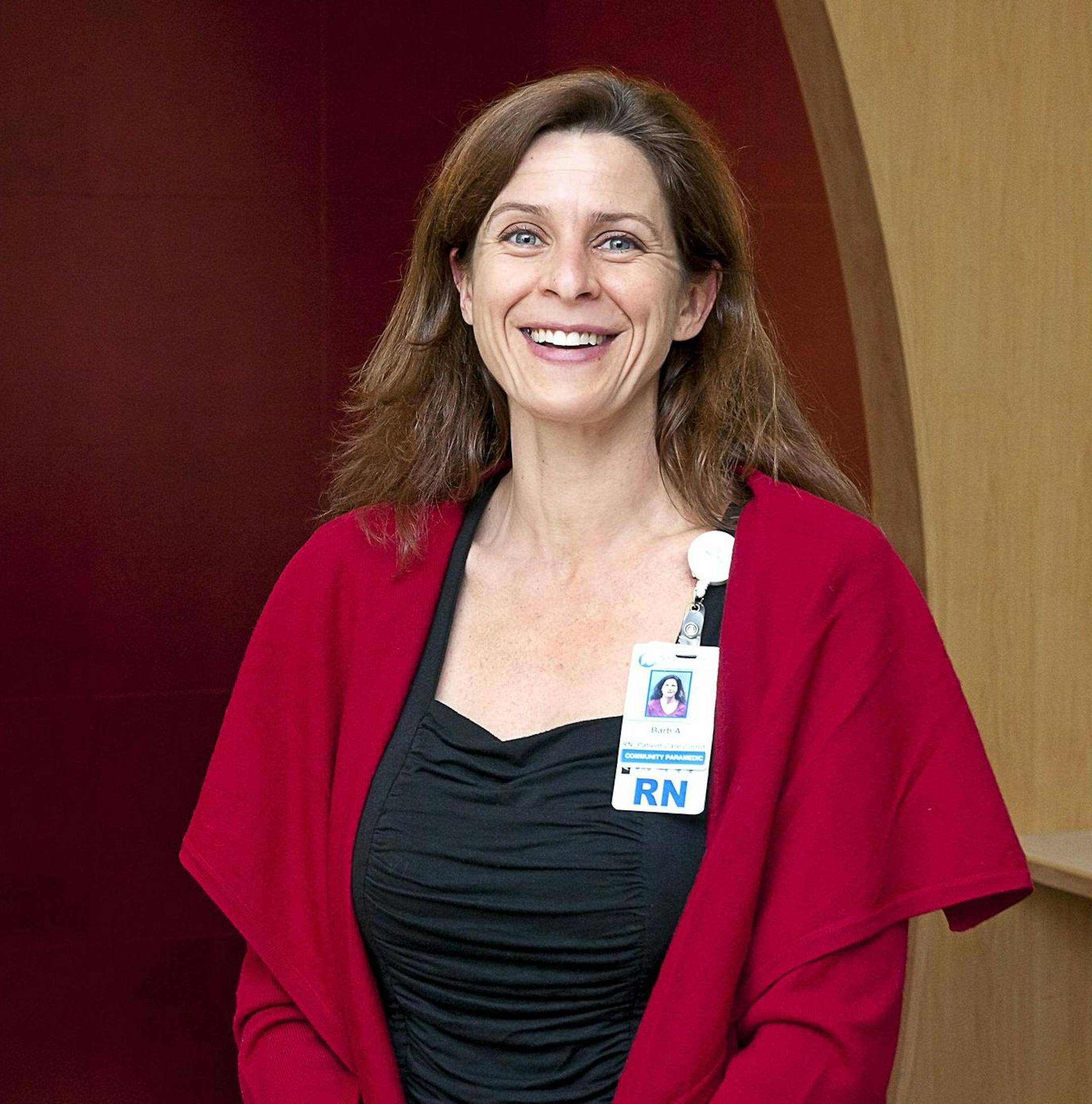
Barb Andrews is a health care pioneer — one of the first nine community paramedics to be employed in the state of Minnesota, which is the first state to offer certification for community paramedics.
"The 911 paramedic puts band-aids on big issues," Andrews said. "The community paramedic is trained to deal with chronic conditions, to prevent patients from needing the emergency room."
Andrews began her career as an emergency room nurse and became a 911 paramedic for North Memorial Hospital in 2001. Like all of the community paramedics, she continues to work some shifts as a 911 paramedic. "As community paramedics, we wear a different uniform and we drive our own vehicle instead of an ambulance," she said.
Hennepin Technical College offers the community paramedic training to experienced paramedics. "Of the nine of us who went through the training, the least senior guy had six years of experience, " Andrews said. "A couple of people had more than 30 years as a 911 paramedic."
While some people see the community paramedic career as a way to extend the working life of 911 paramedics, Andrews thinks the basic difference is less about the physical demands of the job and more about core skills like planning ability and patient relationships. "If you're a person who likes to clock and in and clock out, this is not for you. The 911 paramedic asks, 'Are you sick or not sick?' We say, 'Okay, you're sick. We need to keep you as healthy as possible'."
Andrews is quick to note that the community medic is not a replacement for existing services like home health nurses. "This isn't a 'skilled need,' and insurance won't cover it. We are certified, not licensed," she said. "We work under the instructions of a physician. We are a direct line to what the doctor wants to do."
That can be everything from setting up a weekly pill box for a patient who is baffled by medications to monitoring the weight of a patient who is on diuretics, so that the doctor can adjust the dosage. If a patient is falling, the community paramedic will see whether rugs are causing tripping and whether lighting is adequate.
Paramedics can also recommend community resources, ranging from Meals on Wheels for elderly patients who aren't getting good nutrition to pro bono contractors who might provide a wheelchair ramp so that a wheelchair-bound patient can get out of the house.



