
Counterpoint | Post-game prayers aren’t performative — they’re an act of humility

Whether whispered alone or spoken together, prayer depends on the posture of the heart, which is something no one else can rightly judge.

October 10, 2025 at 6:26PM
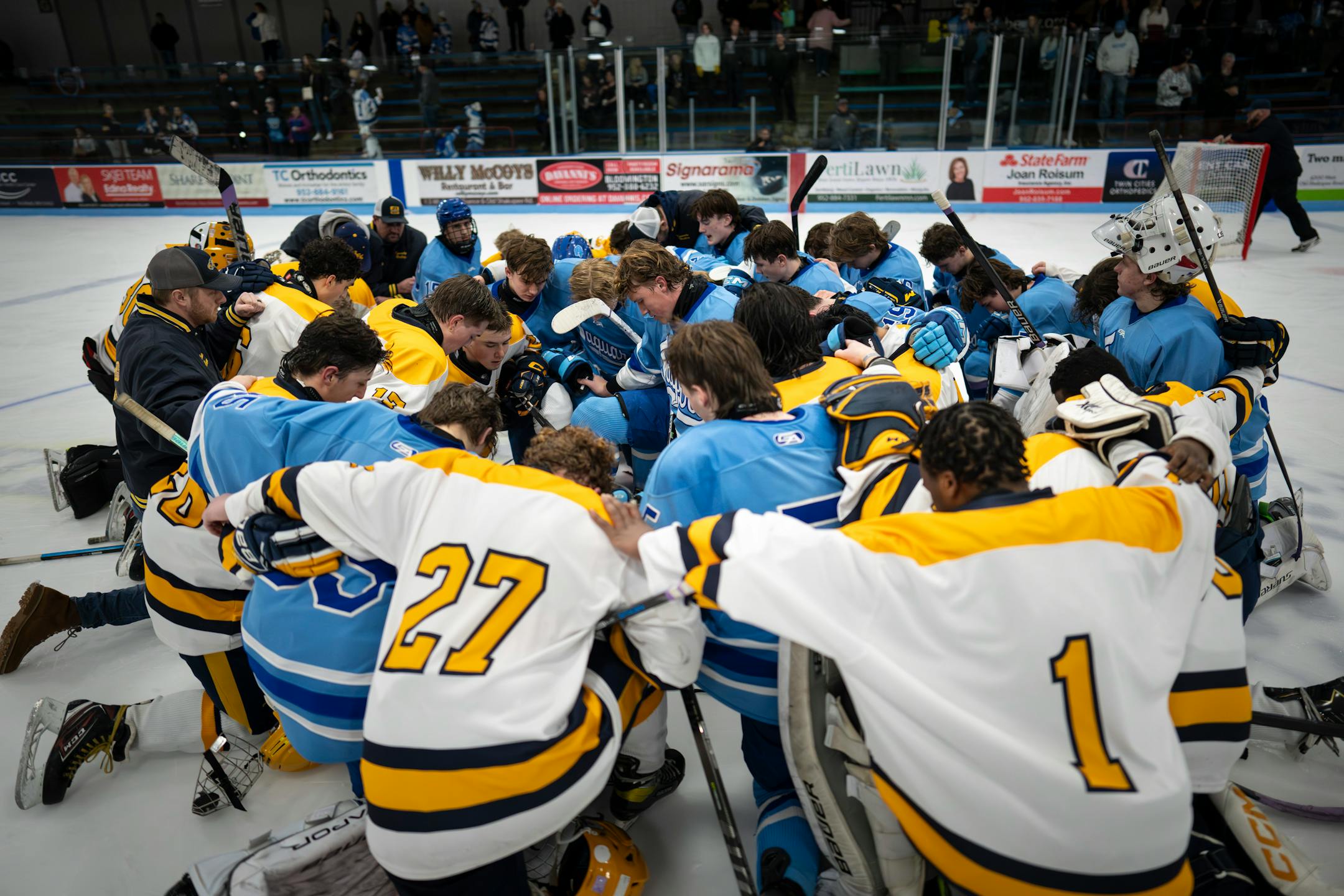
Bloominton Kennedy players (in yellow) huddle with Bloomington Jefferson players (in blue) for a post-game prayer in the center of the ice at the Bloomington Ice Garden on Jan. 11. (Renée Jones Schneider/The Minnesota Star Tribune)

Opinion editor’s note: Strib Voices publishes a mix of guest commentaries online and in print each day. To contribute, click here.

•••

A recent column in the Star Tribune questioned the practice of post-game prayer circles in hockey (“Prayers at center ice run counter to Christian teachings,” Oct. 3). I appreciate the opportunity for public discussion on faith and believe it is a good practice to wrestle with, and sharpen each other around, the meaning of God’s word. But the argument the author made misrepresents both the heart behind these gatherings and the broader purpose of prayer itself.

Public prayer is not about spectacle. It’s about the connection between people, and between humanity and the divine. In an age of isolation, that connection has never mattered more.

The columnist cited Jesus’ warning in Matthew 6 about the Pharisees who prayed on street corners to be seen by others. That passage, though, is not a condemnation of public prayer, but of prideful motives. Christ wasn’t forbidding people from praying in front of others; he was calling out the hypocrisy of those who prayed to elevate themselves.

If the intent of a prayer is humility and unity, not superiority or attention, it reflects a genuine posture of sincerity. Humble, public prayer is something scripture supports throughout the Bible. Just one chapter earlier, in Matthew 5:14-16, Jesus teaches that we are to be the “light of the world … a lamp that should not be hidden.” Later, in Matthew 18:20, he promises, “Where two or three are gathered in my name, there am I with them.”

Prayer, whether whispered alone or spoken together, depends on the posture of the heart, which is something no one else can rightly judge.

The prayer circles forming at center ice after hockey games aren’t about victory or defeat, pride or attention. They’re about players, who moments earlier competed fiercely, coming together to acknowledge something greater than themselves.

These huddles are not exclusive, either. They are open invitations for anyone who wishes to participate, regardless of faith or background, and no one is pressured to join. Some bow their heads in prayer; others simply take a moment of quiet reflection. It’s a moment of humility, not hierarchy, a shared recognition of our humanity that transcends jerseys, schools and beliefs.

This tradition, which began almost two decades ago, has never been about asserting dominance or exclusion. It has always been player-initiated and prayer-led, and at its core has always been about gratitude, respect and connection.

To claim these circles are a sign of Christian triumphalism is to miss the larger picture. In reality, they are examples of what our society desperately needs: people coming together in mutual respect and connection, despite differences of belief or other divides that exist. As Christians, Jesus has commanded us to love one another, just as he first loved us (John 13:34-35). This expression of love is not conditional; it is sacrificial and is born out of the humility of serving others.

Freedom of faith, including the freedom not to believe, is a cornerstone of American life. Protecting that freedom means defending the right for individuals to express their beliefs peacefully and voluntarily. When young athletes initiate these moments, adults should be encouraging their impulse to connect, not undermining it with suspicion.

We can, and should, teach our children that our differences do not have to divide us. Whether motivated by faith, sportsmanship or simple gratitude, moments of shared reflection remind us of what we hold in common.

Players bowing heads after a game is not a show of power, it’s an act of humility. It’s a way to say: “We are more than opponents. We are people first, and you matter to me.”

If we truly care about building stronger communities, then protecting the freedom to connect, in faith or in fellowship, should unite us, not divide us.

In a time when the world feels increasingly fractured, maybe a few kids kneeling together on the ice have something to teach the rest of us.

Cameron Carson lives in Princeton, Minn.

about the writer

about the writer

Cameron Carson

More from Commentaries

See More
card image
Evgeniy Maloletka/The Associated Press

Yes, it has resources and strategic value. But it isn’t simply up for grabs.

card image
card image