
Old lefties, new media and young voters

A few clues to the rise of Jeremy Corbyn and Bernie Sanders.

September 18, 2015 at 11:21PM
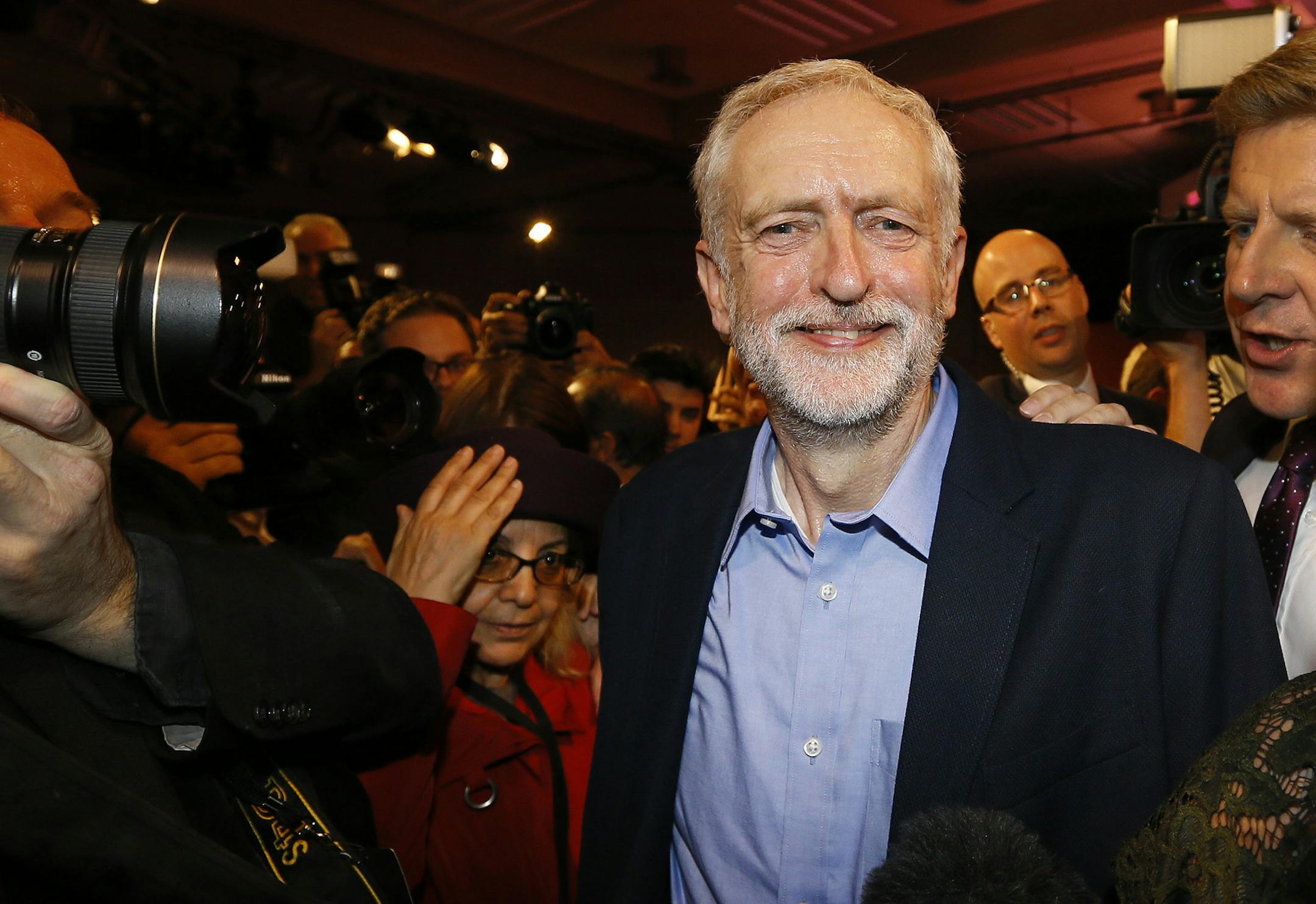
Jeremy Corbyn smiles as he leaves the stage after he is announced as the new leader of The Labour Party during the Labour Party Leadership Conference in London, Saturday, Sept. 12, 2015. Corbyn will now lead Britain's main opposition party. (AP Photo/Kirsty Wigglesworth) ORG XMIT: MIN2015091812513960
Jeremy Corbyn smiled as he left the stage after he was announced as the new leader of the Labour Party in London last Saturday. Corbyn will now lead Britain’s main opposition party. (The Minnesota Star Tribune)

The landslide election of the left-wing politician Jeremy Corbyn as leader of Britain's Labour Party last weekend provoked an avalanche of bien-pensant opinion. A glance at the headlines in Britain's right-wing press confirms this: "Red and Buried" (Daily Mail); "Bye, Bye Labour" (Daily Express); "Leader Nightmare" (Sun); "Death of Labour" (Telegraph). David Cameron saw it fit to tweet that Corbyn's election makes the Labour party "a threat to our national security, our economic security and your family's security."

Such hysterical responses to a supposedly unelectable and hopeless politician are interesting in themselves. They should make us ask deeper questions about the political climate in which an apparent throwback to the 1960s like Corbyn — or the 74-year-old Bernie Sanders in the U.S. — becomes freshly relevant in the political mainstream.

It has certainly been astonishing to watch the spontaneous mass movement — led by the young — that enthroned an old-style leftist like Corbyn. The most obvious explanation, of course, is that people are fed up with a professional political class that is too frequently found in bed with big business and financiers.

In this conventional account of rising outsiders and populists, the new media has cleansed public debate of special interests, allowing a figure like Donald Trump to speak above the heads of powerful television networks that break or make politicians.

But such a broad explanation not only obscures the diversity of political sentiment among the young and the old, the rich and the poor, the declining middle class and the aspiring lower middle-class. It also leaves out the genuine appeal of old-fashioned political activism, and the suspicion of both old and new media, among a young generation in Britain and America whose members confront a more uncertain economic future than any youthful generation in recent history.

They have witnessed, from a sentient age, slick experts and technocrats who made mass participation in democratic politics seem unnecessary. They have grown up with digital media, and its seductive promise of empowering citizens by amplifying their experiences and messages.

Indeed, the victory in 2008 of a rank outsider like Barack Obama showed that the new media could be used effectively to mobilize grass-roots supporters and overcome entrenched elites.

It still can, but its limitations have also become clearer to the young.

Anyone can now join the chattering class with Twitter and Facebook accounts. But this only adds to the general cacophony — a tumult in which the goal of identifying the public good by reasoned debate is replaced by a secondary imperative: to make your voice heard.

At worse, the loudest and more extreme voices hold sway. At best, every fact and opinion are smothered in overinterpretation, from all possible positions, by conspiracy theorists and self-promoters as well as supposed experts.

The "old" media then often restages these free-for-all debates. Instead of consolidating behind a political party or a movement, public opinion splinters. The public good recedes further, while ignorant armies clash in the night. The citizen ends up as a consumer of democracy as spectacle, confusing his own ephemeral passions on every possible topic — and the energy spent in commenting, forwarding and rating opinion — with political participation.

The result is intellectual and civic impotence, whose benefits are mostly reaped by those who make money off aggregating opinion.

Such is the impasse brought about by a democratized media and its raucous bazaar of opinion. Not surprisingly, digitally savvy young people are looking for a path beyond it.

Many of them now invest their faith in unreconstructed old lefties like Bernie Sanders and Jeremy Corbyn, two unconventional politicians who manifest in their public persona the rare virtues of authenticity and sincerity, rather than managerial slickness or poll-tested platitudes.

To ask, as many pundits do, whether Corbyn is electable five years from now is to ignore the historic task he and his youthful supporters have already accomplished: the swift junking, after a humiliating defeat, of a failed mode of electoral politics, and a broad shift to participatory democracy within Britain's biggest opposition party.

In the vacuum created by the technocracy and the media, an old-fashioned kind of politics has appeared — one that promises true political engagement and solidarity to citizens, rather than private self-aggrandizement or the pursuit of power at all costs.

The abrupt resurrection of the old-style left is a reminder that big social, economic and political divisions and discontents exist over and beyond their fragmented and distorted representations by professional politicians and their spin masters in the media.

This rude uncovering of a veiled reality is what drives the reigning technocrats and their chums in the right-wing press to hysteria. The inexperienced Corbyn may not survive their hostility. But he has inaugurated what may seem in a few years a momentous transition to a reality-based political community.

about the writer

about the writer

Pankaj Mishra, Bloomberg View

More from Commentaries

See More
card image
Alex Kormann/The Minnesota Star Tribune

The administration’s justifications keep changing. The focus on county jails is just one of the latest.

card image
card image