

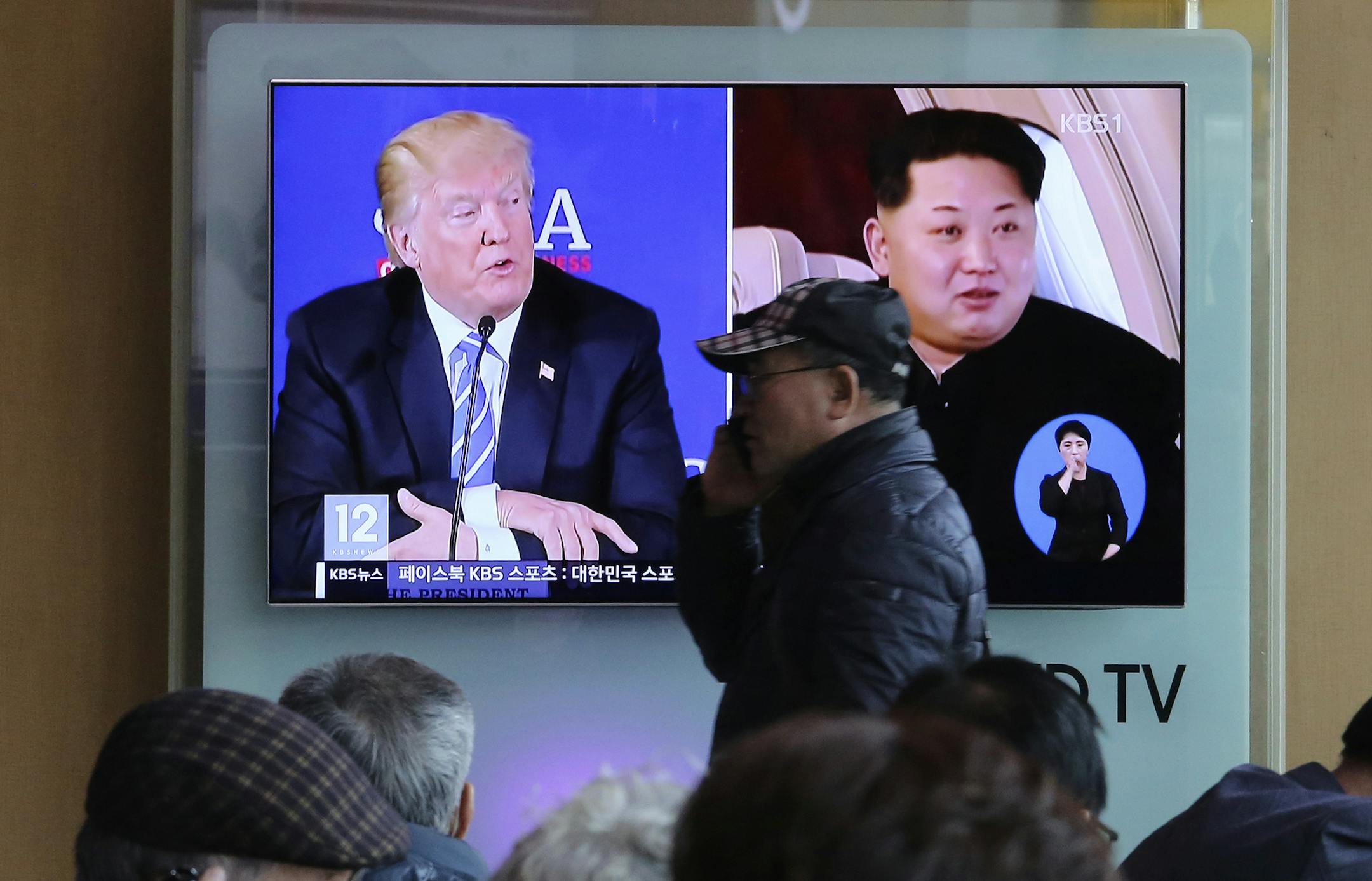
There's only about a month to go before the first-ever summit between a U.S. president and a North Korean hereditary ruler: President Donald Trump and Kim Jong Un are expected to meet in May or early June. In March, the North Korean leader met with China's leader, Xi Jinping. This was the first time he is known to have ever met a sitting head of state. What's more, come April, Kim will talk to his South Korean counterpart, President Moon Jae-in.
The official line in Washington, more or less echoed by Pyongyang as well as by Beijing and Seoul, is that the Trump-Kim summit will be held to advance the case for North Korea's denuclearization. Alas, it is not that simple. Good things might emerge from the summit, but denuclearization is definitely not going to be one of them.
Kim himself, reversing the long-held line of Pyongyang, said that he is interested in denuclearization — at least as long as the process is "progressive and synchronous." This is a massive turnaround: As recently as few months ago, the North Korean government was not only testing new missiles capable of hitting the United States but also using every opportunity to stress that it would never give up its "nuclear deterrence."
The earlier statements were correct. Pyongyang leaders have no intention of surrendering their nuclear weapons. They see nukes as the major, even only, guarantee of their regime's long-term survival. They believe that without nukes they are as good as dead, and recent history — Iraq, Ukraine and, above all, Libya — confirms their worst expectations.
Kim and his people do care about economic growth. Contrary to common misconceptions, the North Korean economy has improved considerably under his watch. Even so, regime survival is far more important to him than any economic growth, so no amount of promised economic benefits will lure him into surrendering his nukes.
There are two reasons Kim suddenly switched to being more congenial and diplomatic after his yearlong display of unusual bellicosity. The North Koreans are increasingly worried by signals and leaks from Washington that seemingly indicate that Trump might be serious about using military force against them, even at the risk of provoking a massive war. Second, they expect that a new raft of economic sanctions, now fully supported by China, will soon deliver a heavy blow to their recovering economy. They do not want their economy to be ruined, and they do not want to be shot at, so they need a break.
Surrender of the nuclear program is not really on the table, however. The only realistic option is a moratorium on nuclear tests and missile launches. With some persistence, U.S. negotiators could also get some of the North Korean nuclear and missile production facilities dismantled — but their gains would not go much further than that. No matter what, the North Koreans will still keep some of the nuclear weapons they have already produced.
A partial deal of this type would, however, be hard to swallow for many in the United States and elsewhere, so its deficiencies would somehow have to be disguised — which is where the idea of "gradual denuclearization" comes in. The essence of this approach is to present a partial "nuclear freeze deal" as merely the first step on the long road toward North Korean denuclearization — with a tacit assumption that the next step will not follow any time soon, if ever.


