

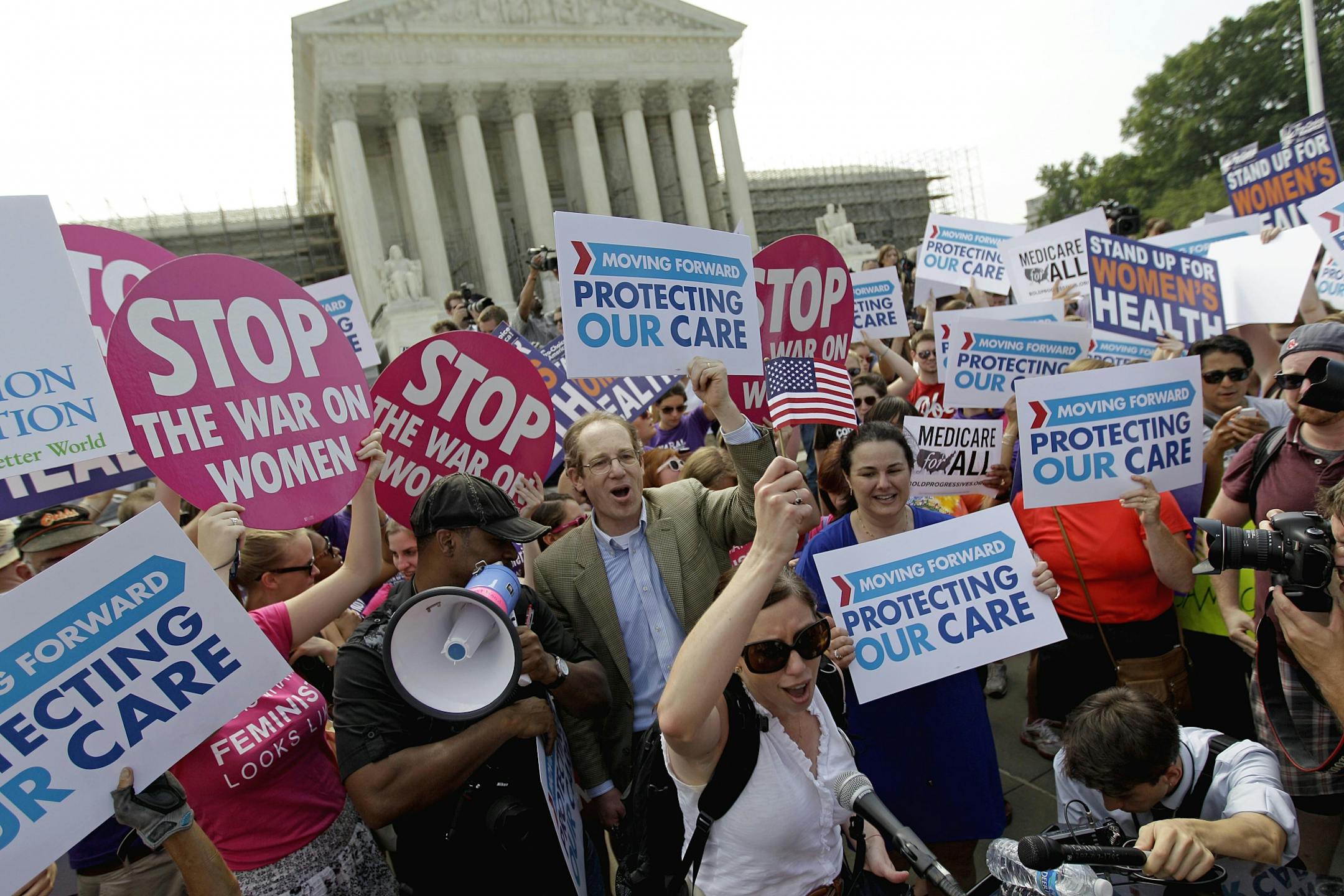
Will the real U.S. Supreme Court please stand up?
Impeccable liberal sources insist that the court is radically activist and conservative, regardless of its decision to uphold the Affordable Care Act. Conservative observers continue to intone that the court is liberal and out of touch with America -- as it has been for nearly 60 years, since Earl Warren was named chief justice in 1953.
Who is right? Should we be paying more attention to the court's cursory one-pager reaffirming Citizens United (and the super PACs), or to the health care and immigration decisions, in which close majorities reached compromise positions that leaned left?
The liberal case that this is a strikingly conservative court poised to become more so must be taken seriously. A slim 5-4 majority that includes Justice Anthony Kennedy has essentially gutted campaign-finance regulation over the past three years, ending a decades-old judicial compromise in which campaigns were allowed to spend as much as they wanted but individuals and corporations were limited in how much they could donate.
That compromise never made much doctrinal sense: If money is speech, neither spending nor donation should be limited; if it isn't, both should be subject to regulation. Nonetheless, the compromise did represent a pragmatic solution to the partisan political debate over money in elections. Now, the court has picked a winner -- the conservative view that money should flow freely. Because its crucial rulings have been based on fundamental constitutional rights rather than the language of the statutes, there is nothing that Congress can do about it.
The court has also struck down an unusual amount of legislation in recent years, often using reasoning that seems to hark back to the bad old days of conservative activism in the 1920s and 1930s. It revived the Second Amendment to strike down gun-control laws in Washington; it invalidated the protection from firing enjoyed by the members of the public accounting board created by the Sarbanes-Oxley corporate reform law, and it held that unions must get the consent of nonmembers before using their money for political purposes.
Yet the liberal critics are soft-pedaling the dramatic end of this year's term. Five major cases loomed. All were extremely close. And in four out of the five, the result was decidedly a win for liberals.
The court ruled, with Kennedy providing the deciding vote, that states could not impose mandatory life sentences on juvenile murderers. This decision continued a decidedly liberal trend of decisions (in which Kennedy has participated) using the concept of cruel and unusual punishment to block states from certain punishments of minors and the mentally disabled. These decisions overruling tough state laws are the sort of thing conservatives detest as elitism and liberals embrace as humanitarian.


