
No rain is farmers' pain

A once-promising forecast is turning ugly for U.S. farmers, although Minnesota's crop is in better shape than most.

July 10, 2012 at 2:10AM
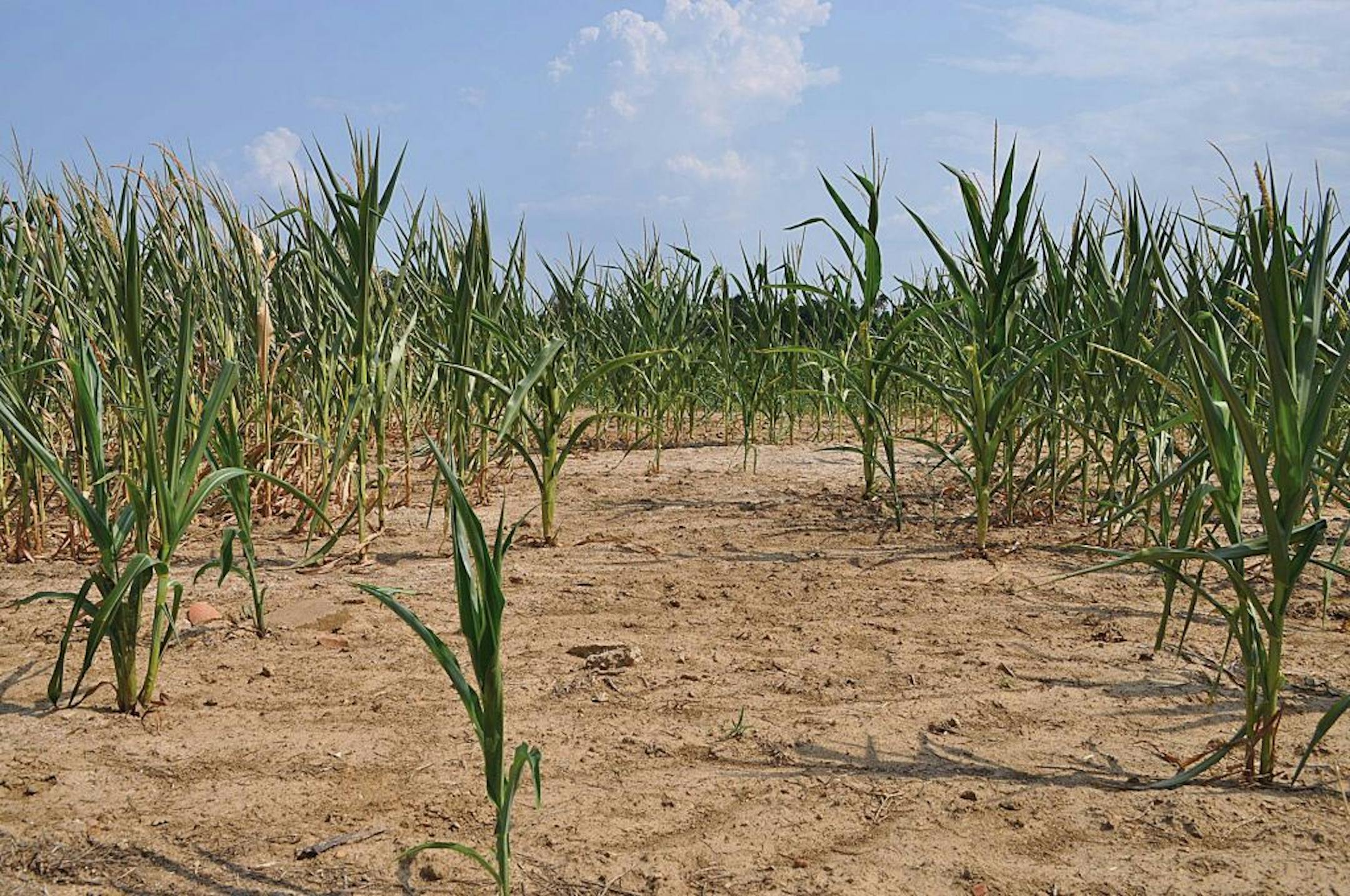
A cornfield in western Kentucky last week showed the effects of a persistent drought affecting much of the Corn Belt.
A cornfield in western Kentucky last week showed the effects of a persistent drought affecting much of the Corn Belt. (Associated Press/The Minnesota Star Tribune)

The corn is tall and still a lustrous green through much of Minnesota. But it's not going to stay that way for long without a good soaking rain -- pronto.

Already, Minnesota corn farmers are seeing wilting leaves and other signs of heat stress, though nothing like the drought that has stunted crops through much of the Corn Belt.

"Most states would trade places with us in a heartbeat," said Michael Swanson, an agricultural economist at Wells Fargo. "We've got it good right now compared to most of them."

Indeed, 77 percent of Minnesota's corn crop was in good to excellent condition for the week ending Sunday, the best of any state, according to Department of Agriculture data released Monday.

"The potential is there for a real good crop," said Chad Willis, who farms corn and soybeans east of Willmar. "But that dwindles every day that it doesn't rain."

The National Weather Service's forecast is not what farmers like Willis want to see: no appreciable rain through at least Friday, and temperatures climbing as the week goes on -- a potential double whammy.

Lured by high corn prices, farmers this spring sowed what's believed to be the biggest U.S. corn crop since 1937. But a heat wave across the Midwest has parched Illinois, Indiana, eastern Iowa and other key corn-growing areas. When July started, U.S. corn crops were in their worst shape since 1988.

"The stage was set for one of the biggest crops in the U.S. ever, and now it is pretty apparent that is not going to happen," said Douglas Tiffany, an assistant extension professor and renewable energy economist at the University of Minnesota.

U.S. corn yields were originally expected to be in line with historical trends of more than 160 bushels per acre. Now, corn yields are only expected to be a little more than 150 bushels, said Wells Fargo's Swanson.

Not surprisingly, markets have reacted by bidding up prices. Corn futures for December delivery on the Chicago Board of Trade jumped 5.3 percent Monday to close at $7.30 per bushel, a nearly 10-month high, according to Bloomberg News.

Higher corn prices will find their way into higher prices at the supermarket, as corn is the base of much animal feed and a key ingredient in a host of processed foods. Higher prices also could be bad news for the ethanol industry, which was hoping for a bumper corn crop and thus lower input costs.

But higher corn prices will benefit Minnesota's corn farmers -- if their luck holds out and they get decent crops themselves.

Minnesota farmers were the beneficiaries of a wet spring, which replenished soil bereft of moisture from a snow-deprived winter and dry fall, said Mark Seeley, University of Minnesota Extension climatologist. With a mild spring, Minnesota farmers also got their crops in early, another plus.

Indeed, corn on average was 64 inches high as of Sunday, compared with a five-year average of 49 inches, according to USDA data released Monday. And farmers reported that a lot of corn was tasseling by July 4th, about two weeks earlier than normal.

Tasseling means pollination is at hand, a critical time that helps determine yield. Hot and dry weather is bad for pollination. But that's what farmers have been getting.

Statewide, temperatures last week were nearly 9 degrees above normal and set records at several reporting stations, according to the USDA.

"This is the time we really need rain to pollinate our corn, and we are not seeing it," said Lori Feltis, a corn and soybean farmer near Stewartville. "We need water now."

Feltis said some of her corn has "pineappled up" -- that's when leaves curl and the plant starts to lose its lustrous green color. However, she's seen that only in corn planted with a more traditional seed; 80 percent of her crop this year is from seed that's genetically engineered to be drought-tolerant.

"All I heard was this year, there's going to be a drought coming," she said. Her prescience paid off.

A picture she e-mailed to the Star Tribune showed the drought-tolerant corn towering over her. Corn from the traditional seed was barely up to her shoulders.

During the 1988 drought, Feltis explained, her family's crop was decimated. "This year, we will not lose our crop."

Star Tribune staff writer David Shaffer contributed to this report.

Mike Hughlett • 612-673-7003

about the writer

about the writer

Mike Hughlett

Reporter

Mike Hughlett covers energy and other topics for the Minnesota Star Tribune, where he has worked since 2010. Before that he was a reporter at newspapers in Chicago, St. Paul, New Orleans and Duluth.

See Moreicon

More from Business

See More
card image
Alex Kormann/The Minnesota Star Tribune

A private-equity deal promised growth for one of Minnesota’s oldest remodelers. Instead, its parent company’s bankruptcy left workers jobless and customers with unfinished homes.

card image
card image
