

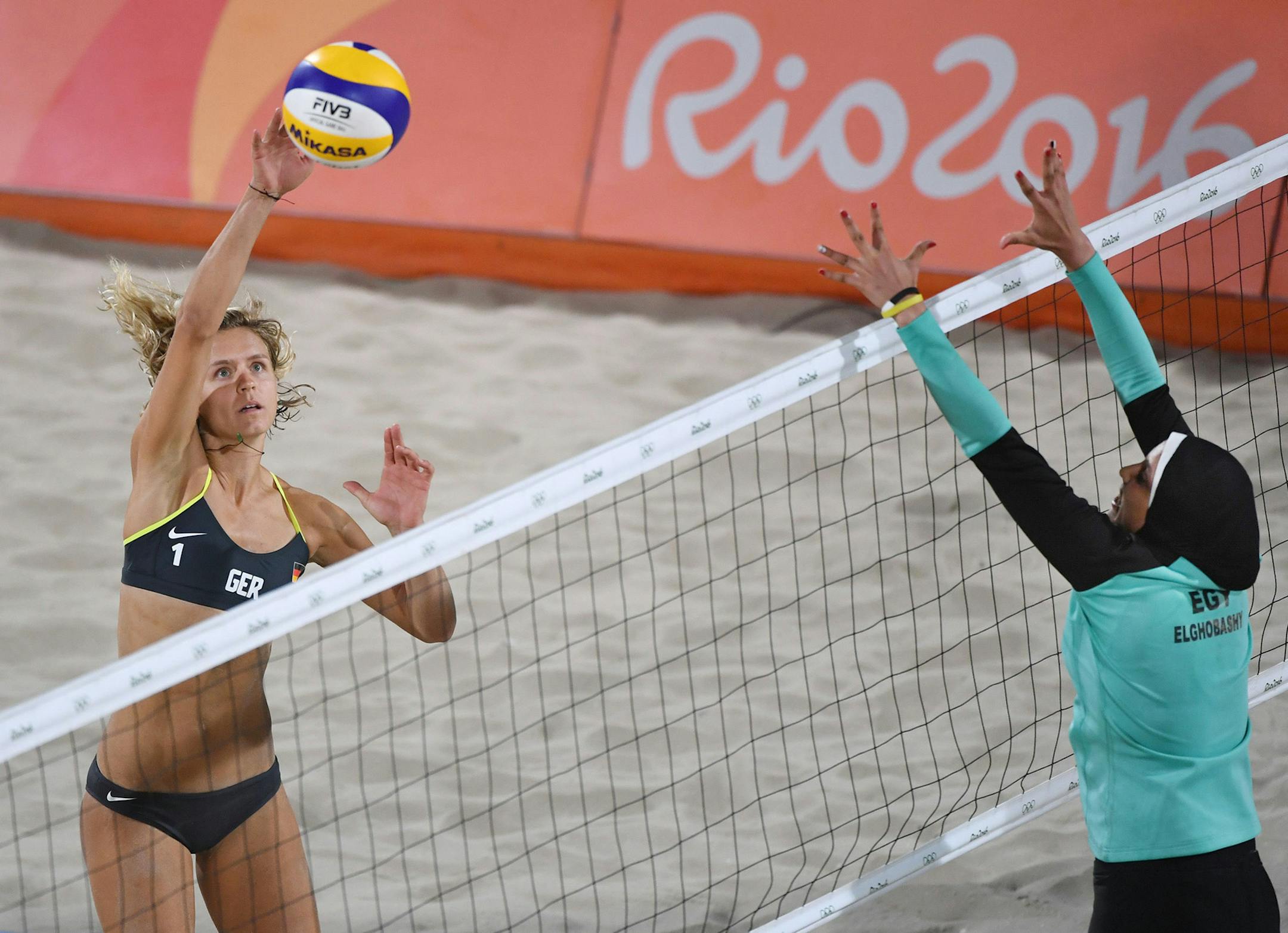
The contrasting images last week of the fully clothed Egyptian women's beach volleyball team playing the skimpily clad German team swept across media coverage and the internet during the 2016 Rio Olympics. Sports uniforms, which are big business mainly dominated by corporate sponsorship, were suddenly transformed into a cultural hot button on the beach of Rio de Janeiro, Brazil.
Watching women with oily bodies in bikinis playing beach volleyball has become a global spectacle, attracting millions of viewers. Sexism has always been a part of women sports. But only recently, in 2012 to be exact, the FIVB (International Volleyball Federation) announced that it would no longer enforce its bikini requirement on women's beach volleyball players.
That decision was driven not by cultural or feminist pressure, but by the global appeal of volleyball in non-Western countries and by fear of losing the market and players in places where people have different ideas about how women should dress. FIVB spokesman Richard Baker said, "We don't think we will see much change [in attire] on the world tour."
However, the Egyptian team not only delivered change at the Rio Olympics, but changed the conversation about women's dress and feminism. Muslim women, body and soul, were once again in the international forefront. The West has been fixated on Muslim women's dress for a long time. France has banned hijab wearing in public schools and government facilities, and the "burqini" — the long swimwear that some Muslim women wear — has been banned at some beaches.
As Arundhati Roy articulated it, "coercing a woman out of the burqa instead of enabling her to choose is an act of violence, humiliation and cultural imperialism."
The idea that Muslim women's dress is a tool of oppression and is forced on Muslims is a very old medieval argument. In a video from the United Kingdom's Telegraph, you can see Syrian women burning their burqas after their town was liberated from ISIL. In the same video, one woman held the burning burqa and chanted joyfully in Arabic: "May god burn their [ISIL's] hearts as they had burned ours."
When the bikini was forced on women players by the International Volleyball Federation, we didn't see a feminist revolt or a bikini-burning protest against the oppressors. Muslim women may burn the burqa when it is a symbol of oppression, or they may wear it as a symbol of resistance to Western colonialism and domination — or to show their displeasure with a despotic military regime.
The U.K.'s Independent noted that a bodysuit (hijab or otherwise) is not worn for religious purposes only. Many players wear them in practice because they are more comfortable. Or they may wear the bodysuit during competition before the cameras and a short or skimpy cloth during practice. It is called privacy.


