
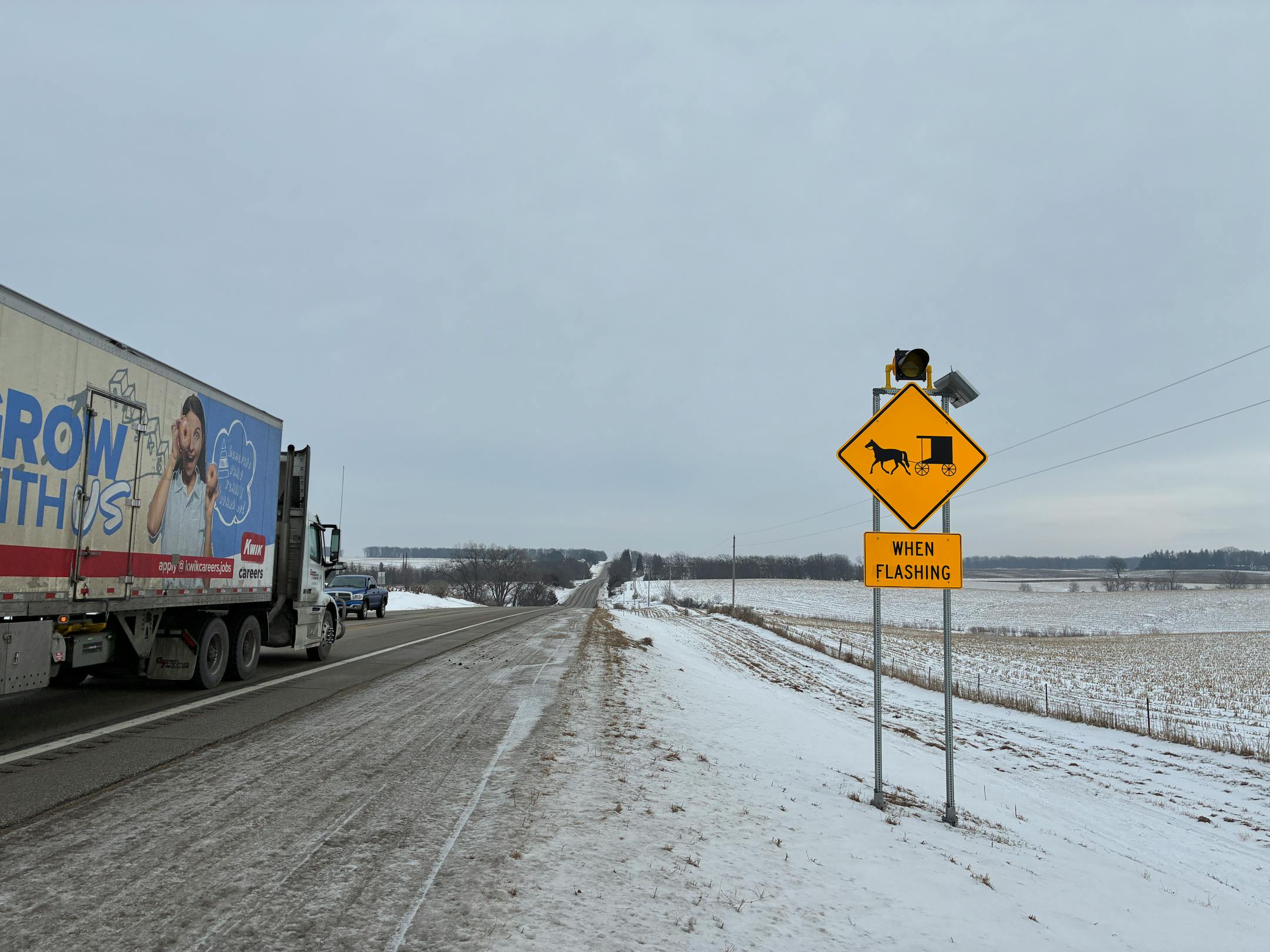
MnDOT testing beacon system to prevent crashes involving Amish buggies

The first-of-its-kind system went live in early January on Hwy. 44 in Fillmore County.

The Minnesota Star Tribune
February 1, 2026 at 10:00PM
New signs with flashing beacons warn drivers on Hwy. 44 about the presence of Amish buggies near 401st Avenue between Canton and Mabel in Fillmore County, Minnesota (Minnesota Department of Transportation)

The Minnesota Department of Transportation has installed a new flashing beacon system on a southeastern highway to warn drivers of Amish buggies. Officials hope it could help cut down on crashes involving the slow-moving vehicles.

MnDOT turned on the first-of-its kind system on Hwy. 44 near 401st Avenue between Mabel and Canton in Fillmore County in early January and will evaluate its effectiveness for the next three years.

“We’re hopeful it works,” said MnDOT spokesman Mike Dougherty.

Horse-drawn buggies are a common sight on the two-lane highway, which runs through one of the state’s largest Amish communities. They primarily travel on the shoulder as about 2,200 vehicles a day, including semis, roll past them at 60 mph or faster.

But at 401st Avenue, the shoulder narrows considerably and a guardrail forces buggies to veer onto the pavement and share part of the traffic lane. A small crest also obstructs motorists’ sightlines, giving them less time to react if a buggy is present, setting the stage for conflict.

In 2018, a motorcyclist died after hitting a horse near the site. A year later in the same area, a 12-year-old boy died a few days after the buggy he was riding in with family members was struck from behind by a vehicle.

At least one other crash that resulted in property damage has occurred at the site. Wrecks involving buggies have also happened on other nearby roads, MnDOT said.

Buggies traveling on the shoulder will pass a motion-activated sensor about 150 feet before reaching the guardrail at 401st Avenue. The sensor will trigger a beacon positioned 600 feet upstream to alert drivers that a buggy is on the road, said engineer David Tsang.

A beacon is attached to a sign that is 48 inches in diameter, the largest dimensions for a traffic warning sign that MnDOT is allowed to display, Tsang said.

“We want to get people’s attention,” he said.

The site was chosen after MnDOT visited following the fatal crashes. Tsang said officials saw buggy tracks on the shoulder until they reached the guardrail, then veered onto the highway.

“We wondered what could be causing the crashes,” Tsang said. “We put two and two together. We could warn people at that location.”

He said MnDOT has installed systems with flashers to alert drivers on mainline highways that motorists on cross streets are approaching the intersection. MnDOT used components from one of those systems to come up with the buggy warning system, he said.

Tsang said the system is nothing fancy. It features a simple motion detector like those that activate home security lights, and anything that passes the sensor can set off the beacon.

The sensor is pointed off the roadway so passing vehicles won’t set it off. But pedestrians or animals walking on the shoulder could, Tsang said.

That is why MnDOT is testing the system before possibly putting it in other places, including nearby Hwy. 52 known as the “Buggy Byway.”

“The application is not for everywhere. It has a limited scope,” Tsang said. “If Amish buggies traveled on the roadway, we could not use it.”

about the writer

about the writer

Tim Harlow

Reporter

Tim Harlow covers traffic and transportation issues in the Minneapolis-St. Paul area, and likes to get out of the office, even during rush hour. He also covers the suburbs in northern Hennepin and all of Anoka counties, plus breaking news and weather.

See Moreicon

More from News & Politics

See More
card image
Minnesota Department of Transportation

The first-of-its-kind system went live in early January on Hwy. 44 in Fillmore County.

card image
card image