
Opinion | Birtherism was the blueprint. We are living the outcome.

Trump’s demand that a president prove his legitimacy has evolved into a system that now demands the same of everyone in America.

December 26, 2025 at 10:58AM
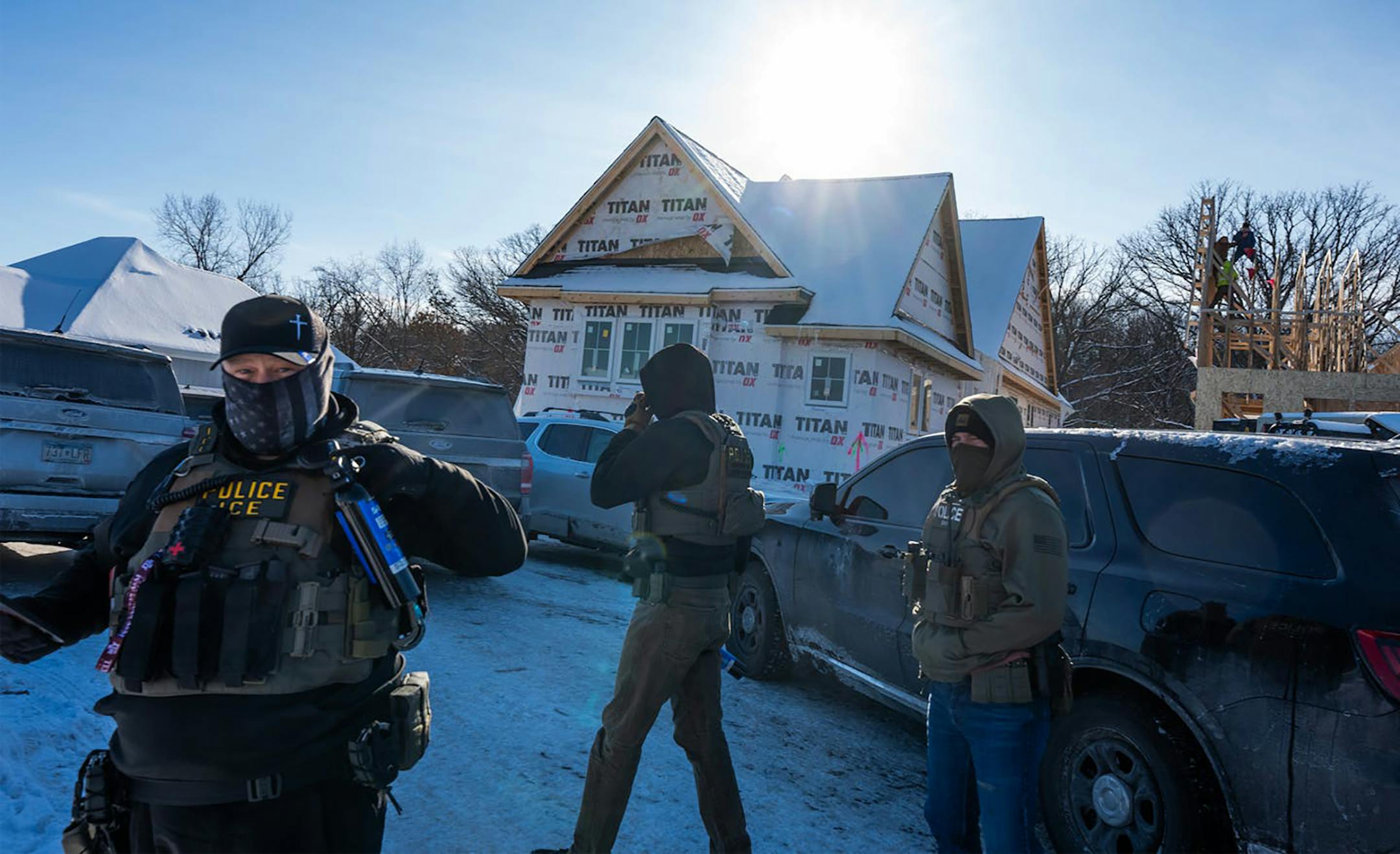
ICE agents target a construction site in Chanhassen on Dec. 10 as "Operation Metro Surge" stretches into the Twin Cities suburbs. (Richard Tsong-Taatarii/The Minnesota Star Tribune)

Opinion editor’s note: Strib Voices publishes a mix of guest commentaries online and in print each day. To contribute, click here.

•••

In recent weeks, immigration enforcement has moved deeper into daily life in Minnesota. Federal agents have conducted operations across Minnesota, from Minneapolis to Willmar, through Chanhassen, Richfield, Burnsville and St. Paul. People are being asked to prove they belong here, sometimes explicitly, sometimes through the quiet pressure of suspicion. Papers are requested. Explanations are demanded. Presence itself becomes a question.

I see this moment clearly. What is happening is not a sudden escalation or a series of mistakes. It is the predictable outcome of a political strategy President Donald Trump has refined for more than a decade: Make belonging conditional, then force people to prove it.

That strategy did not begin at the border, and it did not begin with immigration enforcement. Long before Trump held public office, he used it against the first Black president of the United States.

Former President Barack Obama recounts in his memoir that Trump eventually admitted he believed Obama was born in Hawaii, yet still took public credit for forcing him to “certify” his status. The truth never mattered. The process did. The demand for proof, the insistence on public verification, the power to decide who must explain and when an explanation is sufficient. Birtherism was not a sideshow. It was the prototype.

That blueprint is now reshaping daily life. In Noem v. Vasquez Perdomo, the Supreme Court declined to block federal immigration agents in Los Angeles from relying on one or a combination of factors, including race or ethnicity, language or accent, location or type of work, when deciding whom to stop and briefly detain. On paper, this reads like a technical refinement of Fourth Amendment doctrine. In practice, it authorizes sweeping inferences about who might belong and who must prove it.

The consequences are no longer theoretical. This month in Minneapolis, federal agents tackled Mubashir, a Somali American, put him in a headlock, and forced him into a vehicle as he shouted that he was a U.S. citizen. He was taken to another city, held for nearly two hours, and then told to walk home after agents verified his citizenship using a passport photo that had been on his phone the entire time. Days earlier, a Somali American woman was zip-tied downtown until she could prove her citizenship. These are not isolated errors. They reveal how easily suspicion expands and how quickly the burden of proof shifts onto people who already belong.

As a courtroom litigator and former adjunct law professor, I understand the legal framework the court relies on to justify this outcome. Immigration stops receive extraordinary deference under Fourth Amendment doctrine, a deference that now mirrors the very strategy Trump has long employed: Expand doubt, widen suspicion and shift the burden of belonging itself onto those who look or sound “other.” The doctrine may read as coherent on the page, but legality is not the same as justice.

In practice, the message is unmistakable. Some people must show their papers, and others never will. Some are presumed to belong. Others must prove it, repeatedly and under pressure. The fear generated by these encounters is not accidental. It is part of the design. Doubt becomes a tool of governance. Suspicion becomes policy.

Many Americans still tell themselves that Trump’s language is just talk. Provocation without intention. But he openly said he liked that Obama had to prove his status. Now, under his leadership, people across this country are being made to do the same. What began as a political stunt has matured into a governing method: Redraw who counts as fully American, then compel those on the margins to demonstrate their legitimacy in the only home they have ever known.

Belonging in a democracy cannot be conditional. It cannot depend on whether an agent interprets your language, your neighborhood or your job as suspicious. A country cannot sustain itself if entire communities move through daily life under a presumption of doubt, wondering not whether they have rights, but whether those rights will be honored when they need them most.

Institutional trust rarely collapses all at once. It frays through procedures that seem technical, through demands that sound reasonable in isolation, through questions asked of some people and never of others. The question before us is not whether enforcement is necessary or whether courts have spoken. It is whether we are willing to live in a country where legitimacy must be demonstrated on demand. That is not only a legal question. It is a civic one. And it belongs to all of us.

Jazz Hampton is a Minneapolis-based lawyer and former candidate for mayor of Minneapolis, as well as a business owner who previously served as an adjunct professor of law and entrepreneurial finance.

about the writer

about the writer

Jazz Hampton

More from Commentaries

See More
card image
iStock

Those year-end book lists that claim to be all about diversity often seem to miss this one major demographic.

card image