
Minnesota turkey deaths to top 2 million with new bird flu outbreaks

Turkey deaths top 2 million in the nation's No. 1 turkey-producing state.

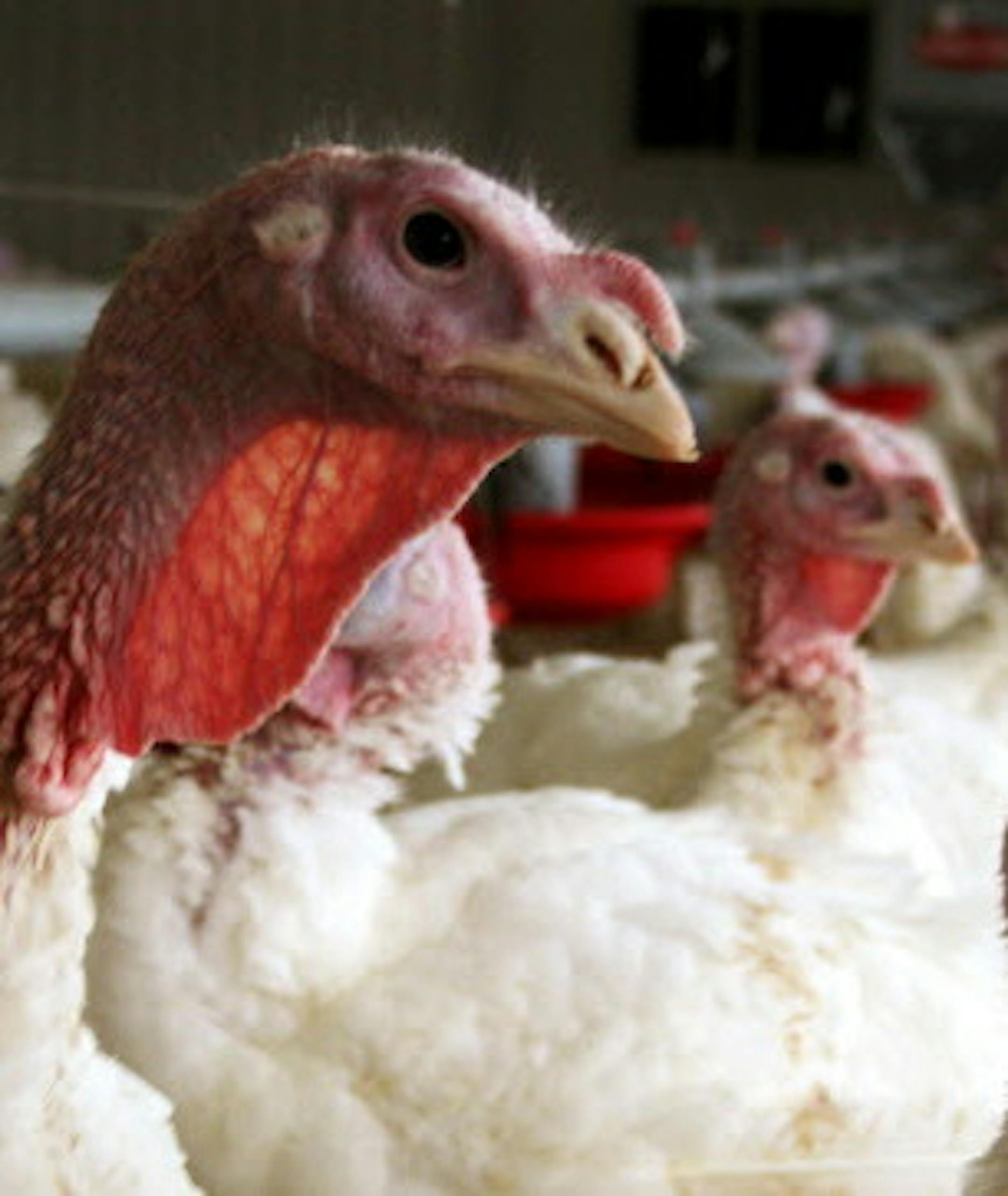
A turkey farm effected by the bird flu Thursday, April 9, 2010, in Melrose, MN.](DAVID JOLES/STARTRIBINE)djoles@startribune.com DNR officials scour the banks of the Sauk River for waterfowl droppings, hoping to find a link to a bird flu that is sweeping through turkey-producing country. Nine Minnesota turkey farms have been hit by the bird flu in recent days.
The number of turkeys culled in Minnesota to halt the spread of bird flu has reached 2 million. File photo of a turkey farm near Melrose, Minn., earlier this month. (The Minnesota Star Tribune)

Lethal bird flu has been confirmed at three more Minnesota turkey farms, bringing to more than ­2 million the number of turkeys in the state affected by the virus.

Meanwhile, the Minnesota Senate on Tuesday unanimously approved $893,000 in emergency state funds to respond to the avian flu outbreak, but a political squabble over an unrelated provision attached to the legislation by the DFL's Senate majority may slow down distribution of the money.

The U.S. Department of Agriculture on Tuesday reported new outbreaks of H5N2 flu at farms in Wadena, Cottonwood and Kandiyohi counties. The Wadena farm, owned by Austin-based Hormel Foods Corp., has 301,000 turkeys, the second largest of 31 Minnesota farms now stricken.

The largest farm hit so far, a 310,000-bird operation in Meeker County, also is owned by Hormel, the nation's second-largest turkey processor. Twenty of the 31 Minnesota farms hit by the flu are suppliers to Hormel, known for its Jennie-O brand.

Shares in poultry-related companies were hit Tuesday by bird flu worries, with Hormel's stock falling $1.30, or 2.3 percent, to close at $55.09. After the market closed Monday, Hormel said bird flu outbreaks are crimping its turkey production and pressuring its profits.

Minnesota, the nation's largest turkey producer, is the epicenter of the highly pathogenic H5N2 bird flu. The state annually produces about 46 million turkeys, meaning 4 to 5 percent of Minnesota's annual production has now been affected by the flu.

While a minority of birds on each farm die directly from the virus, surviving turkeys are killed as a precaution against the disease's spread.

Turkeys are particularly susceptible to the H5N2 flu, but the largest single outbreak of the virus was reported Monday at an Osceola County hen farm in Iowa.
The USDA reported that 5.3 million chickens would be affected, but the egg company hit by the flu, South Dakota-based Sonstegard Foods, later said it has only 3.8 million hens. The USDA said it initially reported the operation's capacity, not its actual birds.

The USDA also reported Tuesday that a turkey farm in Spink County, S.D., with 33,000 birds, has been hit by the flu, the sixth such case in that state.

The flu can wipe out a barn full of thousands of turkeys in a couple of days. However, it's not seen as a food safety risk and the flu poses a low risk to humans, health experts say.

The costs of the flu are mounting into the tens of millions of dollars, and the Legislature is trying to pony up money to state agencies fighting the bug.

The House passed the avian flu money on Thursday, dividing it into two pots: $514,000 for the state Department of Agriculture, and $379,000 for the state Board of Animal Health. "There is some urgency," Sen. Kevin Dahle, DFL-Northfield, said Tuesday during Senate debate.

However, on Monday at the Senate Finance Committee, DFL senators attached a provision that would move up a yearly date on which the Minnesota Management and Budget office reports the size of the state's budget reserve to legislators. Backers said it would give lawmakers more time to prepare for the legislative session and the scope of resources available.

Also on Monday, House Speaker Kurt Daudt released a statement saying he did not want unrelated measures attached to the avian flu money. The Legislature has a tradition of not adding unrelated provisions to disaster relief and emergency response bills, Daudt said.

GOP senators warned in Tuesday's floor debate that the provision added by Sen. Dick Cohen, DFL-St. Paul, would slow down the progress of the avian flu money. DFL senators united to defeat a GOP amendment to remove the unrelated measure. "This provision you're talking about has nothing to do with avian flu, " said Senate Minority Leader David Hann, R-Eden Prairie. Neglecting to strip it out "will delay disaster relief to the farmers of this state."

Mike Hughlett • 612-673-7003

Patrick Condon • 651-925-5049

In this 2012 photo provided by Bethany Hahn is a flock of turkeys at a Minnesota poultry farm. Midwestern states are struggling to contain a virulent strain of bird flu that has doomed millions of turkeys and chickens since March. (Bethany Hahn via AP)
In this 2012 photo, a flock of turkeys at a Minnesota poultry farm. Midwestern states are struggling to contain a virulent strain of bird flu that has doomed millions of turkeys and chickens since March. (The Minnesota Star Tribune)
Turkeys await processing outside a Jennie-O Turkey Store processing plant Thursday, April 9, 2010, in Melrose, MN.](DAVID JOLES/STARTRIBINE)djoles@startribune.com DNR officials scour the banks of the Sauk River for waterfowl droppings, hoping to find a link to a bird flu that is sweeping through turkey-producing country. Nine Minnesota turkey farms have been hit by the bird flu in recent days.
The Legislature is considering additional money for state agencies fighting the bird flu, but the funding measure has stalled as DFLers and Republicans spar over a measure added to the bill. (The Minnesota Star Tribune)
about the writers

about the writers

Mike Hughlett

Reporter

Mike Hughlett covers energy and other topics for the Minnesota Star Tribune, where he has worked since 2010. Before that he was a reporter at newspapers in Chicago, St. Paul, New Orleans and Duluth.

See Moreicon

Patrick Condon

Night Team Leader

Patrick Condon is a Night Team Leader at the Star Tribune. He has worked at the Star Tribune since 2014 after more than a decade as a reporter for the Associated Press.

See Moreicon

More from Business

See More
card image
Richard Tsong-Taatarii/The Minnesota Star Tribune

The “economic blackout” day creates unnecessary risk for people who are on the side of getting ICE out of Minnesota.

card image