
Minnesota legislators cut deal to boost minimum wage to $9.50

Details of the agreement are expected to be released by House and Senate leaders Monday morning, but two sources with the knowledge of the deal said Sunday that the minimum wage would rise to $9.50 an hour and future increases would be linked to increases in inflation.

April 7, 2014 at 3:20AM
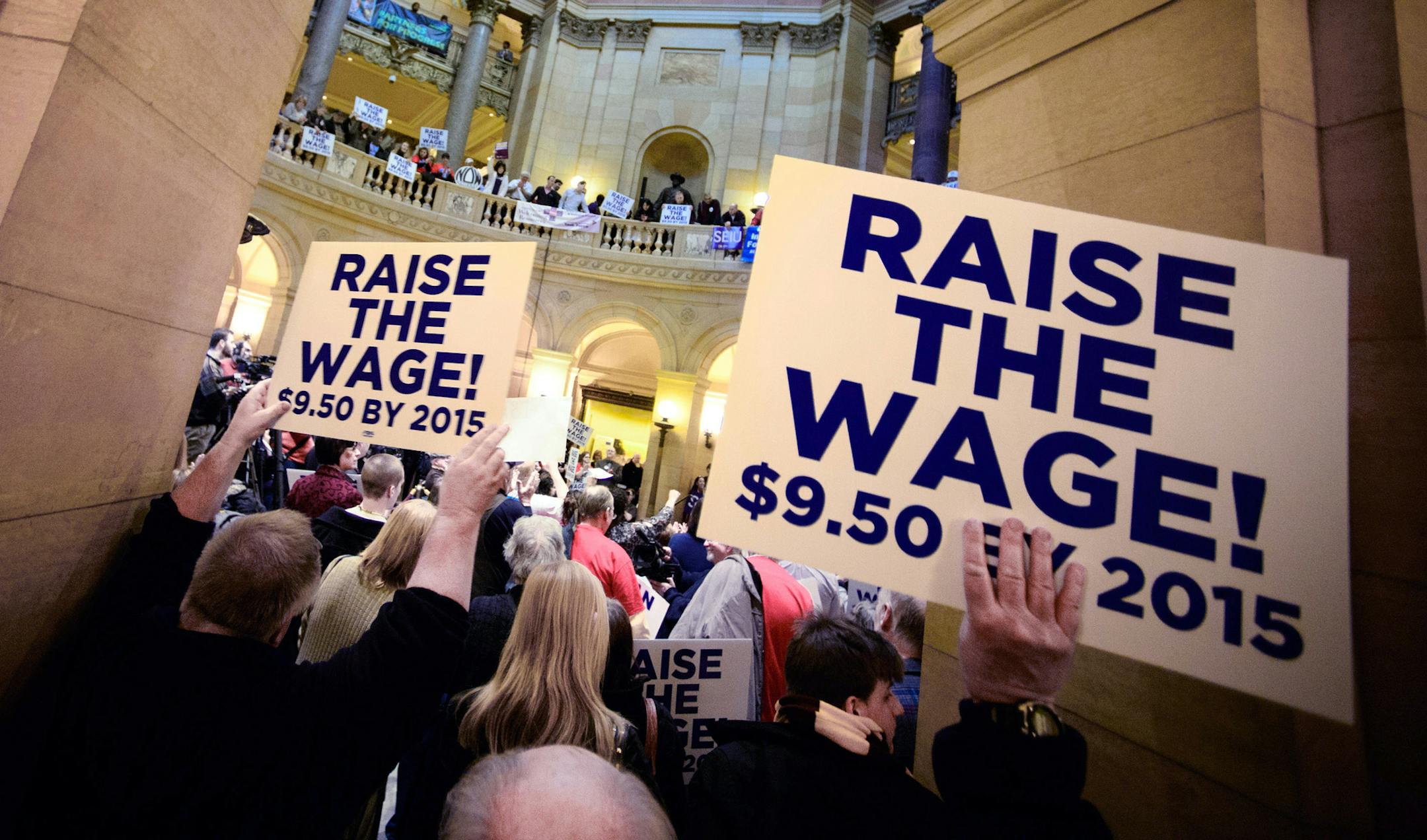
March 4: These demonstrators showed what they think should be a top priority for legislators.
March 4: These demonstrators showed what they think should be a top priority for legislators. (Stan Schmidt — Star Tribune/The Minnesota Star Tribune)

Minnesota's legislative Democrats have struck a deal to raise the wages of the state's lowest paid workers.

Monday morning, House Speaker Paul Thissen, House Majority Leader Erin Murphy, Senate Majority Leader Tom Bakk, along with key negotiators of the minimum wage measure will announce they've come to agreement. The Star Tribune has been told by two sources with the knowledge of the deal that it would hike the wage to $9.50 an hour and would link future increases to increases in inflation.

"I feel really good," said Deputy Senate Majority Leader Jeff Hayden, a Minneapolis DFLer who had long worked on the minimum wage issue. "I think there are going to be a tremendous amount of smiles (tomorrow.)"

The agreement will likely end what has been a major source of tension at the Capitol and allow lawmakers be lay claim to giving hundreds of thousands of Minnesotans a wage boost. According to the Minnesota Department of Employment and Economic Development, more than 350,000 Minnesota workers held jobs that paid less than $9.50 an hour, many of them in greater Minnesota.

Business leaders have warned that raising the wage too fast by too much could mean fewer jobs or business loses.

After the DFL took over control of the Legislature last year, advocates expected lawmakers would raise the state's minimum wage from $6.15 an hour, one of the nation's lowest. Despite increasing pressure to hike the wage floor, a national campaign led by President Obama to raise the federal minimum and other states moving their minimum wages up, Minnesota DFLers were stymied.

After a months' long campaign Senate Democrats began the year backing a gradual increase to $9.50 an hour, one of the nation's highest. That's the rate both House Democrats, DFL Gov. Mark Dayton and advocates insisted upon.

But the details of the measure still kept negotiations at a standstill between the House and Senate.

Senate leaders insisted they could not get 34 votes for a $9.50 an hour minimum wage that included so called indexing, which would mean future wage rates would be adjusted upward.

That left House and Senate leaders at an uncomfortable standstill over one of many Democrats top priorities of the session.

"The bottom line, to me, if the Senate wants to kill the bill, they should just tell Minnesotans directly and stop playing games with it," House Speaker Paul Thissen, DFL-Minneapolis, said last month.

Meanwhile, Senate Majority Leader Tom Bakk, DFL-Cook, said while he would support the House's plans, he could not get enough members to do so.

Despite that, in recent weeks, unions and other Democratic allies held rallies, delivered postcards and contacted senators to campaign for the wage increase.

"Recently, some in our caucus have been re-thinking the indexing issue. As a result, they have decided to lend their support. We are reaching out to you now to enlist your support, as well," said a letter sent to Bakk in mid-March. "Please help us pass this bill. It's the right thing to do."

The letter was signed by Sens. Sandy Pappas, Patricia Torres Ray, Alice Johnson, Chris Eaton, Susan Kent, Barb Goodwin, Bev Scalze, Melissa Wiklund and Kari Dziedzic. Eaton is the chair of the conference committee charged with finding a compromise on minimum wage.

The breakthrough on minimum wage came just after a breakthrough on another contentious issue at the Capitol: a new senate office building. Bakk had long insisted the new building was needed.

On Friday, House leaders agreed to approve the building.

Many Republicans and some Democrats had said that draft plans for the building were too luxurious and at $90 million, including parking structures, were too expensive especially since the building would not have housed all 67 senators.

The plans House leaders approved last week actually increased the total cost of the building but stripped out some amenities and a parking ramp. Senate leaders are expected to give the building their final okay this week, clearing the way for construction of a $77 million office space.

about the writer

about the writer

rachelsb

More from No Section

See More
FILE -- A rent deposit slot at an apartment complex in Tucker, Ga., on July 21, 2020. As an eviction crisis has seemed increasingly likely this summer, everyone in the housing market has made the same plea to Washington: Send money — lots of it — that would keep renters in their homes and landlords afloat. (Melissa Golden/The New York Times) ORG XMIT: XNYT58
Melissa Golden/The New York Times

It’s too soon to tell how much the immigration crackdown is to blame.