
Edina mayor: How ICE has upended life in Minnesota

Operation Metro Surge has hollowed out civic life, undermined public safety and left local leaders to pick up the pieces.

February 5, 2026 at 5:43PM
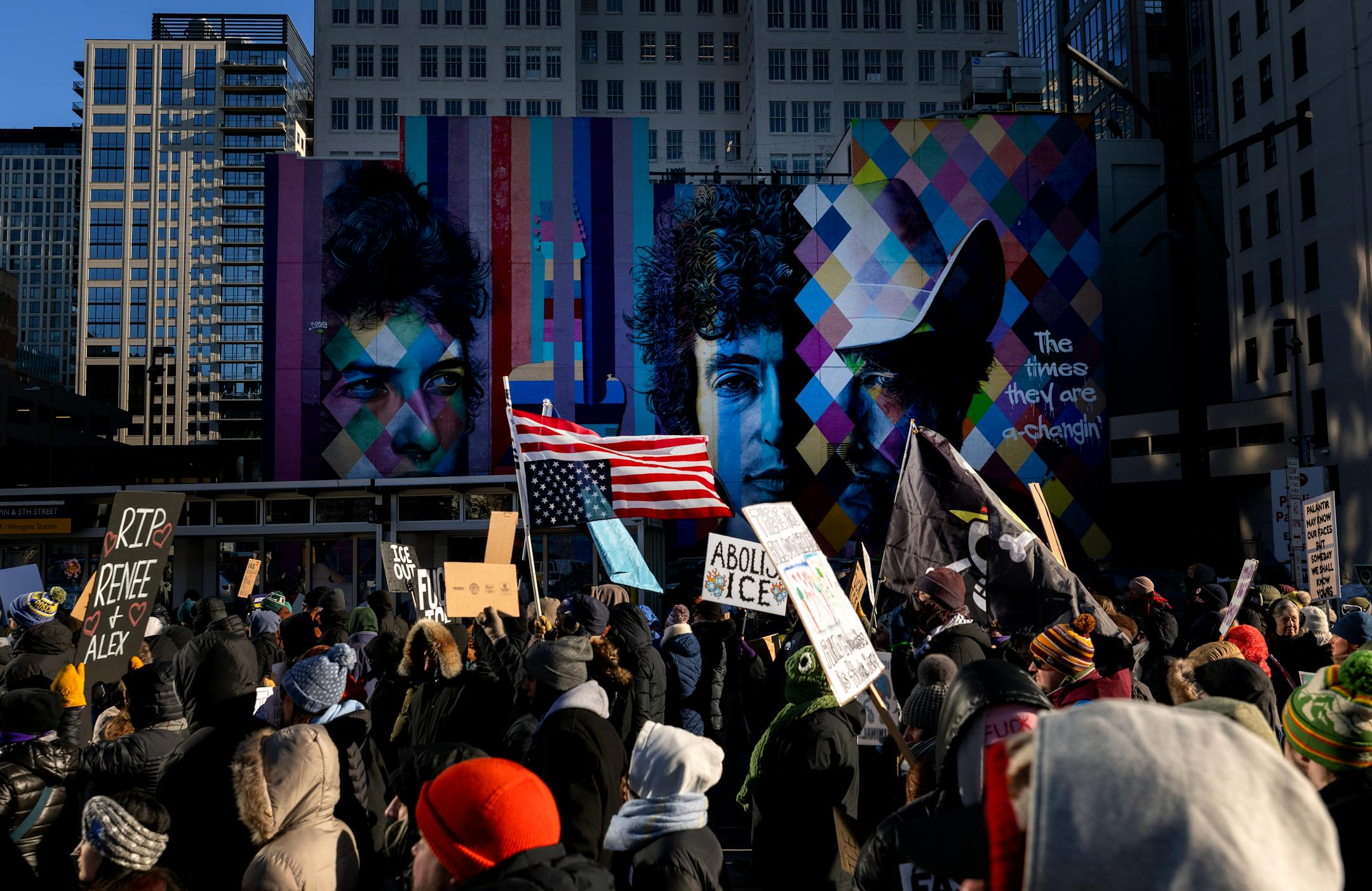
"Minnesotans have long understood that order is preserved not by fear, but by legitimacy; that rules endure not because they are imposed but because they are believed to be fair; that when authority overreaches, as it did in our state, Minnesotans do not only shout — they reason, they document, they challenge and they persist," James B. Hovland writes. Above, demonstrators march in downtown Minneapolis during an ICE OUT general strike protest on Jan. 30. (Carlos Gonzalez/The Minnesota Star Tribune)

Star Tribune opinion editor’s note: The following is the text of an address that Edina Mayor James B. Hovland gave last week before the U.S. Conference of Mayors in Washington.

•••

Strib Voices publishes a mix of guest commentaries online and in print each day. To contribute, click here.

•••

Fellow mayors, I come to report plainly what we have seen and felt in our towns and cities of Minnesota.

The work of federal enforcement has entered our neighborhoods, our workplaces, our schools, our churches and our medical facilities. The effects are not abstract; they are human, immediate and consequential and, as presently carried out, are reshaping our cities in ways none of us who were elected to lead our communities can ignore.

We are told the actions are precise — they are not. We are told their effects are contained. They are not. Fear has not confined itself to a single household or status. Citizens withdraw alongside non-citizens. Law-abiding residents learn that invisibility feels safer than participation.

We have observed, first, a deep chill of uncertainty settle over many lawful, hardworking residents — citizens and non-citizens alike, and we have seen enforcement as visible, sudden and physical; it does not stop neatly at the door of those it seeks. It spreads outward, touching mixed status families, lawful permanent residents and even long-standing citizens who share a name, an accent, a color or a fear. Attendance falls at schools putting kids behind in their education; patients delay care and risk adverse outcomes and faith and worship becomes a private matter. Trust, once shaken, is slow to return.

Second, there is the economic reckoning. In Minnesota, our restaurants, food-processing plants, construction sites, elder-care facilities and hospitals rely upon immigrant labor. When enforcement actions are abrupt, entire workforces can vanish overnight — not only undocumented workers, but legal employees who choose silence or absence over risk.

Third, we face the paradox of public safety. Local law enforcement, sworn to protect all residents, finds its work harder when communities fear that any interaction may carry federal consequence.

Finally, there is burden placed upon local government. Mayors and city council members are left to explain federal actions we do not control, to calm fears we did not create, and to mend relationships strained by forces beyond our municipal boundaries. We are asked, in effect, to hold the fabric of community together while others pull hard upon its threads.

In just a few short weeks, this is what we have learned: No city can thrive without the rule of law and no nation can govern without borders; but enforcement, as currently practiced, is not merely removing individuals, it is hollowing out civic life, undermining public safety and leaving local leaders to pick up the pieces. A democracy cannot prosper when enforcement is divorced from proportionality, clarity and humanity. The strength of our country has never rested solely in the rigor of its laws; but in the confidence of its people that those laws are carried out with fairness and wisdom.

Minnesotans have long understood that order is preserved not by fear, but by legitimacy; that rules endure not because they are imposed but because they are believed to be fair; that when authority overreaches, as it did in our state, Minnesotans do not only shout — they reason, they document, they challenge and they persist. They insist relentlessly that power explain itself. They demand that force justify its use. They appeal not to impulse, but to principle and they persevere in seeking to right injustice. In doing so, they have kept faith with the Constitution — not as an abstraction, but as a living discipline that defines moral and legal conduct.

In these trouble-filled days, the nation should know that Minnesota has not resisted legal immigration enforcement; it has resisted excess. It does not reject law; it rejects lawlessness clothed in authority. It does not deny the nation’s right to govern its borders; but it insists that such governance be worthy of and deferential to a free people.

These distinctions matter. The future of immigration policy in America will not be shaped by those who merely cheer or condemn; but by those who demonstrate — through practice and wisdom — that security and humanity can coexist; that enforcement can be both firm and lawful; and, that the dignity of persons need not be a casualty in the implementation of policy.

Whether the federal government will recognize that cities are not collateral terrain, that trust — once-broken — is far harder to restore than it is to shatter and that enforcement should be carried out with wisdom and respect for human dignity, regardless of immigration status, remains an open question.

So this, then, is the message from Minnesota: immigration enforcement, when conducted without close coordination with local realities and respect, does not merely remove individuals — it reshapes communities. It alters behavior, weakens trust, and imposes costs that towns and cities will carry long after the headlines fade.

We ask not for an exit strategy from our federal government but for partnership, not for chaos, but for coherence. And above all, for policies that recognize that the smallest city block may bear the weight of the largest national decisions.

If enforcement continues as it has, we will not be debating immigration alone. We will be confronting the long-term damage done to the relationship between government and the governed. And that is a reckoning no republic should take lightly.

In time, when this chapter in Minnesota history is read, not in headlines, but in history, I hope it may be said that when the nation faltered between fear and fairness regarding who deserves to live in our country, that Minnesota chose the harder path: not merely to oppose what was wrong but to help build what is right.

That will be no small service to a troubled country.

James B. Hovland is the mayor of Edina.

about the writer

about the writer

James B. Hovland

More from Commentaries

See More
card image
Carlos Gonzalez/The Minnesota Star Tribune

Operation Metro Surge has hollowed out civic life, undermined public safety and left local leaders to pick up the pieces.

card image
card image