Minnesota farmers recover from late planting start

Much of Minnesota's crop is in the ground, despite a late-ending winter and spring rains that kept farmers out of the fields.

May 25, 2013 at 1:28AM
If the weather holds Jerry Demmer, right, expects to start planting his corn and soybean fields this Monday. He was helping his brother Brian get a tractor and planter ready to go. Friday, April 26, 2013 ] GLEN STUBBE * gstubbe@startribune.com EDS, Jerry is wearing red, his brother yellow ORG XMIT: MIN1304261637551092
While he waited for their fields near Clarks Grove, Minn., to dry, Jerry Demmer, right, helped his brother Brian get a tractor and planter ready to go on April 26. (The Minnesota Star Tribune)

Despite a winter that never seemed to end, Minnesota farmers are going into Memorial Day weekend with a good percentage of their crop planted — a better outcome than feared a month ago.

Planted acreage is still below historical average, and this spring's late start could yet reduce yields, particularly of corn. But a U.S. Department of Agriculture report shows that 70 percent of Minnesota's corn crop had been planted by May 19, a huge increase from only 18 percent on May 12, though still behind the five-year average of 84 percent.

The rest of the nation's Corn Belt — also hammered by weather-induced late planting — made similar strides during the week ending May 19. Illinois corn farmers had 74 percent of their crop planted by May 19, compared with 17 percent a week earlier. In Iowa, 71 percent of the corn crop was in on May 19, up from 15 percent on the 12th.

"Planting is behind schedule, but much less than in prior weeks," Cowen Securities analyst Charles Neivert wrote in a research report this week. "We continue to believe that farmers should be able to make up a substantial portion of lost time."

Like much of the Corn Belt, Minnesota suffered through a brutal spring. By May 1, hardly a corn seed was planted in Minnesota, yet April 25 through May 1 is the sweet spot for planting corn in much of the state. And corn planted in May's second half — the later, the worse — is inherently more susceptible to decreases in bushels harvested per acre.

John Mages, a farmer near Belgrade in central Minnesota, finished planting corn on May 16. "I think we'll pay just a little [yield] penalty. We're probably just a week later than we'd like it."

May's weather has been spotty, with cold and rain plaguing a good part of the state this week. But farmers have also been granted windows of warm, dry weather this month.

"When you get an open window of four or five days, you can get a lot of work done," Mages said by phone — from his tractor — as he planted soybeans Friday.

That's partly due to technological advances in farming. Tractors are speedier, and equipped with GPS, which allows for longer planting hours and reduces farmer fatigue. Mechanical planters are bigger, too, allowing farmers with more up-to-date equipment to work 18 rows at a time, instead of 12. "You can definitely cover a lot of ground," Mages said.

Despite the mid-May planting turnaround, some farmers are still uncomfortably behind where they'd like to be.

Jerry Demmer farms near Clarks Grove in southern Minnesota, an area hit particularly hard by one of May's snow blasts.

"We're in that band where the soils are wet," he said. "We didn't have much time to get in [to the fields]."

Demmer said about 70 percent of his corn is in the ground, and he hasn't even started his soybeans yet. He's hoping the weather will be dry enough to finish his corn crop quickly, as the yield clock is ticking.

"That's the 64-dollar question on corn," he said. "Can we get it in by the 31st of May?"

Minnesota wheat farmers also made great progress in planting from May 12 to May 19. The state's spring wheat crop was 71 percent planted on May 19, up from 19 percent a week earlier, though still below the five-year average of 80 percent, according to USDA data. Trends were similar for barley and oats.

And after a slow start, the bulk of the state's sugar beet crop has been planted.

Mike Hughlett • 612-673-7003


Wet farm fields taken Wednesday April, 24 2013 in Fairmont , MN. ] JERRY HOLT • jerry.holt@startribune.com ORG XMIT: MIN1304261045170844
Fields near Fairmont, Minn., were still snowy in late April. This spring’s late start could reduce crop yields. (The Minnesota Star Tribune)
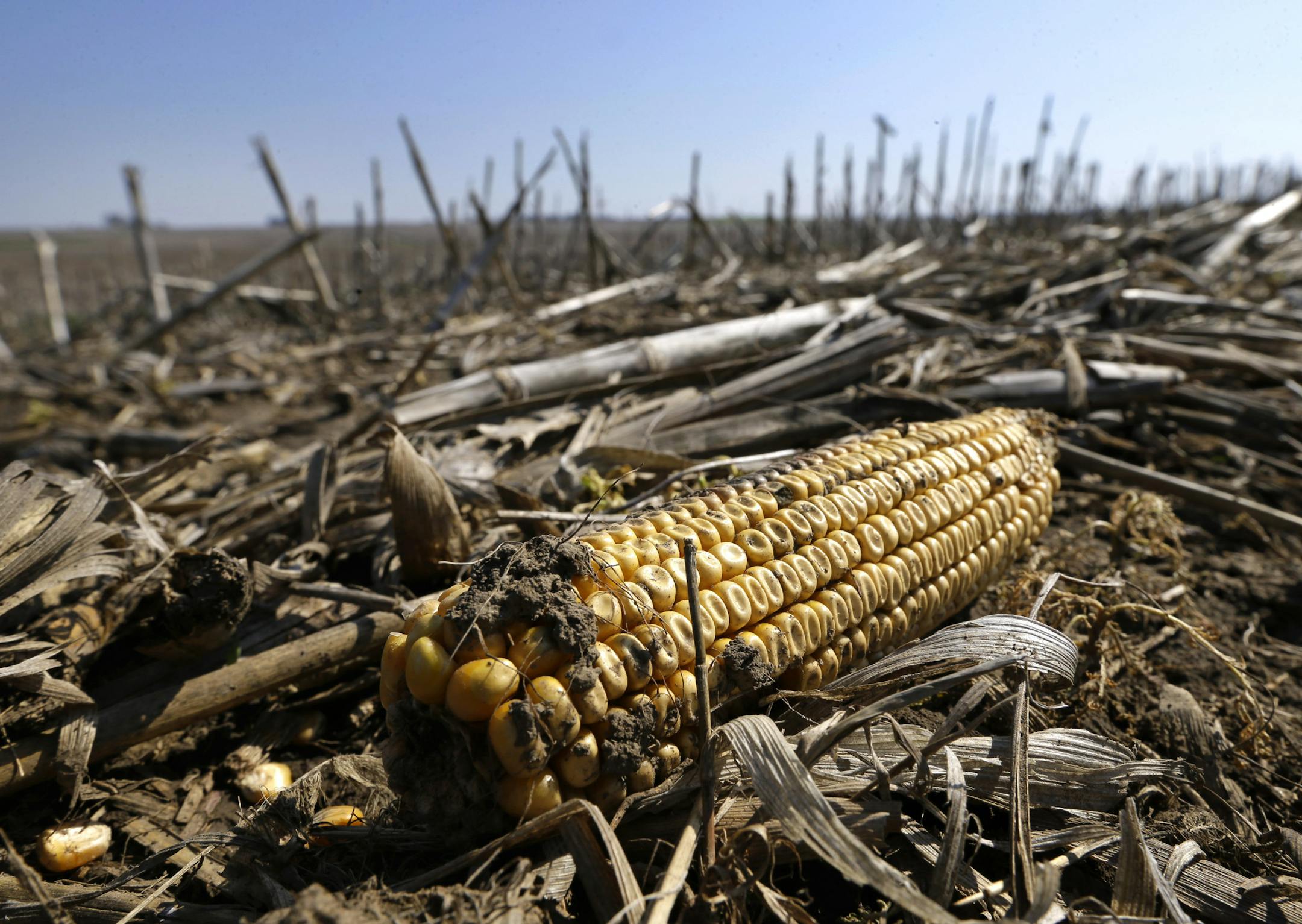
A ear of corn from last year's harvest lies in a wet field on a farm, Tuesday, May 7, 2013, near Carlisle, Iowa. The USDA's weekly crop progress report showed that just 12 percent of the nation's cornfields have been sown, about one-fourth of the typical pace over the past five years. The numbers have been even worse in the biggest corn-producing state, Iowa, where only 8 percent of the corn crop is in the ground, down from 62 percent the same time last year. The USDA says it's the slowest plant
Corn from last year’s harvest rested amid stalks May 7 near ­Carlisle, Iowa. Since then, farmers have made rapid progress in planting. (The Minnesota Star Tribune)
about the writer

about the writer

Mike Hughlett

Reporter

Mike Hughlett covers energy and other topics for the Minnesota Star Tribune, where he has worked since 2010. Before that he was a reporter at newspapers in Chicago, St. Paul, New Orleans and Duluth.

See Moreicon

More from Business

See More
card image
Fairview Health Services

The school is changing an elective course while still working with the Eden Prairie-based health care giant after students raised concerns.

This transmission electron microscope image shows SARS-CoV-2, the virus that causes COVID-19, isolated from a patient in the U.S., emerging from the surface of cells cultured in the lab. (NIAID/TNS) ORG XMIT: 1659810
card image