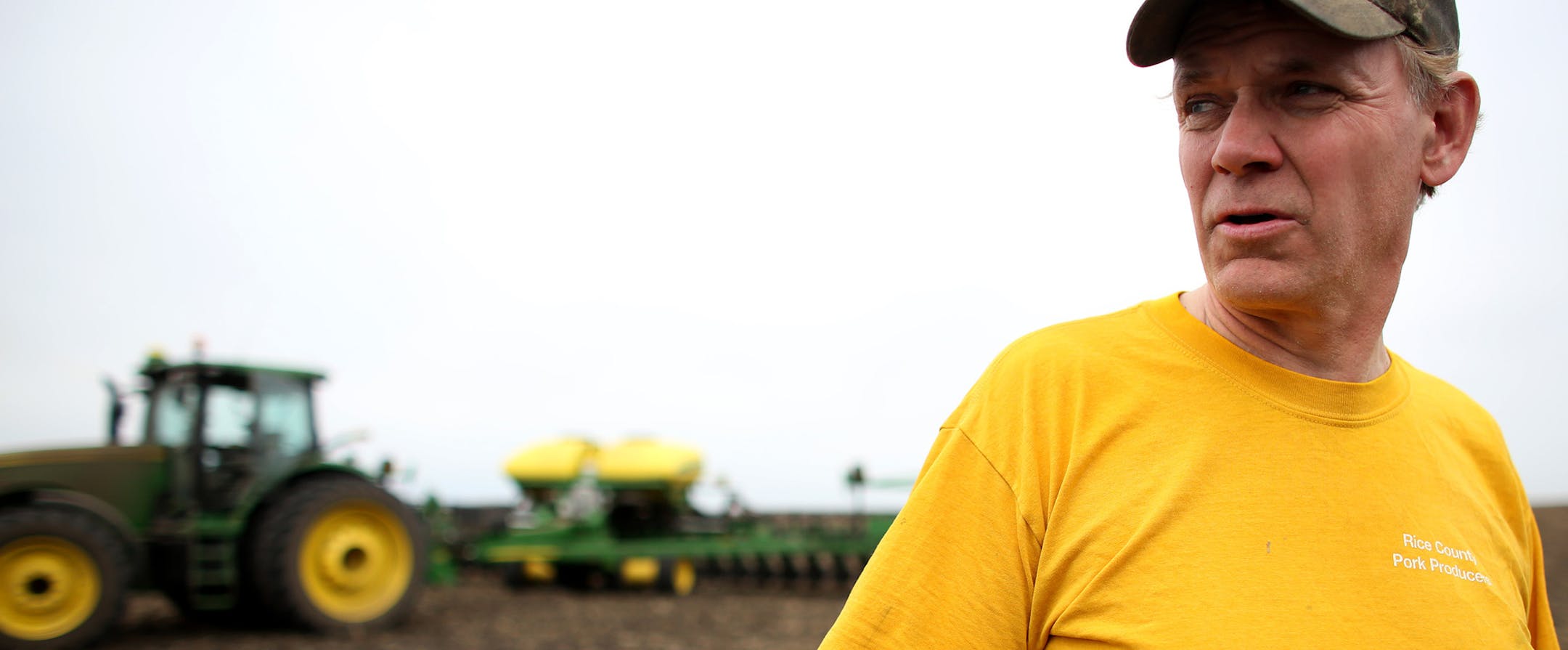
The Peterson brothers were rolling early this year, with Chris planting corn on one field near Northfield, Bruce planting soybeans about a mile away, and Brian racing between the two of them to supply extra seed, oil and other needs.
"It's sure nice this year to be able to get going early," said Chris with a broad smile. He watched monitors in the cab of a GPS-guided John Deere tractor as the planter behind it sowed 36 rows of corn at a time, 34,000 seeds per acre. This year more than ever, the early start thanks to good weather is important.
Putting in a crop is not cheap. In 2014 it cost about $750 an acre for corn and $470 per acre for soybeans in direct expenses, according to reports from nearly 1,600 farms in a University of Minnesota Extension database.
Yet for months, the price that farmers receive for those crops has remained stubbornly low: for corn, about $3.40 to $3.60 per bushel.
Economists, lenders, and crop farmers who have done the numbers come up with the same conclusion, not only for corn, but also for soybeans and some other crops: Prices are not high enough to cover the average costs of production.
"Right now there's many farmers that at current prices might be looking at losses of close to $100 per acre," said Kurt Lensing, grain industry specialist for AgStar bank.
The one saving grace may be that two- to three-week early start, which could translate into better yields at harvest if the weather continues to be ideal.
The big three
More than 70 percent of the expenses to grow corn were for three items, according to the Extension data: $128 per acre for seed, $167 per acre for fertilizer and $250 per acre for land rent. Those costs represent a huge investment, since growers in Minnesota are projected to plant 8.5 million acres of corn and 7.5 million acres of soybeans this spring.
![Treated corn seed. ] (KYNDELL HARKNESS/STAR TRIBUNE) kyndell.harkness@startribune.com The Peterson brothers worked their land at Far Gaze Farms in Northfield Min., Tuesday, April 28, 2015.](https://arc.stimg.co/startribunemedia/DT3XAM32AAX4GZP2KHQWDAKZJM.jpg?&w=1080)