Frey posts strong showing in first-choice votes, but it’s not over yet

Mayor Jacob Frey had 42%, followed by state Sen. Omar Fateh with 32%. Counting of second-choice votes will start Wednesday morning.

The Minnesota Star Tribune
November 5, 2025 at 6:11AM
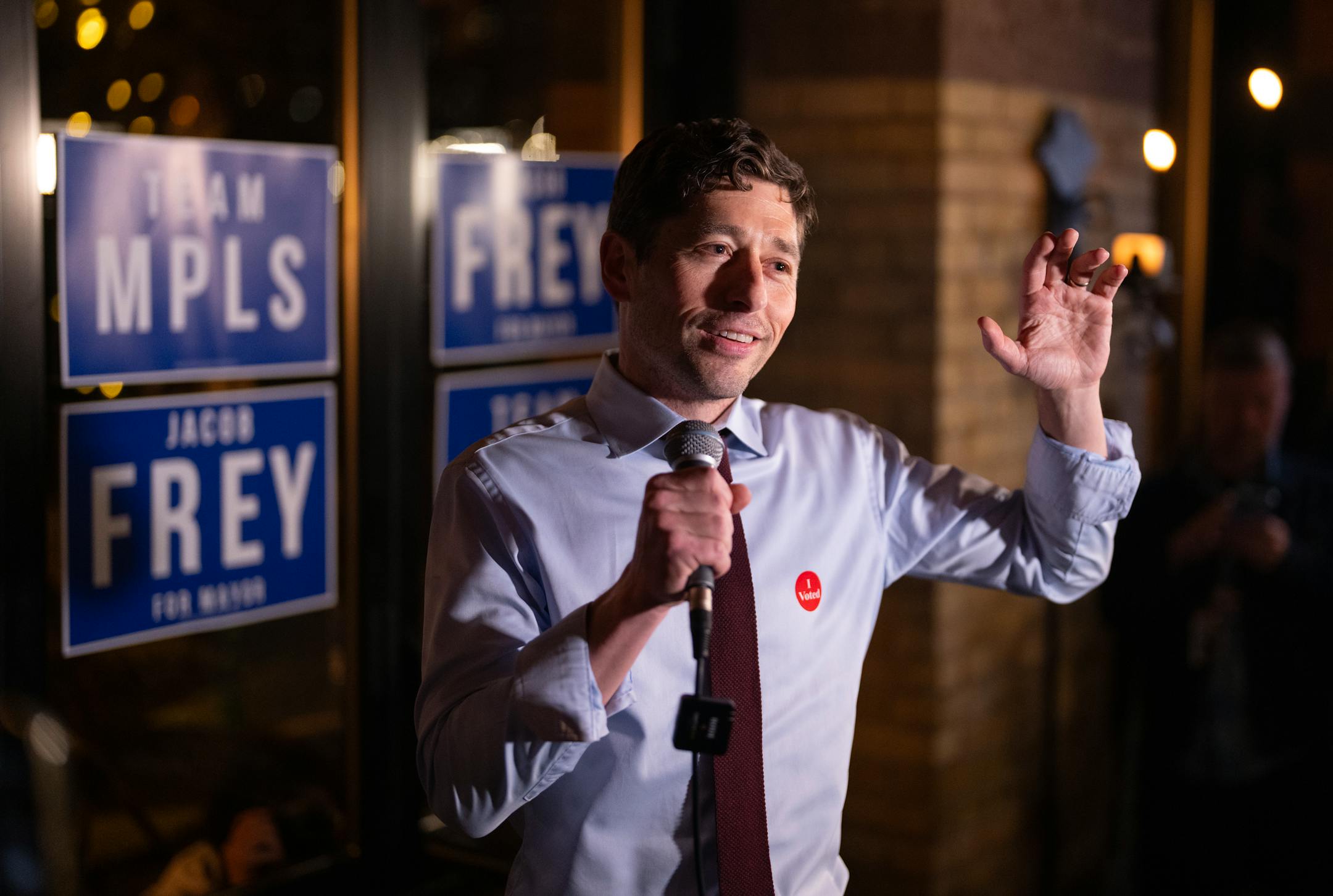
Minneapolis Mayor Jacob Frey thanks supporters at his election night watch party at Jefe Urban Cocina in Minneapolis. (Jeff Wheeler/The Minnesota Star Tribune)

Minneapolis went to bed Tuesday not knowing who its next mayor will be.

The city uses a ranked-choice voting system. None of the candidates won a majority of first-choice votes, so the tabulation will continue Wednesday morning.

In the first round of counting, Mayor Jacob Frey won 42% of first-choice votes, followed by Sen. Omar Fateh with 32%, former pastor DeWayne Davis with 14% and entrepreneur Jazz Hampton with 10%, with 99% of precincts reporting.

Because nobody won more than 50%, election officials on Wednesday will begin eliminating candidates who cannot mathematically win, and their ballots will be transferred to the next ranked choice. The process of elimination continues until a candidate wins a majority.

Frey’s campaign spokesman said his supporters are “cautiously optimistic,” but Frey told a watch party Tuesday night “this city showed up once again.”

“We got what appears to be near-record turnout. And I’ll tell you what — it looks damn good for us," he said, although he stopped short of declaring victory.

At his watch party, Fateh thanked a boisterous crowd for believing in his “scrappy” campaign. He said the race was too close to call, and that all the votes must be counted.

“From day one,” Fateh said, “we knew what we were up against.”
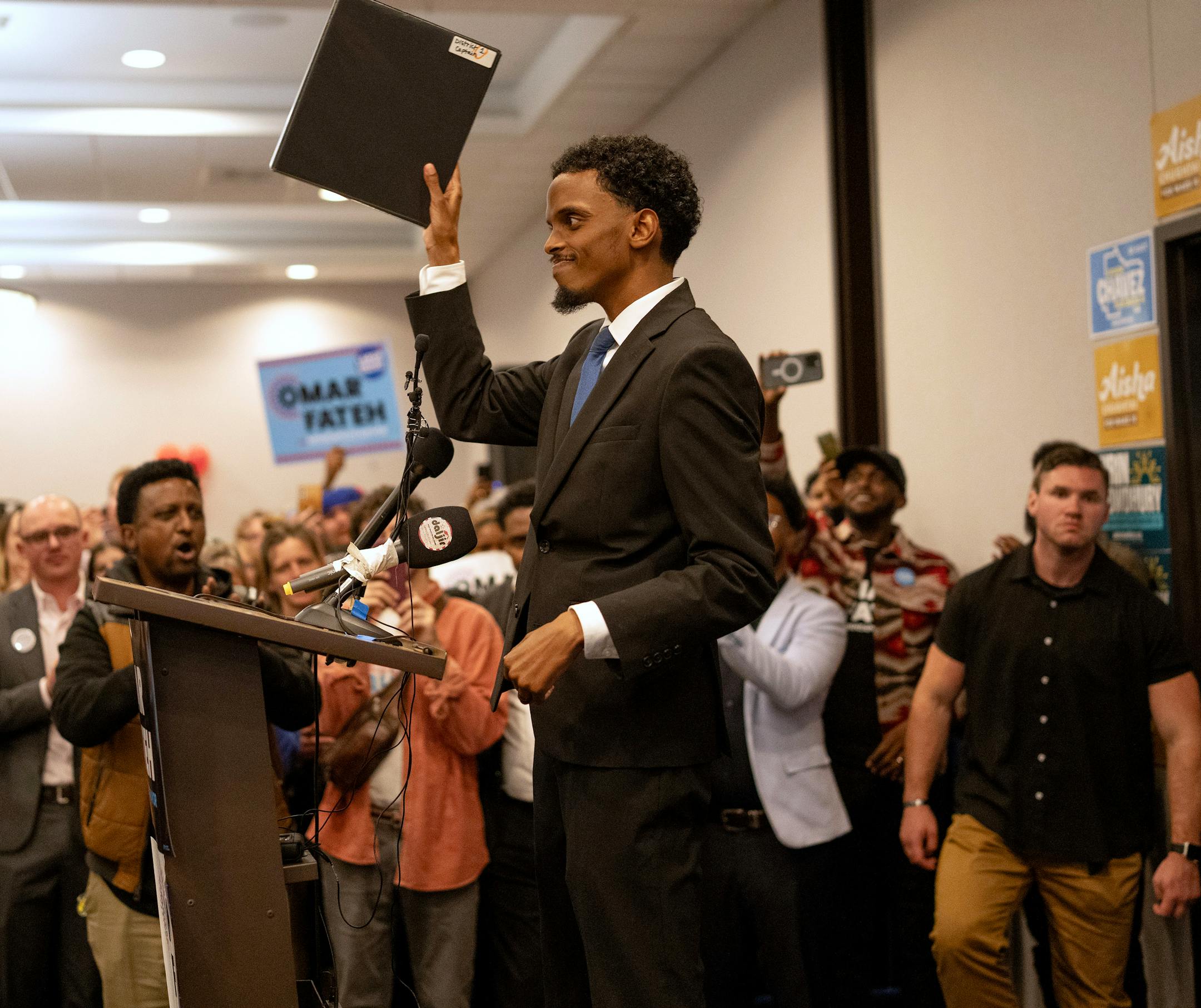
Sen. Omar Fateh speaks to supporters at his election night watch party in Minneapolis. (Jerry Holt/The Minnesota Star Tribune)

Fateh was Frey’s lead challenger as the mayor sought a third term, casting himself as a moderate bulwark to the left flank of the Democratic Party represented by Fateh.

If Fateh manages to pull off an upset, he would make history as the city’s first Muslim, first Somali American and first democratic socialist mayor of Minneapolis, home to the largest Somali community in the nation.

In addition to the mayor, all 13 City Council seats were on the ballot in an election emblematic of a national battle for control of the party between progressives and comparatively moderate Democrats. Based on unofficial results, the progressive wing kept control of the council.

Fifteen candidates were on the ballot in the ranked-choice voting election, where voters could select up to three top choices. Fateh, Davis and Hampton teamed up to try to boost their chances of winning with what they called a “slate for change.”

Turnout was strong, with nearly half of all registered voters casting a ballot by 5 p.m., according to the city’s elections office. The record turnout of 54% was set in 2021, one year after George Floyd’s police killing fueled a ballot measure that would have dismantled the police department, but the proposal was rejected by voters and Frey was re-elected.

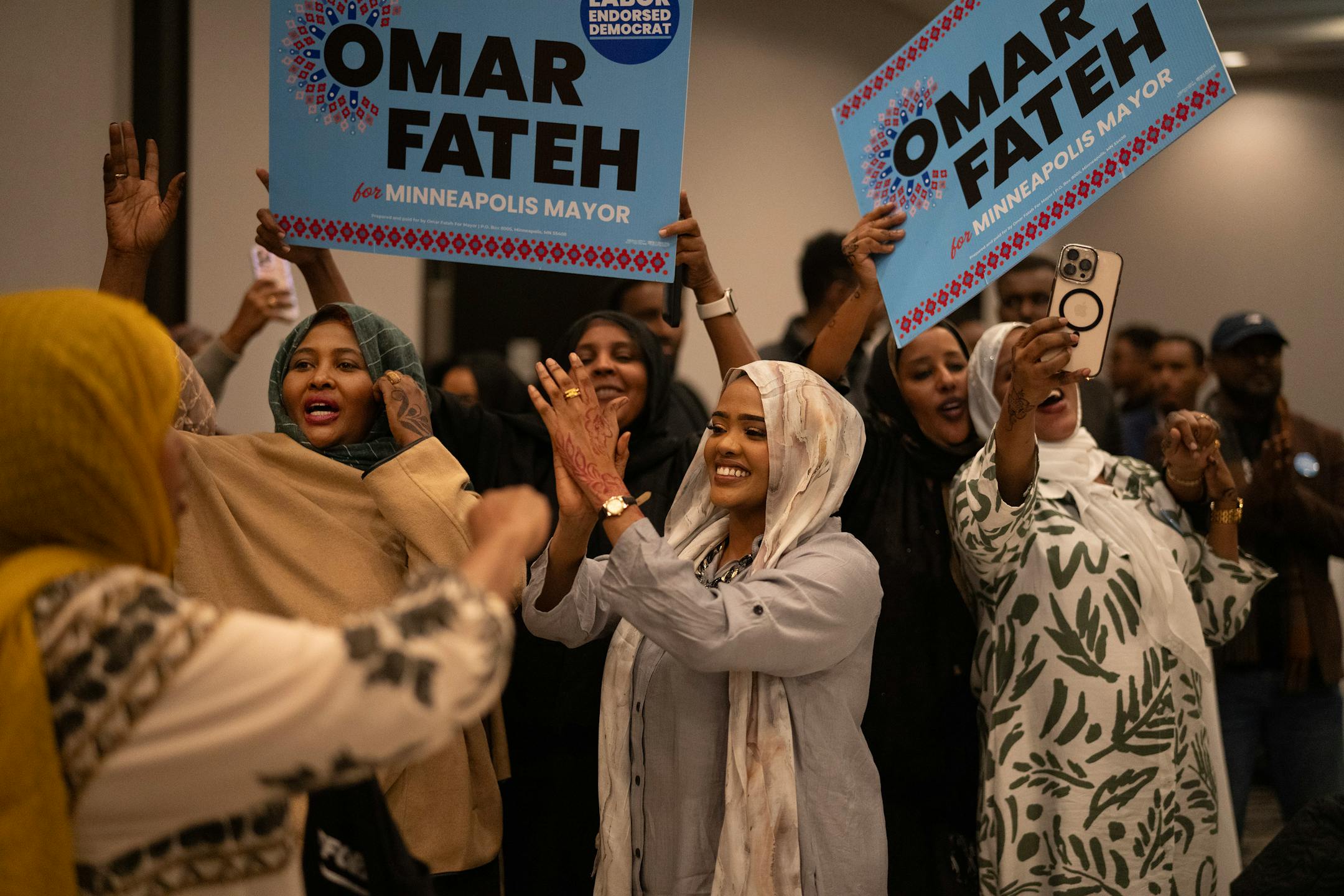
Supporters of Minneapolis mayoral candidate Omar Fateh dance at his election night watch party at the Courtyard by Marriott Minneapolis Downtown as they waited for results. (Jerry Holt/The Minnesota Star Tribune)

Voter enthusiasm

Outside the Coyle Community Center polling place in the Cedar-Riverside neighborhood Tuesday morning, a small crowd of people formed across the street to show their support for Fateh. Residents hugged each other, saying it’s time for a change.

Vann Daley, 48, said she thought Frey was “feckless and reckless.”

“I don’t like the way Frey has handled really anything to be honest,” said Daley, a comedian who voted with her 18-year-old daughter.

Fartun Roble said she supported Fateh as a representative of the Somali community.

“My kids were born here in this neighborhood; we want it to be safe,” Roble said.

Joey Daniewicz, 34, voted for Fateh in the Lowry Hill East neighborhood based on affordability issues and the “bad relationship” between Frey and the more progressive City Council.

“I think it’s just a bad way of doing politics,” Daniewicz said. “A lot more would get done and we’d have a better tenor in the city with that solved.”

Beth Barron, 70, thought of her grandchildren and her savings before voting for Frey in the Bryn Mawr neighborhood.

“I don’t think [Frey’s] doing a bad job,” she said. “We’ve had so many years of discontent.”

North Minneapolis resident Kiersten Latowski, 34, ranked Fateh, Davis and Hampton for mayor.

“I definitely wanted to see candidates who were pro-defund the police,” she said.

At the University of Minnesota’s Weisman Art Museum, Ashton Abram, a 19-year-old freshman student from the suburbs, was enthusiastic about voting for Fateh to address cost of living, homelessness and public safety.

“I think obviously the [Democrat] establishment, as it’s existed for a while, has been failing us,” Abram said. “They haven’t been bringing change in the issues that are really prevalent here.”

University student Emily Luebben said she voted for Fateh because of his support for rent control and his pledge to increase the minimum wage to $20.

At Phillips Community Center in south Minneapolis, JJ Kebeto, 27, voted alongside his mother, Fatuma Denbel, 58. Kebeto ranked Fateh first while Denbel’s first choice was Frey.

“I like both of them, but [Frey] works hard and he helps everybody in the community,” Denbel said, with her son translating her Somali to English.

Kebeto said he preferred Fateh because “he’s talented and his energy is totally different.”

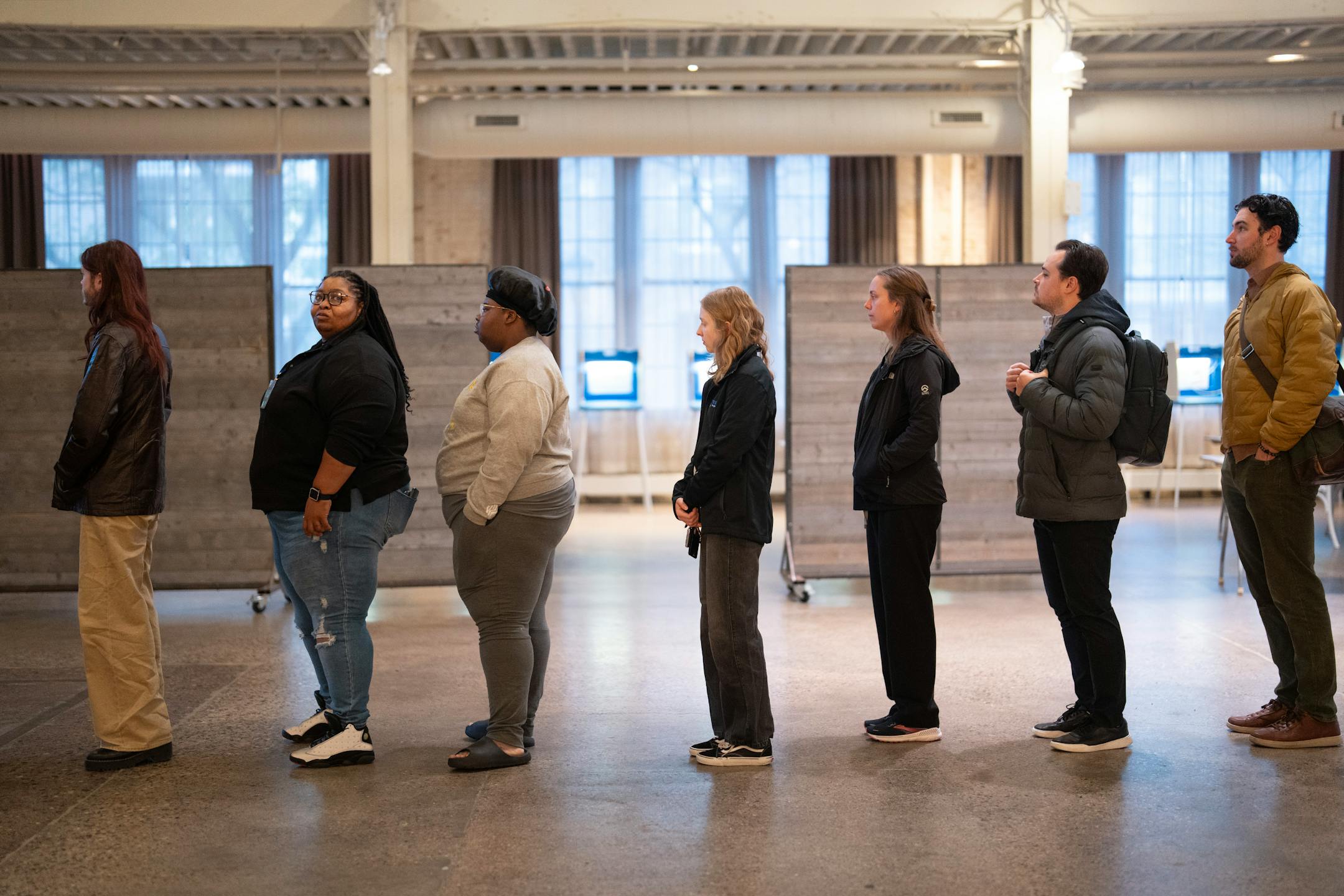
Voters wait in line while others fill out their ballots at the Machine Shop in Minneapolis on Election Day. At 5 p.m. nearly half of all registered voters had cast ballots. (Alex Kormann/The Minnesota Star Tribune)

The top candidates

Frey had the advantage of incumbency, having served two four-year terms and on the council before that. He campaigned on a vow that Minneapolis is “coming back,” portraying the city as resilient despite tragedies such as Floyd’s police killing and the Annunciation school mass shooting.

Frey promised to shepherd Minneapolis through the post-pandemic doldrums downtown, continuing to rebuild the police ranks, implement police reform, drive down violent crime, and build more affordable housing.

Fateh said there are two sides to Minneapolis: the wealthy and well-connected, and the renters, transit-riders and working families. He energized diverse, young, working-class voters with a promise to make Minneapolis more affordable by increasing the minimum wage to $20 by 2028, enacting rent control and preventing evictions without “just cause.”

He has been compared to Zohran Mamdani, who was elected mayor of New York City on Tuesday. Their similarities attracted national attention: They’re both in their 30s, Muslim, state lawmakers and democratic socialists who took on establishment candidates.

Fateh vowed to work better with the more progressive City Council majority, who often butts heads with the more moderate mayor.

Louis Krauss, Susan Du, Sofia Barnett and Kyeland Jackson of the Minnesota Star Tribune contributed to this story.

about the writer

about the writer

Deena Winter

Reporter

Deena Winter is Minneapolis City Hall reporter for the Star Tribune.

See Moreicon

More from Minneapolis

See More
card image
Jerry Holt/The Minnesota Star Tribune

Among federal policy reversals on the rollout of SNAP benefits this month, cities and counties have focused on funding food banks themselves to help residents make ends meet.

card image