
Olson: ‘F------ b----’: What two words tell us about ICE and violence against women

It’s impossible to dismiss the threads of misogyny present in the fatal shooting of Renee Good.

Columnist Icon
The Minnesota Star Tribune
January 20, 2026 at 11:00AM
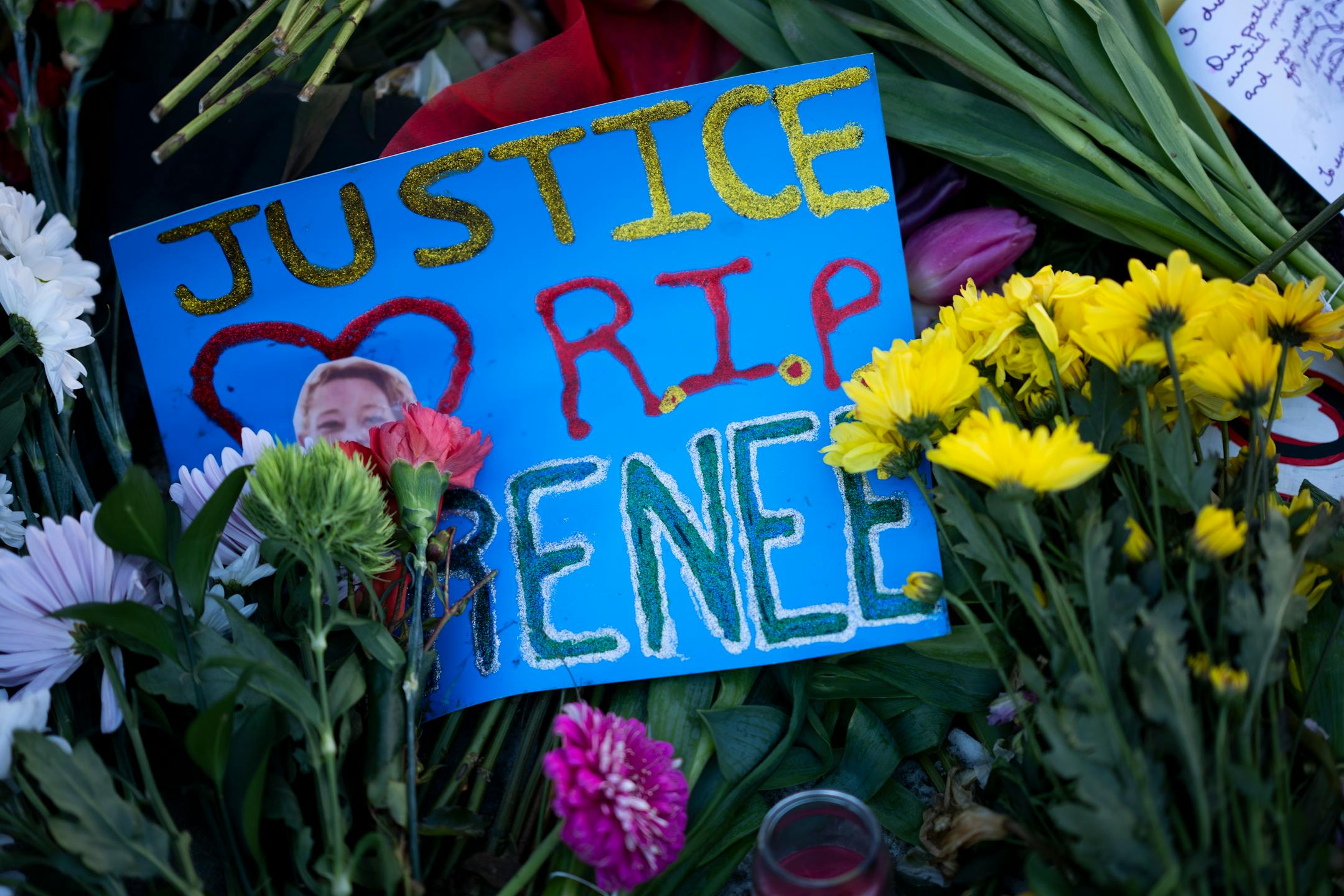
A memorial has sprung up at the spot where Renee Good was killed by a federal immigration agent in Minneapolis on Jan. 7. (Renée Jones Schneider/The Minnesota Star Tribune)

Opinion editor’s note: Strib Voices publishes a mix of commentary online and in print each day. To contribute, click here.

•••

Such a nasty woman.

Remember when Donald Trump, then a candidate for president, directed that invective at his Democratic opponent, then-Secretary of State Hillary Rodham Clinton?

It was October 2016, the third and final general election debate. Clinton was talking about raising taxes on the wealthy to fortify Social Security and took a parting jab at Trump about his boasts of personal tax avoidance.

Trump interrupted her with a gender-based slam: “Such a nasty woman.”

The invective “nasty woman” became a rallying cry and launched unknown numbers of memes and a movement for some. It was shocking at the time that a major presidential candidate would flaunt his misogyny so proudly.

We know now it wasn’t a one-off for Trump who has twice won election despite bragging in the “Access Hollywood” tape about how famous and powerful men can sexually assault women with impunity.


Misogyny has been an unapologetic part of the brand for this president. And now it’s impossible to dismiss the threads of such misogyny that were also clearly present in the final and extreme violation of Renee Good’s civil rights as she sat behind the wheel of her SUV and cheerfully told a federal agent she wasn’t mad at him shortly before being shot dead.

We’ve heard the two words Jonathan Ross used to describe Good after he fired the shots that killed her. I’m sorry to use them again, but we must. He said, “Fucking bitch.”

To that end, Trump was hardly any less circumspect when he quickly weighed in on the fatal Immigration and Customs Enforcement encounter as the shocking video of Good’s death exploded into the nation’s purview.

“At a very minimum, that woman was very, very disrespectful to law enforcement,” Trump told reporters last week aboard Air Force One.

These are familiar tropes, excuses to marginalize and demean women: She got out of line. She was mouthy. Nobody likes an angry woman. We’ve heard them all before.

In December 2021, I covered the Hennepin County District Court trial of former Brooklyn Center Police Officer Kimberly Potter. Instead of grabbing her Taser as intended, Potter unholstered her gun and shot 20-year-old Daunte Wright behind the wheel of his vehicle at a traffic stop.

There was body-camera video of the immediate aftermath of Wright’s shooting that was not unlike the Good video. The drivers both fatally incapacitated, their vehicles rolled slowly down the street before crashing and coming to a stop.

But Potter’s reaction was much different than what we heard from Ross.

Potter didn’t add verbal insult to mortal injury by blaming Wright for his own death. She collapsed onto the curb and sobbed inconsolably at length. She knew she had taken a life. Her 26-year law enforcement career was over.

A jury convicted Potter of first and second-degree manslaughter. She would pay for her mistake with a 16-month prison term and home confinement.

It’s unclear whether Ross will ever face any public accounting as Potter did. The Department of Justice has indicated it has no plans to investigate Ross. Department of Homeland Security Kristi Noem won’t even tell us whether he’s back at work or on leave.

That doesn’t mean there won’t be the pursuit of accountability for Ross and others who excuse him or inflict their own violence. There are moral leaders among us who are challenging the violent tyranny.

Gender Justice, a nonprofit focused on gender and sexual orientation, has requested information from anyone who has experienced or witnessed federal immigration agents targeting people based on sex, sexual orientation and/or gender identity.

“By documenting what people have experienced and witnessed, we can demand accountability, and ensure this history is not rewritten by those in power,” executive director Megan Peterson said.

Documentation, creating a record, is vital.

Minnesota Attorney General Keith Ellison and Hennepin County Attorney Mary Moriarty are seeking to collect information, as well, to conduct an investigation into Good’s death. Their effort came after state and county officials were barred from being part of the federal crime scene inquiry.

Most of us don’t think much about our civic leaders until a moment of crisis or conflict, those moments when we desperately need them to be brave.

Perhaps no one is currently in a tougher spot than Minneapolis Police Chief Brian O’Hara, but he is proving himself to be extraordinary in a moment of growing unrest and federal and local tension.

He’s spoken blunt truths to the D.C. powers, including his professional assessment of how Ross handled the encounter with Good.

“I’ve seen the videos, and it’s not clear to me why he appears to be in the path of the vehicle more than once,” O’Hara said on 60 Minutes. “When you approach someone in a vehicle in a law enforcement encounter, there’s very basic steps you take to ensure the officer’s safety and to de-escalate the situation.”

O’Hara has had plenty of valuable perspective to offer in many recent public forums about ICE tactics. For close to two weeks, the chief has been a courageous moral authority as the police department he leads is now vastly outnumbered by the federal forces that have been deployed here in recent days. He appears to remain unbowed.

And that is how you lead: You tell the truth, you keep your calm in the face of provocation, and you don’t bow to bullies.

The Trump-sanctioned siege of Minnesota will not last forever.

How and when we emerge from these dark days will hinge on all of us but especially leaders like O’Hara who continue to act on all our behalf — courageous leaders who are willing to stand up to blame-shifting tyrants, lies and nasty words.

about the writer

about the writer

Rochelle Olson

Editorial Columnist

Rochelle Olson is a columnist on the Minnesota Star Tribune Editorial Board focused on politics and governance.

See Moreicon

More from Columnists

See More
card image