
Midwest manufacturers grow in February despite job losses

However, growth slowed in exports and employment in February, report shows

March 3, 2015 at 3:11AM
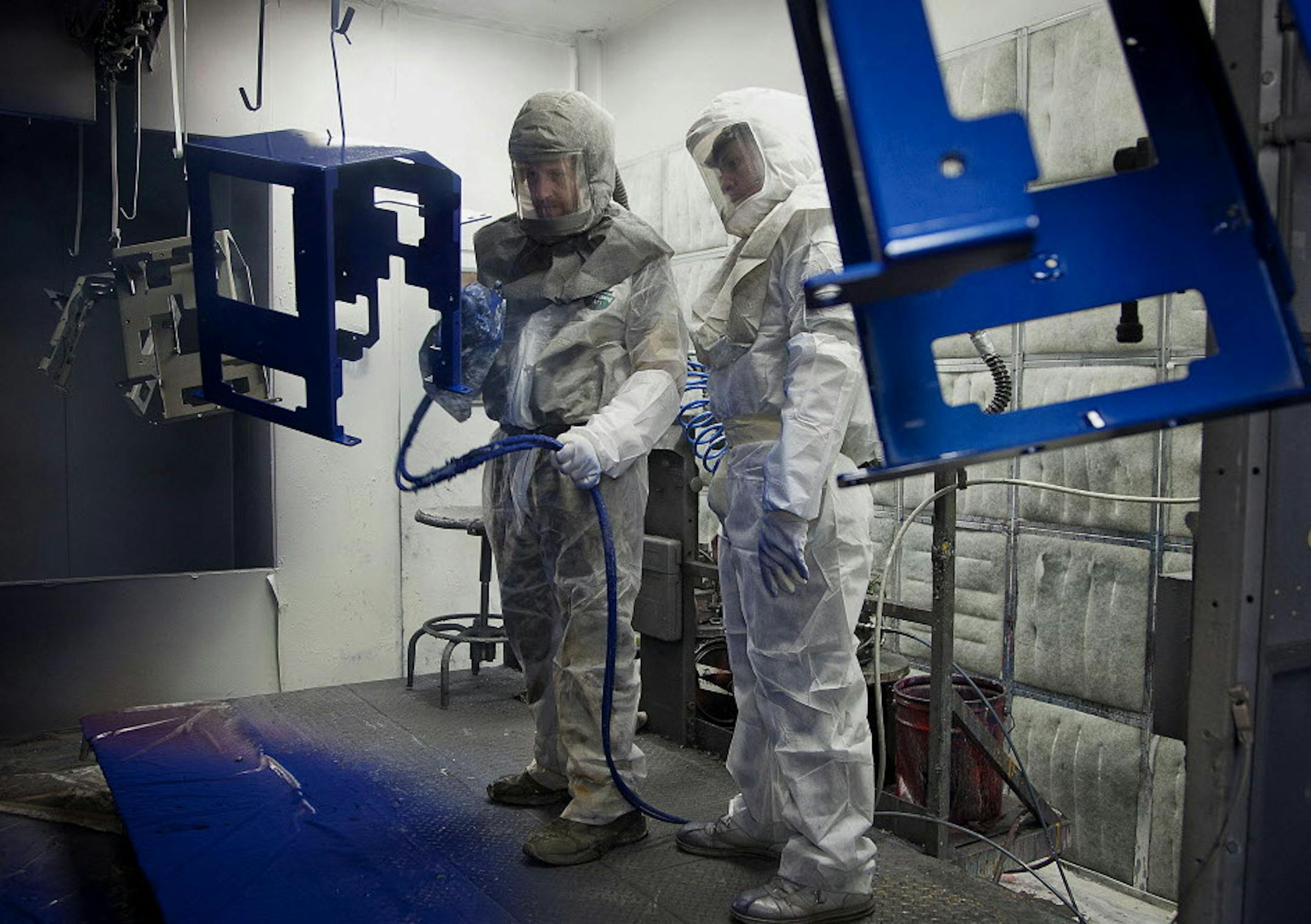
Employee Joe Stelflug, left, and trainee Dwane Whekins paint chassis at the Graco Inc. manufacturing facility in Minneapolis, Minnesota, U.S., on Tuesday, Feb. 5, 2013. The U.S. Federal Reserve is scheduled to release manufacturing production figures on Feb. 15. Photographer: Ariana Lindquist/Bloomberg *** Local Caption *** Joe Stelflug; Dwane Whekins ORG XMIT: 161819514 ORG XMIT: MIN1307011700470833
Employee Joe Stelflug, left, and trainee Dwane Whekins paint chassis at the Graco Inc. manufacturing facility in Minneapolis, Minnesota, U.S., on Tuesday, Feb. 5, 2013. The U.S. Federal Reserve is scheduled to release manufacturing production figures on Feb. 15. Photographer: Ariana Lindquist/Bloomberg *** Local Caption *** Joe Stelflug; Dwane Whekins ORG XMIT: 161819514 ORG XMIT: MIN1307011700470833 (The Minnesota Star Tribune)

The Minnesota and other Midwest manufacturing sector grew robustly in February despite West Coast shipping woes that slammed much of the country, according to two widely watched economic reports released Monday.

While U.S. factory gains slowed in February, Midwest producers reported increases in factory sales and delivery speeds, while benefiting from decreases in raw material prices for the month.

The combination increased the nine-state Creighton University Mid-America Business Conditions Index to 57.0 in February from 54.8 the month before. Any index above 50 signals growth. In contrast, the national Institute for Supply Management index fell from 53.7 in January to 52.9 in February.

The "Mid-America" region includes Minnesota, Iowa, North and South Dakota, Nebraska, Missouri, Kansas, Oklahoma and Arkansas. The region's manufacturing grew even though 44 percent of Midwest factories ­— including Toro, 3M and Polaris Industries — reported West Coast shipping problems.

Bennett Morgan, president of Polaris Industries, which makes ATVs, motorcycles and snowmobiles, said he considers Polaris lucky since just 30 percent of sales are international and affected by port issues.

In the meantime, orders for its ATVs and motorcycles "have been chugging along," Morgan said. "We have our challenges and plenty of head winds, but demand has been pretty strong for us in January and February."

Toro said last month that it benefited from East Coast snowstorms and that the weather should continue to boost sales of its snow throwers and snowplow equipment.

The Creighton study found similar stories from other Midwest companies. "Indices over the past several months are pointing to positive economic gains [for] the next three to six months for the region," the report said.

However, not all was rosy. Midwest exports, employment and confidence levels grew at a slower pace in February than in January. "Areas of the region linked closely to the energy sector, including ethanol, are experiencing pullbacks in economic activity," said Ernie Goss, director of the Creighton University Economic Forecasting Group.

Despite ethanol sluggishness, Minnesota's business conditions index jumped to an impressive 64.7 from 60.1 in January amid strong orders and product sales. Results marked Minnesota's 27th consecutive month with an index above 50.

"Durable goods manufacturers in the state are growing at a solid pace," Goss said. "However, even with this recent healthy growth … this heavy manufacturing sector has lost almost 13,000 jobs. Average weekly wages for all Minnesota workers … have grown by an anemic 0.5 percent over the past year."

Minnesota wasn't alone in seeing employment lag.

The national Institute for Supply Management breaks out employment, which was down 2.7 percentage points to 51.4 percent in February. The overall index of 52.9 reflected slowdowns in new orders, production and employment. Inventory levels rose while commodity prices remained flat.

Surveyed supply managers expressed frustration over the labor woes and shipping backlogs at West Coast ports. Factory heads said the slowdown negatively impacted trade and cost extra money to ensure that inventories were sufficient.

Suppliers said the port issues "negatively impacted exports and imports, requiring workarounds and added costs," said ISM business survey committee chairman Bradley Holcomb. Morgan at Polaris said durable goods makers like his company jumped through hoops to avoid port-related shutdowns. He said Polaris shipped goods through Texas and Vancouver, flew parts in, doubled inventory orders and worked early with supply managers worldwide to keep production flowing.

"We feel OK right now, but there is still some fragility to the U.S. economy," Morgan said.

Economists agreed.

The "rise in the value of the U.S. dollar against the euro" and Canada showed up in the national ISM report, said Don Norman, economic studies director for the Manufacturers Alliance for Productivity and Innovation.

Minnesota-based manufacturers know the problem well. Graco Inc., which makes fluid handling equipment; chemicals firm Ecolab Inc.; pump and valve maker Pentair PLC; filtration giant Donaldson Co.; and ATV makers Arctic Cat and Polaris all recently reported that the soaring U.S. dollar impacted revenue and may hurt them in the future.

Balancing worries about U.S. ports and currency volatility were lower gasoline and heating prices. That spurred consumer spending during the month and was "a net plus for the economy," Norman said.

Dee DePass • 612-673-7725

Goss
Ernie Goss, Mosaic (The Minnesota Star Tribune)
about the writer

about the writer

Dee DePass

Reporter

Dee DePass is an award-winning business reporter covering Minnesota small businesses for the Minnesota Star Tribune. She previously covered commercial real estate, manufacturing, the economy, workplace issues and banking.

See Moreicon

More from Business

See More
Hennepin Healthcare Clinic and Specialty Center,l 8th Street between Park Av and Chicago Av.
The Minnesota Star Tribune

Minneapolis-based Hennepin Healthcare says it also will suspend contributions to some worker retirement plans while pausing $24 million in capital projects.

The newly renovated Parkway Theater is next door to the new restaurant El Burrito Mercado.
card image