

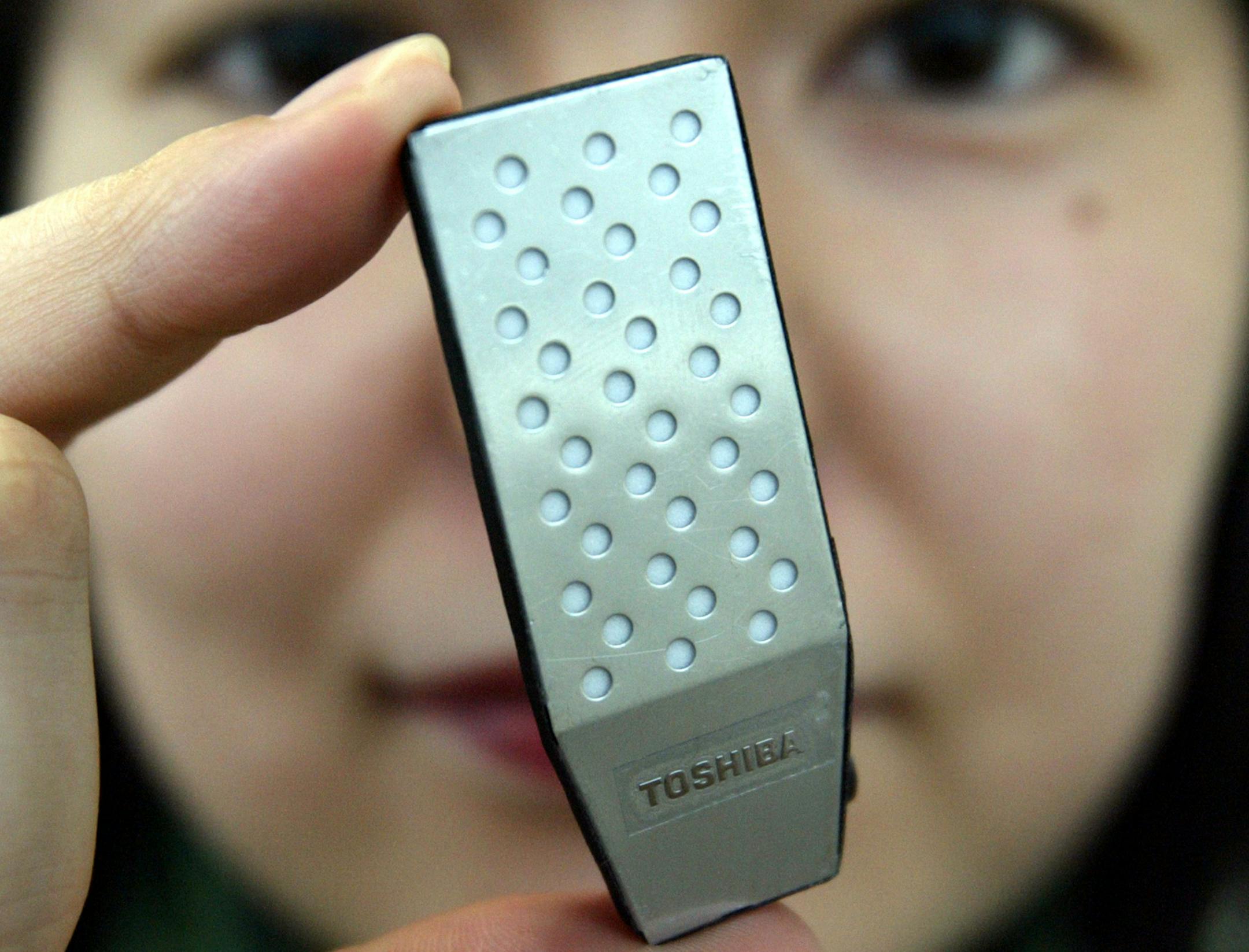
Methanol is nasty stuff. Careless distillation in many a backwoods still has caused it to blind the imbibers of "alternative" alcoholic drinks. Yet it has its uses, and one of them may be to restore fuel cells to their oft-vaunted role as the power packs of the future -- but with a twist. The main role that has been discussed for fuel cells over the past few decades is as replacements for the internal-combustion engine. Their actual use may turn out to be to provide power for portable electronic devices.
A fuel cell is a device that combines hydrogen with oxygen to generate electricity. The traditional approach has been to use the gas itself in the cell -- and that is the approach taken by the world's carmakers in their so-far not very successful attempts to make a commercial fuel-cell-driven vehicle. Because gaseous hydrogen is hard to store and handle, an alternative that some people have considered is to use the hydrogen in methanol, a liquid whose molecules are made of a carbon atom, an oxygen atom and four hydrogen atoms. Methanol will react with water in the form of steam to make hydrogen and carbon dioxide -- a process known as steam reformation. Put a steam reformer in a car along with the fuel cell and you can fill the tank with methanol instead of hydrogen.
That idea hasn't gone very far, either. But it has provoked another thought. What if it were possible to decompose the methanol without steam, and within the fuel cell itself? And that has, indeed, turned out to be possible. The resulting cells are nowhere near powerful enough to run cars, but they can stand in for small batteries. And, they last far longer than batteries, and when they do need recharging, it is the work of a moment.
Proton power
In a direct-methanol fuel cell (DMFC) the methanol is oxidized at the anode in the presence of water. The reaction turns the methanol and water into protons, electrons and carbon dioxide. While the electrons pass along an external circuit as an electric current, the protons diffuse through a membrane to the cathode, where they recombine with the incoming electrons to form hydrogen atoms that react with oxygen to make water. The water is channeled back to mix with the incoming methanol. Even though DMFCs produce carbon dioxide, the amount is small enough that the cells count as a much greener technology than batteries. Toshiba, the large Japanese electronics firm, reckons that DMFCs can be used to produce mobile devices that don't use batteries. Toshiba says that it will begin making such cells within a year for mobile phones and laptop computers. Sharp, one of its rivals, recently said that it had developed new microfabrication techniques to build DMFCs with the highest power densities yet. Sharp reckons this will enable it to produce cells that are the same size as the lithium-ion batteries used in mobile devices, but which can run those devices for much longer. Some in the industry talk of mobile phones capable of operating continuously for several weeks before their fuel cells need recharging.
The most likely way that recharging will be done is with a cartridge of methanol that is inserted into the device and replaced when it is running low. As portable devices become more sophisticated, with added functions and large color screens, they are draining batteries faster. MTI Micro, of Albany, N.Y., has put its version of a DMFC into satellite-navigation devices, which are often used for long periods. The company says it can run even a power-hungry model for as long as 60 hours before the gadget needs refueling.
Longer life is a big appeal; some people would like to run their laptops continuously during a 12-hour transoceanic flight. Hence, new rules are being drawn up for aircraft. The U.S. Department of Transportation is planning a rule change Oct. 1 that will allow passengers and crew to bring fuel-cell-powered electronic devices and one or two fuel cartridges on board in their carry-on baggage. To qualify, the devices will have to meet certain safety standards. It is proposed that each passenger would be limited to about 7 ounces of fuel.
Already, some companies are predicting that sales of refueling cartridges could run into the billions within a few years of them coming into the market. Forget, then, the familiar cry: "Has anyone got a charger I can borrow?" It will be replaced by: "Can you spare me a squirt of methanol?" -- and that won't mean in your hooch.


