

I stopped at a red light in a northern Minnesota town. I was in the right lane and glanced at the driver to my left — an elderly man with the classic, direct-from-central-casting face of a Hollywood grandfather. The gray mane and life lines (not wrinkles) were wrought and balanced to signify wisdom, cheerful stoicism and an endearing patriarchal gruffness that always twinkles. I imagined him balancing adoring toddlers on each knee; capturing the grudging reverence of teenagers; winning the trust of all women. My glance turned into a covert study, and it crossed my mind the man should be scouring Beverly Hills for an agent.
The light turned green and Kindly Grandpa (so my mind had branded him) accelerated. His rear bumper eased into view, and I saw a bright yellow sticker with black letters that read: PEOPLE SUCK.
I guffawed. So much for first impressions. I wondered what Kindly Grandpa would think about the following news:
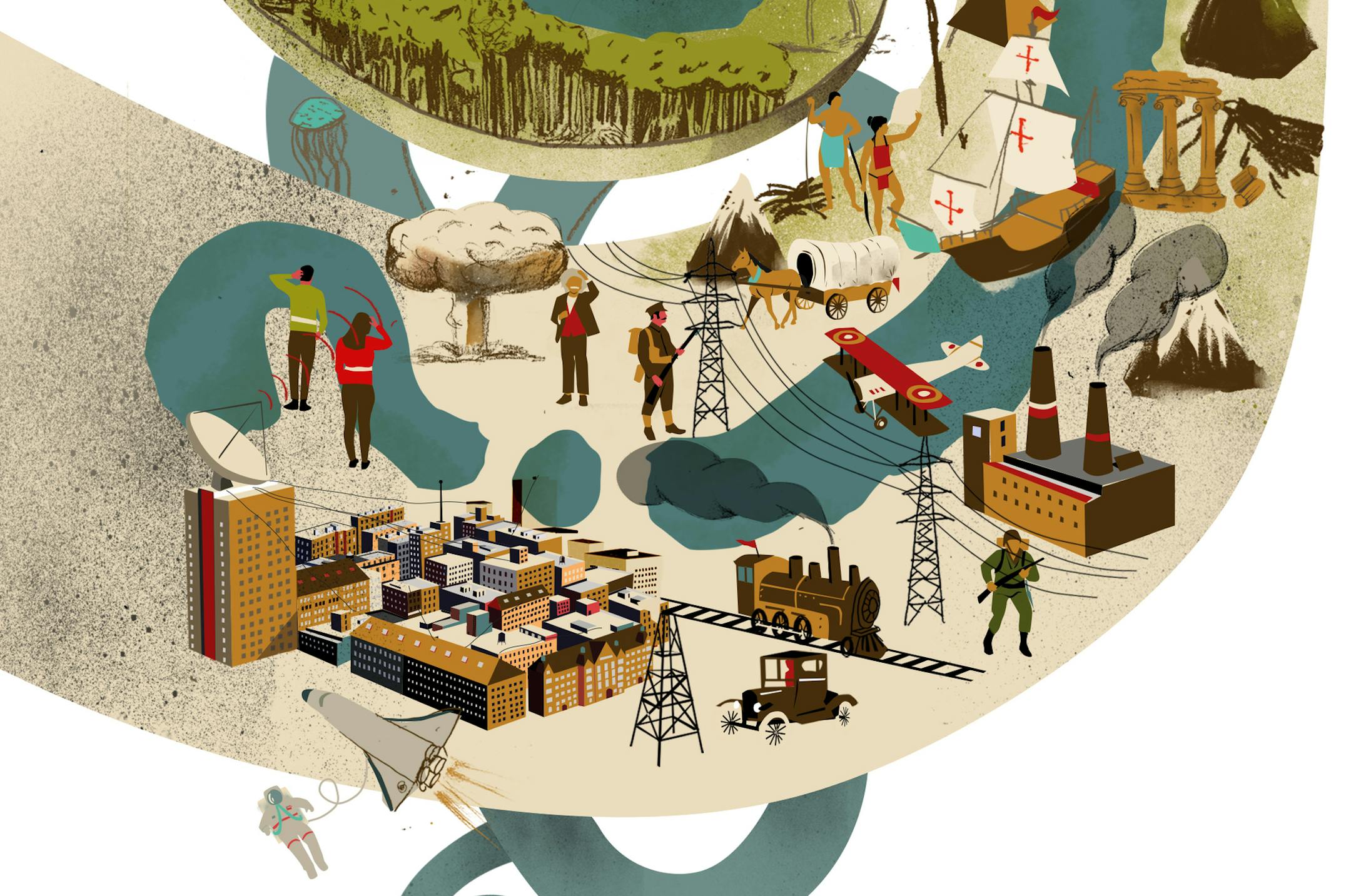
In January, Reuters reported that an international team of researchers produced a paper arguing that our planet has entered a new geological epoch, the Anthropocene ("human epoch"), ending the Holocene, which began after the last ice age about 12,000 years ago. The impact of our numbers and activity on the Earth shows, said Colin Waters, the team's leader: "We are becoming a geological agent in ourselves."
Especially since 1950, population growth and technological innovation have ushered in a new age. Our influence includes human infrastructure that covers vast tracts of the world's surface; a doubling of nitrogen and phosphorus in the soil from agricultural additives; radioactivity from atomic weapons tests in ice and sediment that will be detectable for 10,000 centuries, and carbon dioxide concentrations in the atmosphere that have doubled since the start of the Industrial Revolution and have steeply accelerated the past 75 years.
With the possible exception of the nuclear explosions, none of it is all virtuous or all evil. As mammals in the biosphere, we can't be faulted for reproduction — it's what the living do, whether they are bacteria or people, the most complex of the multicellular life forms known as "metazoans."
Once we multiplied into the billions, the primary need to provide food, clothing, shelter and tools led to our dominance of the planet, inducing the extinction of many species unable to withstand the swelling human tide. This is not unprecedented. About 2 billion years ago, a massive proliferation of cyanobacteria renovated the atmosphere so profoundly that most other life forms perished in probably the greatest mass extinction in history. The "poison" they released was oxygen, thus setting the stage for our evolution, and demonstrating that the biosphere is either neutral or perverse, depending upon your point of view.
My view is that the cosmos is perversely fair: No favorites are chosen or are even possible. So far as we can tell, the house rules don't specially accommodate microbes, people or anything else. From the human perspective, what matters most is the values we assign to what is and what happens.


