

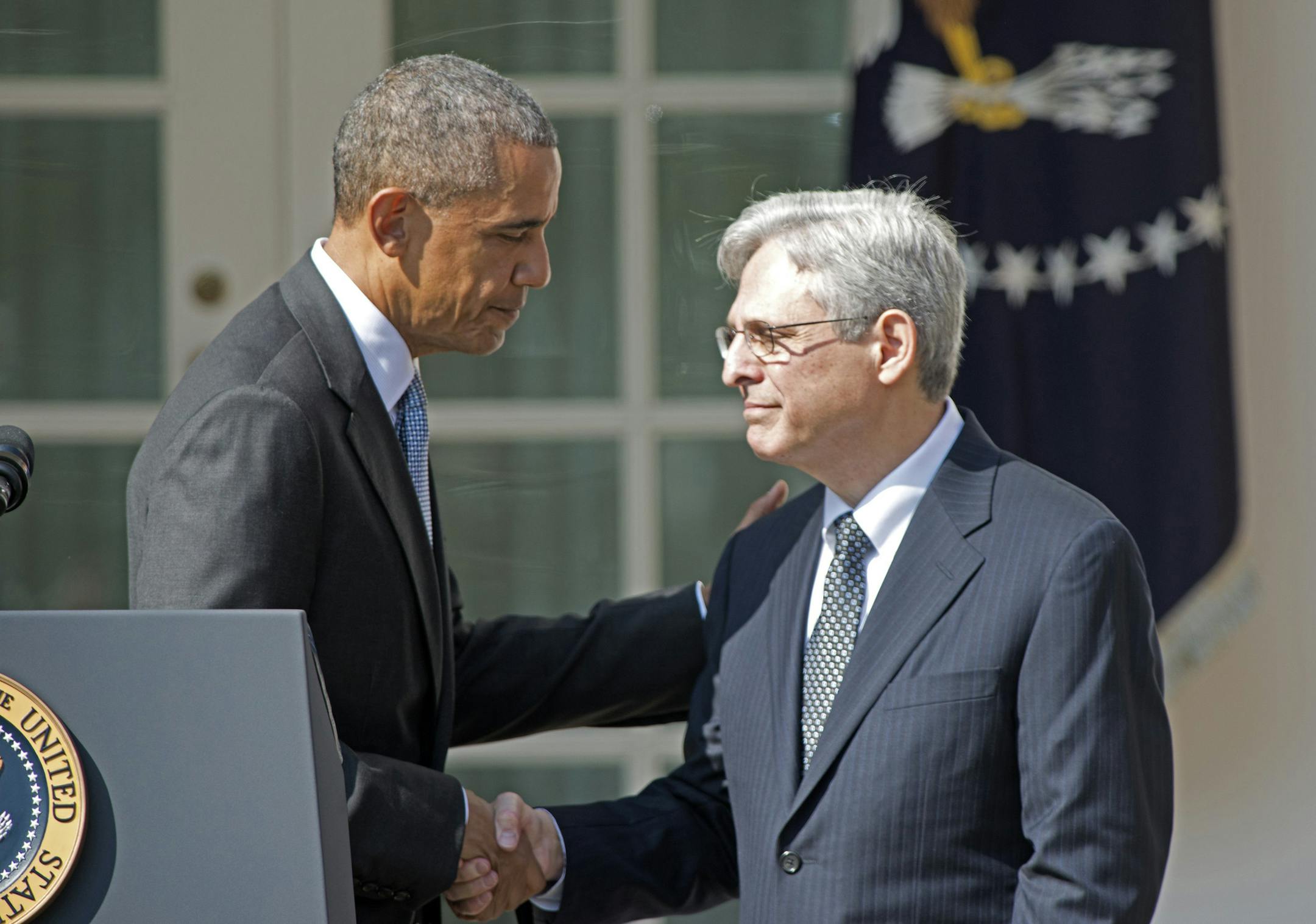
If confirmed, Merrick Garland would be the fifth white man on a court that already has four. He'd be the fourth judge on the current court from the U.S. Court of Appeals for the D.C. Circuit; the sixth Harvard Law School graduate; the fourth former Supreme Court clerk; the fourth Jewish-American.
Since graduating from law school and spending a year in New York as a clerk to Henry Friendly (second Friendly clerk on the current court), he's spent his entire professional life since 1978 in a six-block radius centered on the intersection of Constitution and Pennsylvania Avenues in Northwest Washington, D.C.
Is this the diversity of background and professional experience that the Supreme Court really needs? Garland's high intelligence, first-class qualifications, and vast reserve of personal and professional caution suggest that the ideal of meritocratic qualification for the court seems to have prevailed over diversity.
As one of my most brilliant former students wrote sharply to me last night, "Can you provide any description of Merrick Garland that's not a platitude from the positive discrimination playbook?" What she meant, I think, was that he seems to give life to the caricature of a liberal legal establishment made up of Jewish lawyers who went to Harvard and had fancy clerkships. To paraphrase Woody Allen in Annie Hall, it sometimes seems that way to me, and I'm one of them.
There's an easy — too easy — answer to all this, which is that we don't have to worry about the social meaning of the Garland nomination because he isn't a real nominee at all, just a sacrificial lamb. According to this theory, President Obama nominated him to send a message to the Senate, not to get him on the court.
There are at least two reasons this answer is too easy. First, Garland might get onto the court after all. Utah Sen. Orrin Hatch, a leading Republican voice on judicial matters, said yesterday that he would "probably be open to resolving this in the lame-duck" session of Congress. That's code for the possibility that once Hillary Clinton is elected, Senate Republicans' calculus will have shifted and they might prefer confirming the relatively moderate Garland to waiting for a potentially more liberal Clinton nominee. Obama surely won't have withdrawn Garland's nomination by then — which means Garland has a possible path to confirmation.
Second, even if Garland is blocked, there's a symbolic message in his nomination. That message is that diversity isn't very important on the Supreme Court, and that what matters is a career of legal excellence from which one emerges unscathed by the taint of controversy, risk, or (God forbid) strong opinion strongly expressed.
That hasn't always been the case. The Supreme Court was one of the first institutions in American life where it was widely agreed that diversity counted — and that included diversity of background, experience and viewpoint.


