

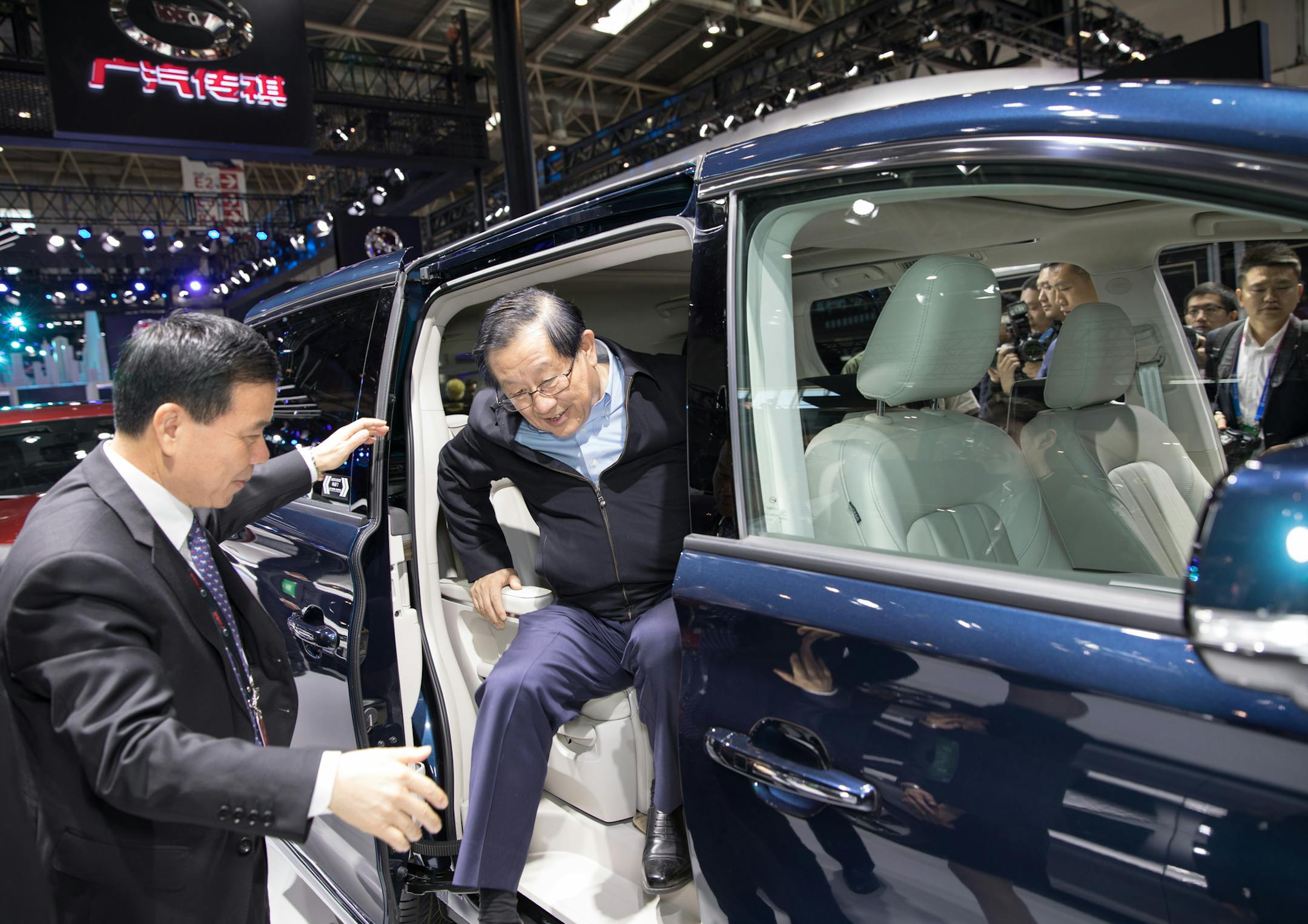
At this year's Beijing Auto Show, a retired Chinese bureaucrat ran his hands over the hood of a sleek sports coupe billed as the world's fastest battery-powered car and smiled like a proud father.
In a way, that's exactly what he was. Two decades earlier, Wan Gang had persuaded China's State Council to throw its vast power behind the risky, unproven technology of electric cars. He advocated using government money, including subsidies, to help create a world-champion industry that would surpass Western automakers. That coupe he was admiring at the April auto show? It was built by homegrown NIO Inc.
Elon Musk made a name for himself promoting new-energy vehicles, or NEVs. But when the history of the electric car is finally written, Wan may loom larger. Chinese drivers buy one of every two EVs sold, and the global auto industry is pivoting to adjust. It's a revolution fomented by Wan, a former minister of science and technology whose achievements are even more extraordinary when you consider that he never joined the Chinese Communist Party.
"He's the father of China's electric-vehicle industry," said Levi Tillemann, a former U.S. Department of Energy adviser and author of "The Great Race: The Global Quest for the Car of the Future." "Without Wan Gang, it's unlikely China would have pushed to surpass the West. That was his big idea."
Wan, 66, who stepped down in March and now holds an academic post at a Beijing-based think tank, is not giving interviews, his office said.
After decades of hype and false starts, electric vehicles are on course to represent a significant segment of the auto industry. This year, China's production of NEVs is expected to reach 1 million vehicles — a 26 percent increase from last year. The U.K., France and India are proposing bans on vehicles powered by internal-combustion engines, according to Bloomberg New Energy Finance.
Leap backward
Long before becoming the nation's top futurist, Wan suffered through the Cultural Revolution of the 1960s, China's great leap backward for science and technology. Sent from Shanghai to a remote village near North Korea at age 16 to learn values from peasants, he spent his days repairing the town's smoke-belching tractor and building its electricity grid from scratch, according to the state-run People's Daily and author Lisa Margonelli, who interviewed Wan.
One of the lucky few of his generation to attend college, Wan was admitted to a Ph.D. program in mechanical engineering at Clausthal University of Technology in Germany. When he graduated in 1991, job offers came from all the big German carmakers, but he picked Audi because it was the smallest and provided the best chances for promotion.


