

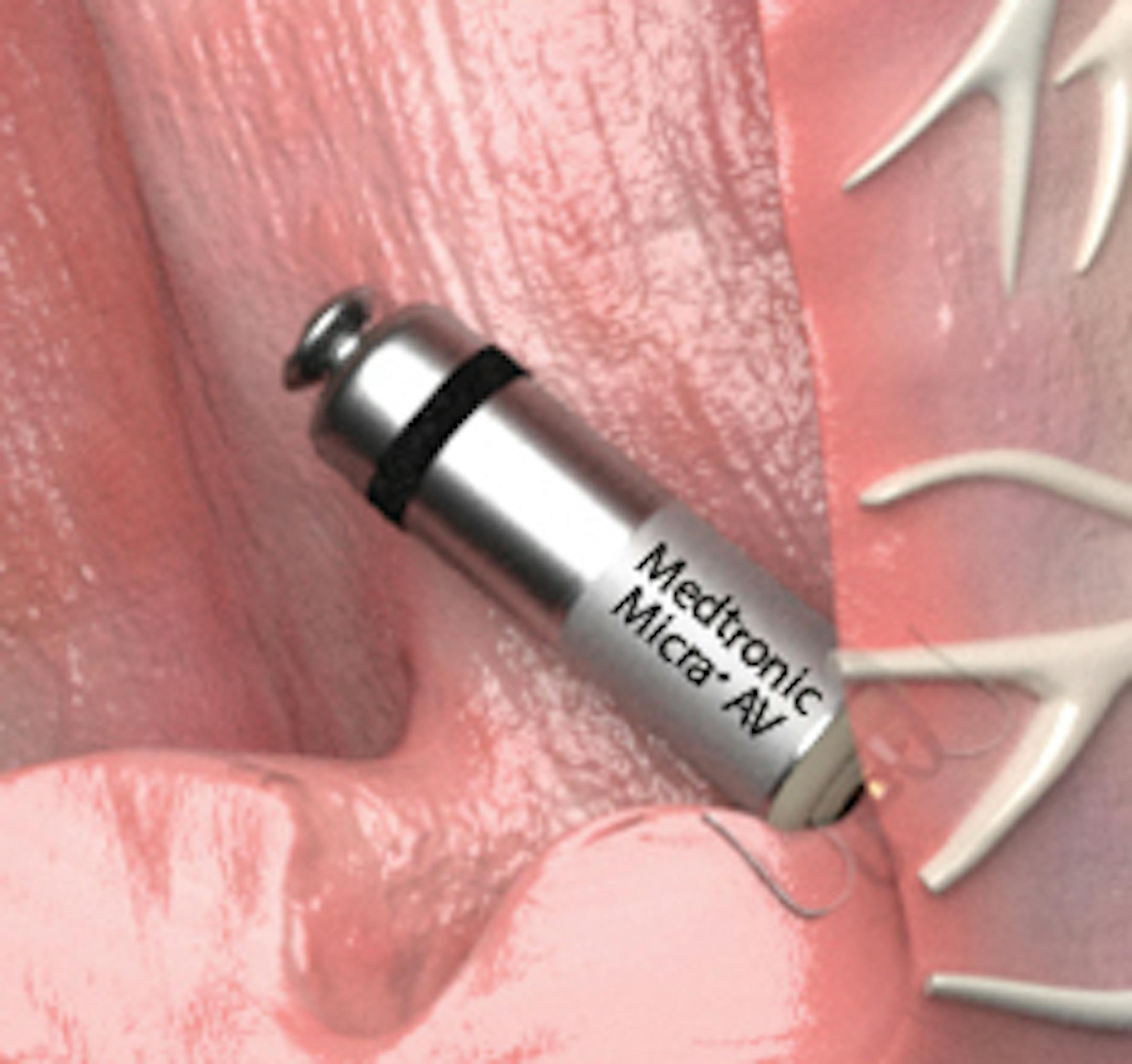
Medical device maker Medtronic, which commercialized the world's first battery-powered pacemakers more than 60 years ago, just won approval for a new minimally invasive pacer that can tell whether the heart's upper chamber is beating without touching it.
The Micra AV, approved by the U.S. Food and Drug Administration on Jan. 21, is an innovation wrapped in an innovation. The original version of the device approved several years ago was so small it could be delivered through the blood vessels and attached to the heart without lead wires, eliminating the sources of most complications in traditional devices that maintain a regular heartbeat.
The newly approved Micra AV looks exactly the same on the outside: like a metal vitamin pill with four small hooks on one end. But the new device comes with a sensitive instrument called an accelerometer and a special algorithm designed to allow the device to sense whether the upper heart chamber is beating, even though the device is implanted in the lower chamber.
As a result, the Micra AV is applicable to a much wider pool of patients than the original, spurring hope among the device's proponents that the tiny device will finally make its mark on the pacemaker market, though questions linger in the medical community about who is the ideal patient to get one of these capsule-sized pacemakers.
Medtronic continues to look for ways to improve the Micra, while major competitors including Boston Scientific, Abbott Laboratories and Biotronik have all confirmed working on similar "leadless" pacemakers that don't use wires to touch the heart.
Medtronic declined to release pricing information on the Micra, the only leadless pacer approved in the U.S. Worldwide, Medtronic and its competitors sold about $6 billion worth of implantable pacemakers in 2017, according to research from Coherent Market Insights.
"We're just at the beginning of the development of leadless technology, and I think this is the future of cardiac pacing," said New York City electrophysiologist Dr. Larry Chinitz, co-principal investigator for the Medtronic study that led to the Micra AV's U.S. approval, and a consultant to Medtronic and other device makers. "But it is still a little bit early in the development. Micra AV is a really phenomenal start."
About 200,000 Americans have permanent pacemakers implanted every year to monitor their hearts and deliver mild electric pulses to speed up a slow heart beat. All such implants run on non-rechargeable batteries that last for about 10 to 15 years, depending on how they are programmed.


