
Advertisement

Medcalf: The Black history many Minnesotans can’t bear to see

A new children’s book tells the story of a bold 1971 experiment to desegregate Minneapolis schools despite fierce resistance.

Columnist Icon
The Minnesota Star Tribune
February 21, 2026 at 4:00PM
Star Tribune file
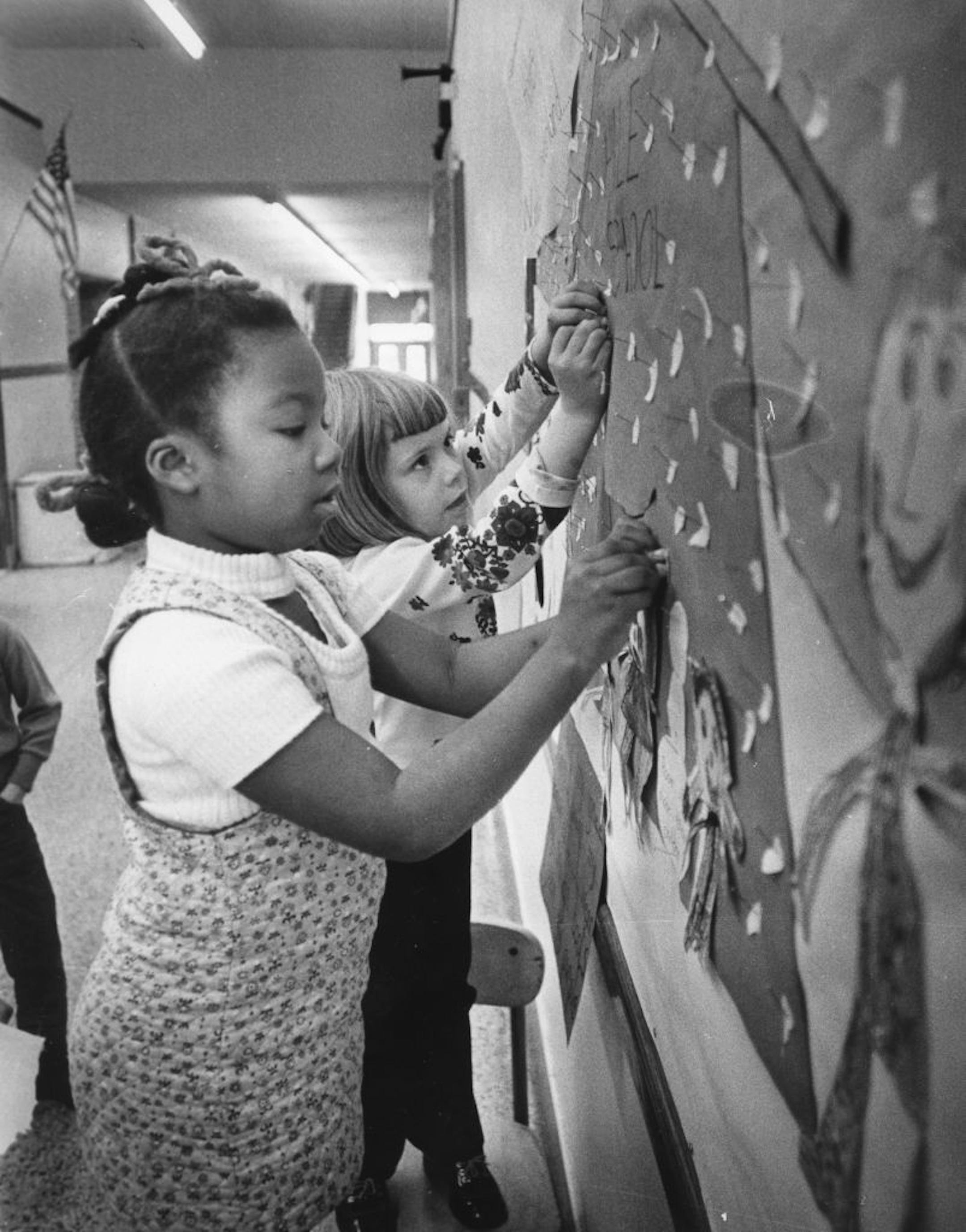
Hale School had one black family before desegregation in 1971 paired it with heavily black Field School. Hale pupils Ann Mingo, 7, left, and Meg Lawson, 6, arranged a bulletin board in December 1971.
Hale School had one Black family before desegregation in 1971 paired it with Field School, which was heavily Black. Hale pupils Ann Mingo, 7, left, and Meg Lawson, 6, arranged a bulletin board in December 1971. (Powell Krueger/The Minnesota Star Tribune)
Advertisement

Derek Francis, a longtime counselor who has worked in Minneapolis public schools, wants local children to know that the diversity they witness in their schools today results from a complex journey.

“I have a daughter and she’s 6 years old and I’ve been enjoying reading with her so much,” said Francis, who now works at BrightWorks Professional Development, a group that provides educational services and programs to more than 50 Twin Cities school districts. “And so it kind of just clicked around what it would look like for children in schools to learn about this history, especially because I didn’t get that chance to learn growing up.”

Francis is not only the author of “Our First Bus Ride,” a new children’s book that details the groundbreaking desegregation effort known as Hale-Field Pairing that involved two elementary schools in south Minneapolis in 1971. He is also the producer of a documentary, “Separate Not Equal: Minnesota’s Integration Story.”

The Hale-Field program was met with hostility by many white parents who didn’t want their children to attend school with nonwhite kids or to acknowledge the inequities segregated schools had created. (More than 57% of Field students were Black and more than 98% of Hale students were white before the pairing.)

Both the book and the documentary discuss the new reality Molly Johnson, who is white, and Monica Lash, who is Black, experienced when the pairing happened. Hale was designated as a K-3 school, and Field had students in fourth through sixth grades.

The two women were friends before the pairing, but the new program changed both of their lives.

“I think the first indication that there was something different was there were reporters at the bus stop and they had the big camera,” Johnson said in the documentary about the first day of school in 1971. “And that was different.”

For Lash, moving into a formerly predominately white school showed her the stark differences in resources distributed to schools in Minneapolis.

Advertisement

“The classrooms were a lot bigger,” Lash said in the film. “It feels like they had tons and tons and tons of books like everyplace. I remember sitting on the floor on this carpet, this nice carpet. The bathrooms were huge. I think they had way more stalls than they had at Field. It was just the overall experience that this building was way different.”

The concept of Minnesota Nice often demands a reimagining or masking of the past. It’s a different perspective from the one I understood as the son of a father who was raised in the Jim Crow South. In the South, the Brown v. Board of Education ruling in favor of integration of schools was fought with violence and intimidation, as local officials and residents tried to hold onto racist values to preserve segregation. There are movies, books, courses and exhibits around the country about the fight for school desegregation in that part of the country. I wish there were more about the battles that occurred here, too.

In Jeanette Booker vs. Special School District No. 1, Minneapolis, Minnesota, a 1972 federal case, the NAACP sued the city over segregated schools, citing its history of redlining and housing discrimination as the foundation of a school system that did not equally serve Black and white students.

The NAACP alleged ”a continuous and intensifying pattern of segregation in the schools of the City of Minneapolis.” Here’s the kicker: the city didn’t deny it.

“Defendant admits that the schools of the City of Minneapolis are segregated,” the judge’s ruling states. “However, it is the District’s contention that segregation has been caused by factors over which it neither had nor has control.”

The judge in the case ruled against the city and stated that Minneapolis’ blatant segregation was “intentional.”

Advertisement

This did not happen in 1924 or even 1954. It happened, right here, in the 1970s. That means there are people alive today who had parents that fought to keep their children out of integrated schools. That means there are folks still alive today who were definitively against the idea of children of all backgrounds securing an equitable education. It also means that there were advocates who fought in favor of the Black families and students seeking the same opportunities as their white peers.

“Yes, we were not exempt here in Minnesota from segregation,” Francis said.

In recent months, tens of thousands of Minnesotans marched, raised money, delivered meals, protested and yelled as loud as they could for our immigrant communities. That’s only part of the mission, though.

Because true integration isn’t about numbers or percentages. True integration is about relationships and opportunities. Laws and standards do not guarantee either. We can stand next to one another and also remain so far apart. It happened here. It is still happening here in a local school system full of inequities for people of color.

“We’ve heard what can happen in a more inclusive school environment. What does that look like for you in your world?” Francis says in his film. “I challenge you to make a difference in your classroom and your community so that people of all backgrounds feel welcome and included.”

about the writer

about the writer

Myron Medcalf

Columnist

Myron Medcalf is a local columnist for the Minnesota Star Tribune and recipient of the 2022 Society of Professional Journalists Sigma Delta Chi Award for general column writing.

See Moreicon

More from Culture

See More
Star Tribune file
Hale School had one black family before desegregation in 1971 paired it with heavily black Field School. Hale pupils Ann Mingo, 7, left, and Meg Lawson, 6, arranged a bulletin board in December 1971.
Powell Krueger/The Minnesota Star Tribune

A new children’s book tells the story of a bold 1971 experiment to desegregate Minneapolis schools despite fierce resistance.

Richard Egarr
Advertisement