
May I suggest that someone’s going to drop the ball?

As in an entire athletic program? It’s been done before when the college-sports-as-a-business/academic balance got out of whack, as it is now.

May 11, 2024 at 11:00PM
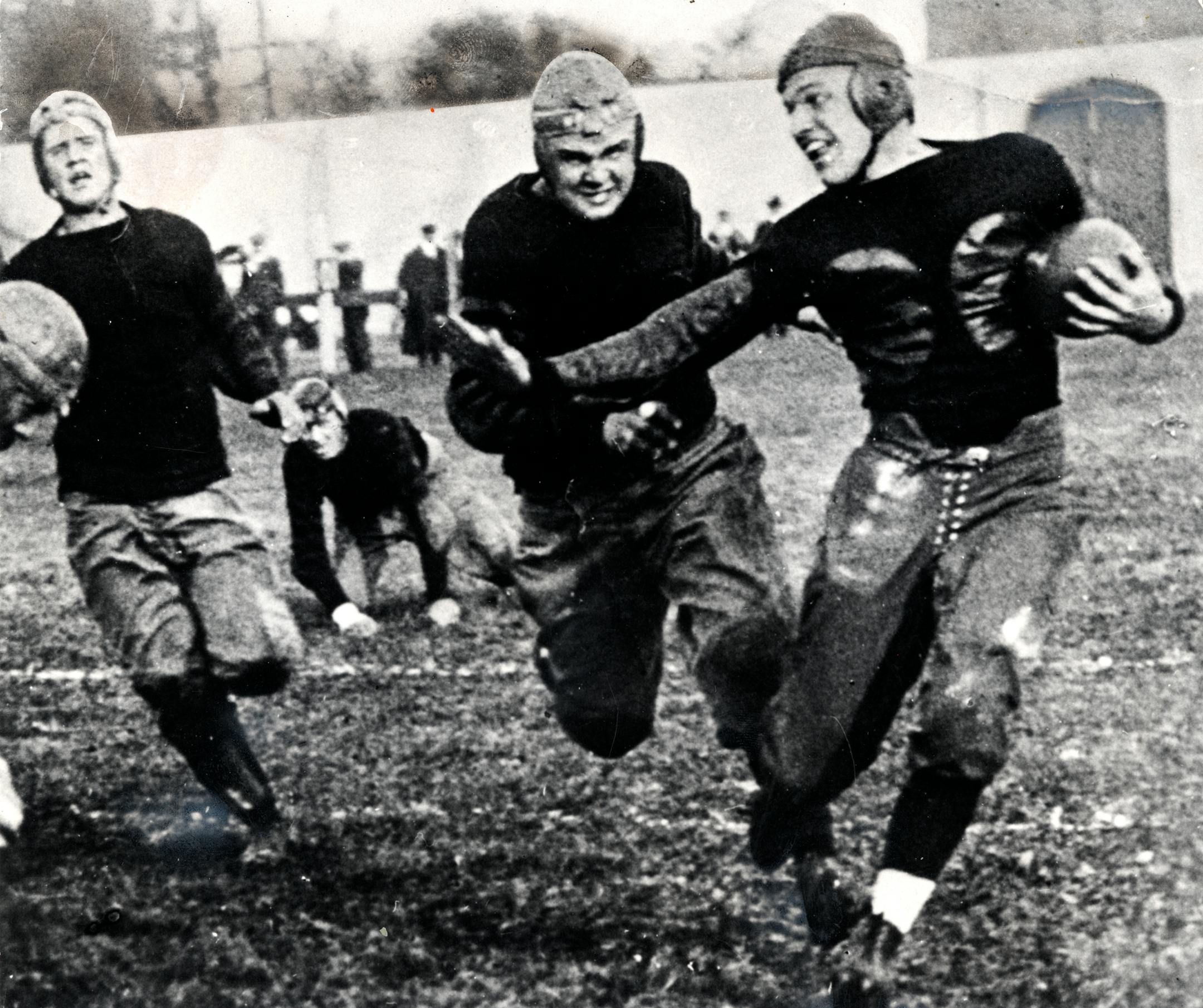
When the University of Chicago decided to get out of the business of intercollegiate football, the university's president, Robert Hutchins said: “Football has the same relation to education that bullfighting has to agriculture.” Above, University of Chicago archival football photos. (The Minnesota Star Tribune)

Opinion editor’s note: Star Tribune Opinion publishes a mix of national and local commentaries online and in print each day. To contribute, click here.

•••

Which institution of higher learning in America will become the University of Chicago of the 21st century? We don’t know yet. But there will be one, especially since the number of potential candidates must come close to equaling the number of division one schools. Surely, the University of Minnesota could be among them.

First: In what, you ask? Hint: The race in question concerns sports. Sports? Hmm … maybe it will be the first school to ax any number of varsity sports in the name of assuring a full roster of players for the one varsity sport that reigns over all the others. No, a number of schools have already done just that, including the U, my own alma mater. But we are getting warmer.

This sports-related issue has much to do with football and basketball, but it increasingly has next to nothing to do with education. This brings us back to the University of Chicago, which in 1936 produced the first Heisman trophy winner and first-ever NFL draftee in Jay Berwanger only to drop intercollegiate football soon after.

The university had also been the first school to pay its football coach more than it paid its president. In other words, intercollegiate football was a big deal at the University of Chicago when it decided to get out of the business of intercollegiate football.

The chief decider was its presumably underpaid president, Robert Hutchins, who had assumed the presidency in 1930 at the age of 30. His reasoning? “Football has the same relation to education that bullfighting has to agriculture.”

Yes, even then college football was coming to be regarded as a business of sorts. And today? It’s big business. Just ask any number of our multimillion-dollar coaches.

Of course, it’s not big business on the order of John D. Rockefeller, whose money created the University of Chicago in the first place. Rockefeller’s oil-refining business model was designed to drive potential competitors out of business.

This is clearly not the model for college football. This big business needs competitors, most of which could be otherwise defined as patsies. How else to better ensure getting to that no longer lofty status of becoming “bowl eligible?”

To be sure, there are bowls (Quick Lane) and there are bowls (Rose). Just as there are conferences (the Pac-12 or what’s left of it) and there are conferences (the Big Ten and the SEC, each of which is now on the verge of mushrooming well beyond both regional and unwieldy proportions). And yet they all have a role to play in the modern business model of big-time intercollegiate sport. At least for the time being they do.

But for how long? The wild west of college football that the NCAA was created to tame has returned. In 1906 the NCAA came into being at the urging and maneuvering of President Theodore Roosevelt, whose goal was to save the game. Injuries were rampant. Players were literally dying. And what were then called “tramp athletes” were forever on the move from school to school.

Progressive president that he was, Roosevelt sought to create order out of chaos, including football chaos, both on and off the field. And he did — especially when it came to football. With the NCAA in place, an NCAA-imposed order reigned supreme for decades. But no more.

Thanks to the innocuously named “transfer portal,” the “tramp athlete” has returned. But no tramps need apply. These vagabonds are full-bore entrepreneurs. And why not? If coaches can bail on their contracts (while dipping into their ample bank accounts to satisfy buyout provisions), why shouldn’t players be able to move from school to school without sitting out a year, but with a better NIL (name-image-likeness) arrangement stuffed in a different jersey?

NIL contracts for alleged amateurs? Why not? A case can be made that an athletic scholarship is valuable in and of itself. But another case can be made that these amateurs are being exploited, given the size of the economic pie that is big-time college football.

In one respect the current version of football chaos makes sense — at least money-wise. Television deals are gravy trains. Coaches are well beyond being well-paid. Patsies take home big bucks for being patsies. And now players can finally get a piece of the action as well.

But the irony of it all cannot be ignored. The NCAA that came into existence to create order is now an NCAA that is presiding over a great deal of disorder. The chaos that Roosevelt once tamed has returned.

Schools, including the University of Minnesota, are wrestling over what to do. Should booster clubs be dishing out NIL directly or should they funnel this money through the school? Or maybe, just maybe, it’s time to get completely out of this entire business.

And for a number of reasons. To borrow from Gophers coach P.J. Fleck, some schools will become nothing more than perpetual “triple A” feeder schools for the perpetual winners. Fan interest will decline. The gap between money demands and educational purpose will widen. And eventually a few college presidents will come to their senses.

In sum, the NCAA may be presiding over a Rockefeller-style business after all, as the really big-time programs indirectly — and inadvertently — begin to drive their “competitors” out of business.

What’s also the case is that the term “student athlete” is at best inaccurate and at worst a fiction. Once upon a time college football was organized and run by and for students, who truly were student athletes. Maybe it’s time to return to that by starting all over. Let students run student-focused sports on campus. Then let’s begin divorce proceedings between big-time sport and our universities, starting with football — and, while we’re at it, basketball.

Higher education in America is currently under fire on many fronts for many good reasons. Therefore, it’s high time that we get back to the basics on many fronts within these institutions. Big-time sport is surely one of those fronts.

Still, such action will take courage, which is a rare commodity among college presidents these days. But once this ball starts rolling these divorce proceedings could take on a life of their own, resulting in an evolution toward European-style club sports instead of college-driven sport.

As far as football is concerned, these clubs could then become the main feeders for the NFL. Or the NFL could create — and pay for — its own triple-A farm system. Or another band of football-crazed billionaires could create a brand-new league. Remember the original AFL? Competition can be a good thing, even if a Rockefeller or an NFL owner might disagree.

Such a scenario could leave the SEC sitting there all by itself — with perhaps the likes of Ohio State and Michigan on the outside looking in. Here’s the solution to that. Let them all play each other on a round-robin basis throughout the fall. Head to head, maybe even twice, but that’s it. No patsies to play — or pay — along the way or in between.

John C. (Chuck) Chalberg writes from Bloomington and performs as Theodore Roosevelt.

about the writer

about the writer

John C. (Chuck) Chalberg

More from Commentaries

See More
card image
Richard Tsong-Taatarii/The Minnesota Star Tribune

If you are approaching the holidays with an ache in your heart, remember that love continues to shape life, even in loss.

card image
card image