

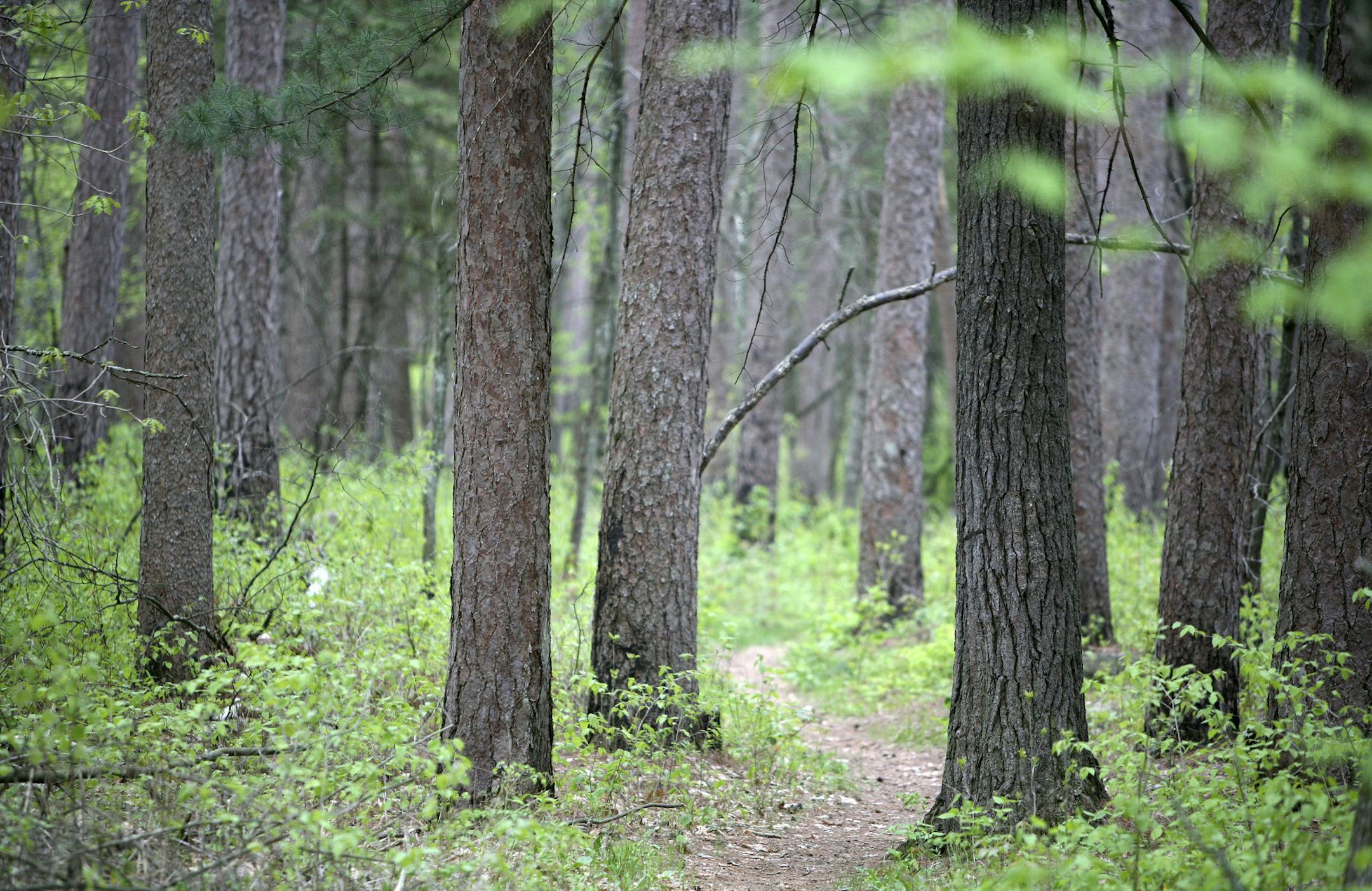
Six degrees below zero, as warm as it's going to get on an afternoon in early February. But the customary payoff for an arctic air mass is in place — an area of high pressure bestowing radiant sunshine, glittering snow, a galaxy of sparkles, and a sky so achingly blue it seems solid, an azure crown on a frosted conifer forest in northeastern Minnesota.
The cross-country skis elicit a soft rasp from a crystalline trail, and the rhythm of the poles is a reverie of motion, both less and more than each swinging stroke, as much paddle as spear, affirming that snow is sculpted water and blurring again — at least in my mind — the difference between ski and canoe. Feel the flow.
The trail is vaulted by pine limbs and bordered by 80- to 100-year-old trunks, or so seems the average age. But amid this wood of relative youngsters are a few grandmothers that overtop the general canopy. One is rooted next to the trail and here I often pause to offer my respect. She's about 90 feet tall and 3 feet in diameter at the base, a magnificent white pine.
Two hundred years old? Two hundred fifty? Maybe more. I frequently reach out to touch the furrowed bark. Sometimes I speak a word of greeting. I don't imagine my reverence impresses the tree or registers with the universe, but it's gladdening for me, a comforting ritual. Why not be respectful and courteous? Why not acknowledge such a presence?
It seems the least we can do, because the fact is we cannot live without snatching the lives of other beings and converting them into matter and energy for our own bodies. We are what we kill.
Our survival and proliferation depend upon the death of plants and other animals. It cannot be avoided. We all know this. If questioned, we readily admit it, and likely with a metaphorical shrug. So what? Is what it is.
I submit there is an important difference between understanding the fact and thinking about the fact — between purchasing the dead or doing the killing, and "going to the funeral," as it were.
When a human being you know dies, why do you attend the wake or funeral? Some or all of these reasons likely apply: respect, remembrance, duty, grief, socialization, ritual, curiosity. Increasingly, the term funeral is being superseded by "celebration of life," which for the following point is appropriate: when we eat, don clothing, shelter in our residences, feed our companion animals, or perform myriad other daily actions, they are only possible because of deaths, and ideally we should celebrate that reality. Celebrate in the sense of "honor or praise publicly." We might consider the Endangered Species Act, for example, as such a celebration, and as an expression of duty and respect.


