

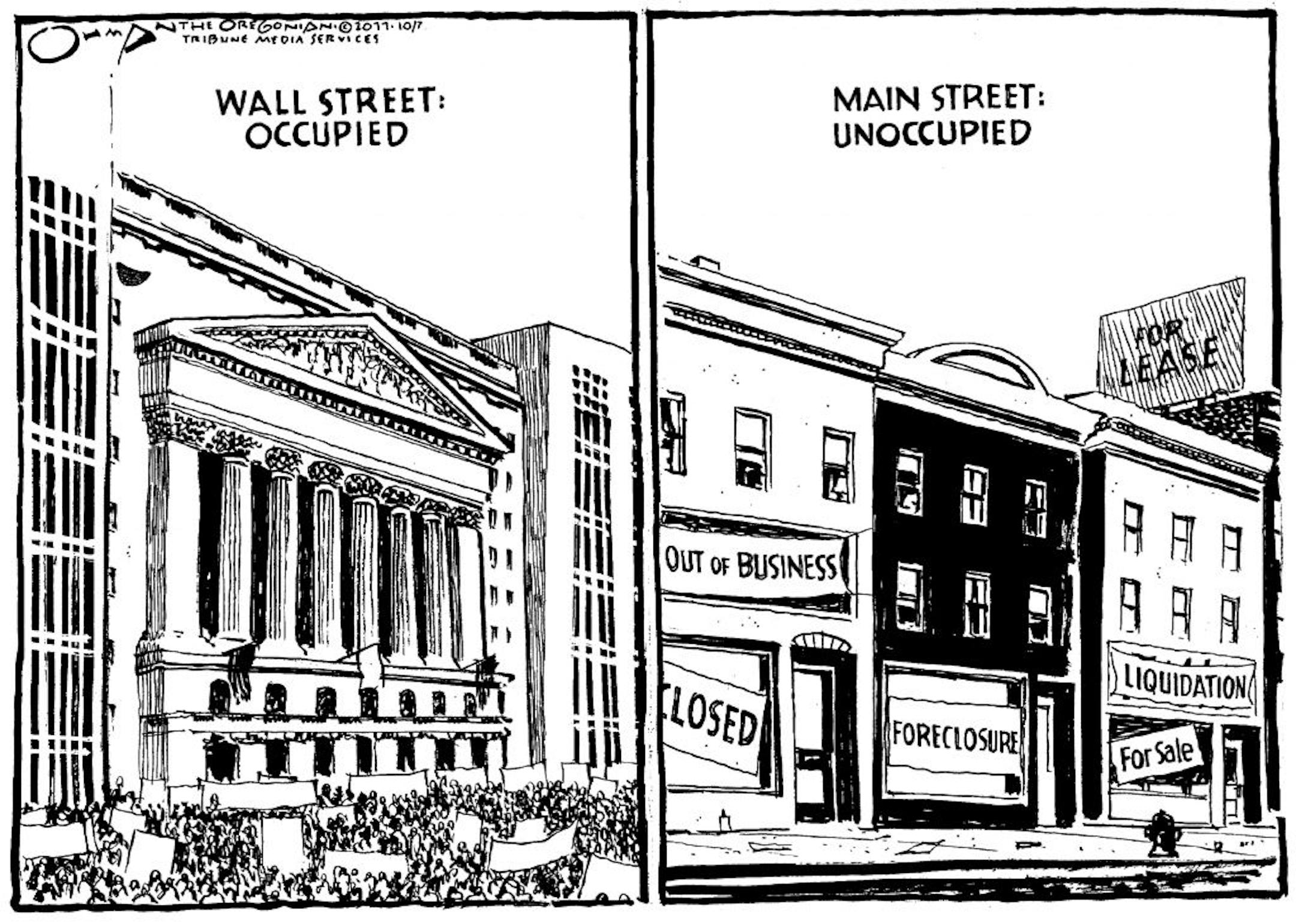
In an hour on the Hennepin County Government Center plaza with the OccupyMN protestors on Friday evening, and in another hour midday Sunday, I heard repeated calls by one or more of the protesters for: a good education for all; forgiveness of huge student loans when graduates can't even find a job; jobs for all; health care for all; single-payer health insurance; clean energy and energy independence; forgiveness of mortgage indebtedness for those underwater; equal justice for offenses by those in high places; gun control, and control of borers they believe are attacking Minneapolis maple trees -- to list a few causes.Apart from being called a "mob" by expected antagonists like Eric Cantor, the protesters have been criticized by many who are mostly friendly to them for lacking a cohesive message. Indeed, a friend who is an actual great American, Tom Sen Gupta, owner of the Schneider Drugstore in Prospect Park, a community catalyst for all people of goodwill, suggested the young protesters could use some advice in framing their message from some of their elders who had been down the protest path before.
Tom may be wrong this time.
On Sunday when he, my wife, Betts, and I left a "general assembly" being held on what one of the protestors described as a "grassy knoll" on the south side of the Government Center, the group had tasked itself to work toward its own cohesive message. Whatever the formal outcome of that endeavor, I believe these young people have more ability to state their message than some of us give them credit for. Their specific complaints make clear their shared belief that our democracy is not working as it should.
The overarching request that emerges from the specifics is that America be made to work for the "99 percent" who are the not wealthiest "1 percent" of us. For this to happen, they know that the 99 percent must find a way to limit the extraordinary control that the "1 percent" has over the rest of us.
Instead, the strength of countervailing institutions has steadily eroded. Over decades, the wealthy have been winning their class warfare against the middle class and growing underclass. Unions, often the only effective counterweight individual workers have in dealing with powerful employers, have steadily shrunk in size and influence before the unremitting assault on them. Globalism, in the form of supernational corporations -- which may ultimately benefit us in the long term, if controlled by us through our government -- is ruinous to many Americans who need a job right now.
It is small comfort that President Obama's jobs guru, Jeffrey Immelt, CEO of General Electric, which earned more than $14 billion entirely untaxed by America last year, was offered a platform on "60 Minutes" at the same time OccupyMN was on the knoll, to expound on his "job creation" remedies: cutting corporate tax rates and allowing free repatriation of overseas earnings, apparently without limit. This at a time when our corporations continue to sit on vast profits, in no small measure due to help from the rest of us by our tax dollars.
We still have a democracy of "one person, one vote" that occasionally succeeds in rejecting candidates of great wealth and interests of great power -- but only occasionally. A law school classmate of mine, Dick Goodwin, told the Los Angles Times as far back as 1997 that "the principal in Washington is no longer the government or the people it represents. It is the Money Power."
That money power brought our country the worst recession since the Depression. And the money power grows ever stronger under a U.S. Supreme Court that accorded corporations "free speech" in the form of unlimited contributions to forward their interests.


