

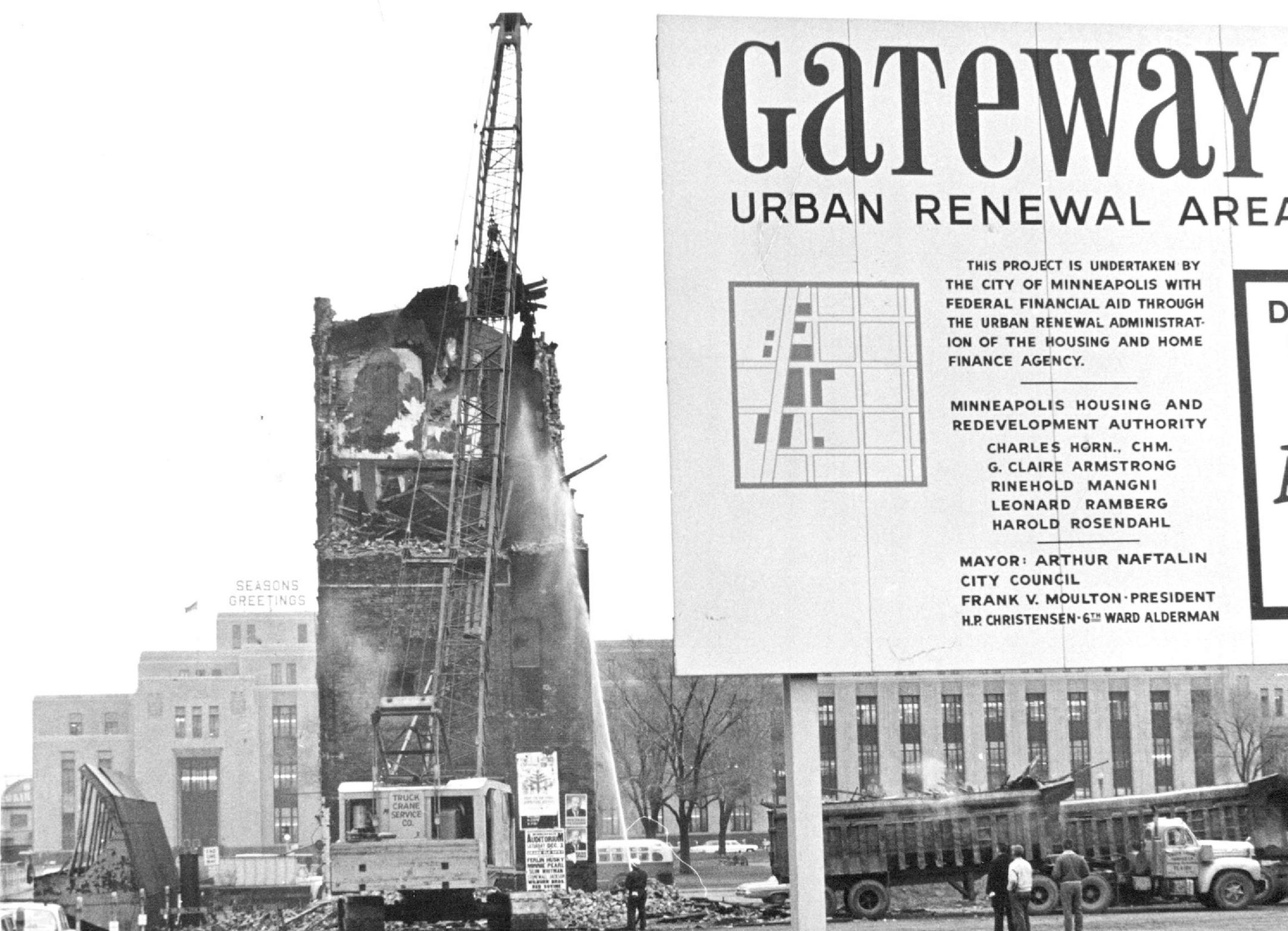
I had my memory jogged by "Letting the Gateway Go" (Nov 25).
In the late 1950s, while attending the University of Minnesota, I was a driver for the Medicine Lake Bus Company — lovingly referred to by its customers as "the Rocket."
This was the era of "downtown shopping," before the advent of the "Dales." One night a week, stores like Dayton's, Donaldson's and Powers stayed open until 9 p.m. I would make a wide sweep of what is now the Plymouth area, picking up shoppers and delivering them to Seventh and Nicollet.
I then parked my bus down near Second Street and Second Avenue, next to the Gateway Park, where I waited for the stores to close so I could return the shoppers home.
During the winter months I would allow several of the Gateway Park patrons on the warm bus while I waited. In today's culture, one might think that was a foolish decision, but I never felt threatened. Everyone was appreciative and well behaved.
The Gateway area in the late 1950s was at the nadir of its existence, and many of the people populating it were viewed to be as "down and out" as the district itself. On Saturdays I drove a one-hour circular bus schedule from the Medicine Lake area downtown and back, ending at the Mission Farm. I delivered many riders from the Gateway to the Farm during my brief career.
The Gateway was to many a major example of urban blight. But along with its bars, flophouses and pawn shops, if memory serves, it also housed several clothing stores. After a bit of bargaining, a young man of limited means could be measured, fitted and sold a good-quality suit or sport coat at a very reasonable price.
I'm not sure I could identify the area that replaced the Gateway, which remains only in memory. Like so much of our architectural history, it has been razed and replaced with little regard for or interest in those who were touched in some way by its existence.


