

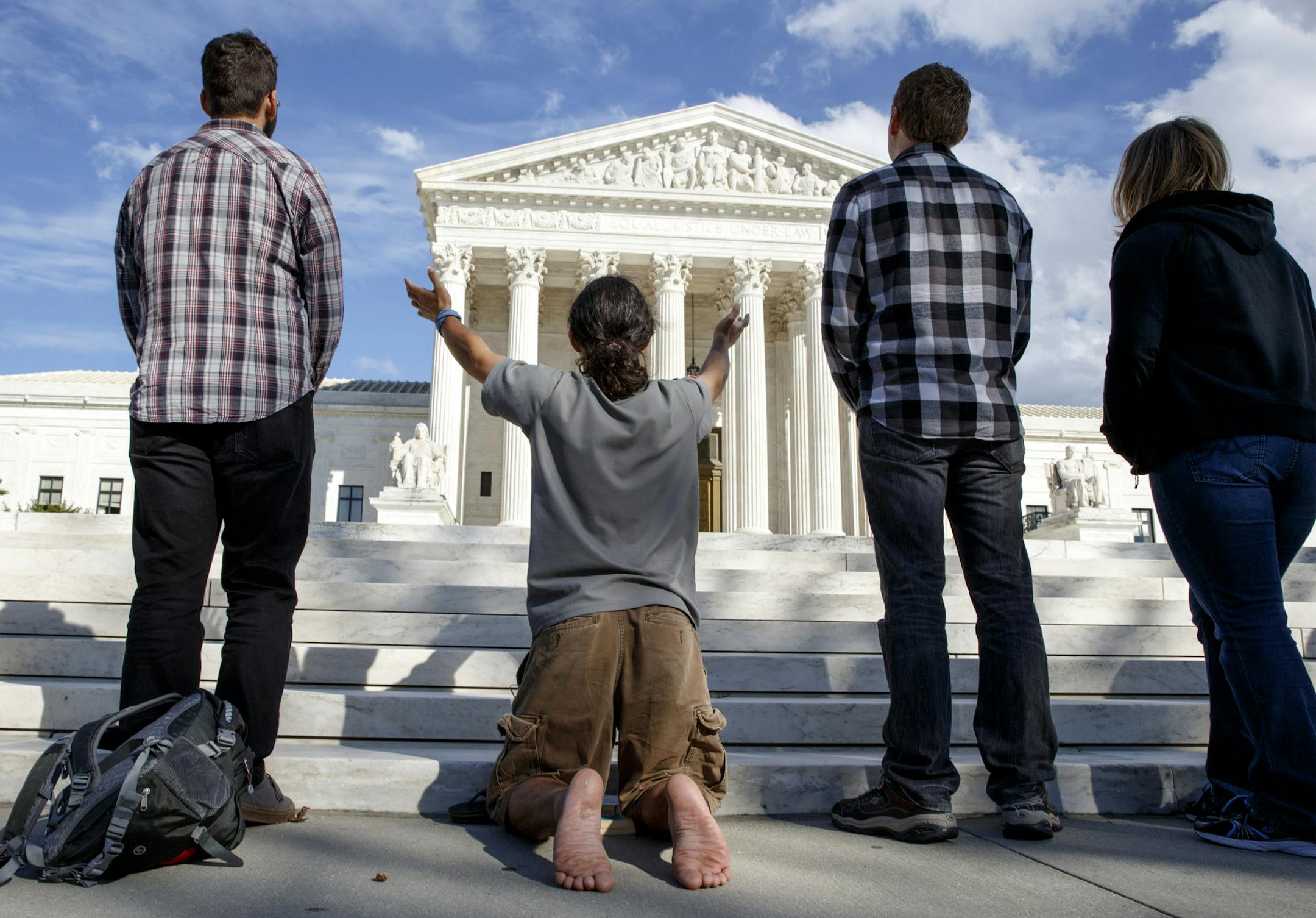
The Supreme Court's ruling in favor of gay marriage was a landmark in the expansion of rights, power and moral legitimacy to a previously marginalized group. For now, social conservatives are despondent. But the logic of expanding rights may contain the seeds of conservative victory in another significant cause: banning abortion.
The expansion of rights has largely been a liberal project. Indeed, part of being a liberal — arguably the most important part — is the ceaseless effort to expand civic, economic and political space for human dignity. That's the process by which abolition, women's suffrage, civil rights, immigrant rights and gay rights extended power from propertied white men out to a wider world.
That process appears to have no end. A successful course for transgender rights seems almost certain in the future. There is even a compelling case that legal polygamy won't be far over the horizon.
The continuing recognition and empowerment of previously marginalized groups may ultimately create tension in liberal support for abortion rights. Indeed, support for abortion rights and liberalism could diverge. Polls show voters self-identifying as "liberal" more often than in the past. The liberal upswing is on vivid display in public support for gay marriage; the trend line looks like a bubbly stock market — up, up, up.
Meanwhile, in a bull market for liberals, support for legal abortion basically hasn't budged. Moreover, unlike the sharp generational differences on display with gay marriage or legal marijuana, both of which generate overwhelming support among millennials, generational differences on abortion are modest. In a Pew Research Center poll earlier this year, 52 percent of baby boomers said that abortion should be legal in all or most cases. Among millennials, support wasn't much different — 56 percent. Right now, the future of abortion rights looks no more robust than the present.
The expansion of rights to vulnerable groups poses an interesting quandary. Fetuses don't have legal rights, but they continue to be afforded varying degrees of moral rights. Among liberals, the view that a fetus is a "blob of protoplasm" with no inherent value has largely been eclipsed. Instead, we hear calls for abortion to be "safe, legal and rare," which implicitly qualifies abortion as a kind of lesser evil (otherwise, why should it be "rare?").
The libertarian impulse in American culture is strong, and rights such as same-sex marriage reinforce that impulse, rather than conflict with it. Still, it's not difficult to imagine how public perceptions could evolve as the circle of rights and dignity expands. In conservative regions, abortions are getting significantly more difficult to obtain as political leaders protect the moral rights of the fetus at the expense of women's constitutional right to access legal abortion.
Such conservatives could one day have company. Animals are not human, and they lack a fetus's linear potential to become human. Yet people can be sentenced to jail for animal cruelty. The animal-rights movement wants far more robust protections than that, of course, and may ultimately convince a majority of fellow citizens that much of what we have long taken for granted, including a meat diet, amounts to barbarism. At what point does living human potential, in the form of a first- trimester fetus, muscle in on the dignity and legal protection afforded other living things?


