

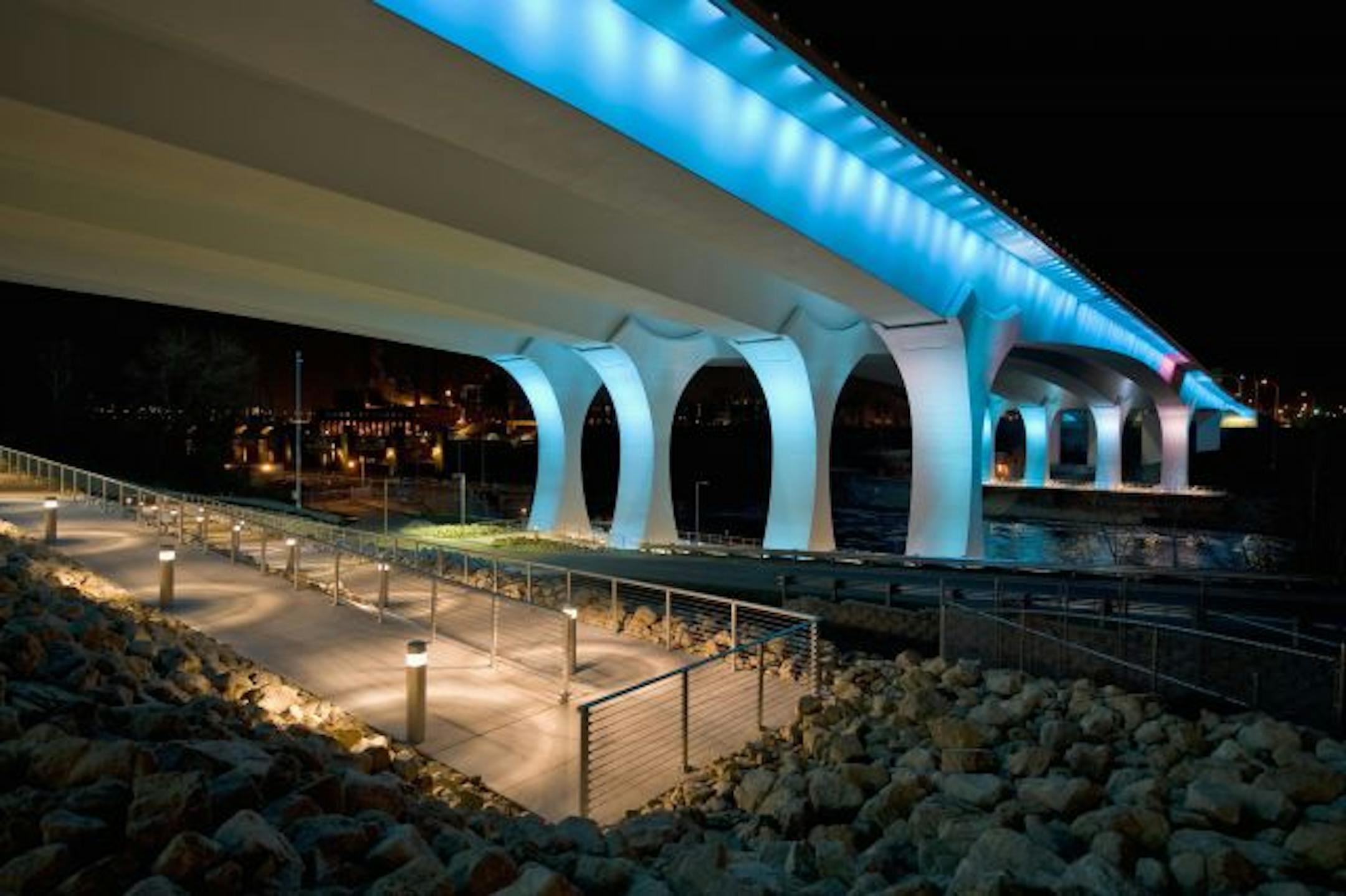
Nighttime commuters driving over the reconstructed Interstate 35W bridge may notice a bluish glow coming from the ten pairs of street lights lighting their way. Mounted 40 feet above the traffic, the lights are not bulbs but rows of LEDs, or light-emitting diodes -- similar to those found in stoplights and laser pointers.
"This is the first interstate highway to be lit with LED lighting," said Kevin Orth, director of sales for Wisconsin-based BetaLED, which makes the lights. LEDs are coming to the streets of Eden Prairie, where officials are replacing the city's old street lights, and already illuminate the parking lot of a Cub Foods store in St. Paul's Phalen neighborhood, which last month became the second certified energy-efficient supermarket in the country.
For large projects like these, the long-run savings in energy and maintenance, as well as the environmental concerns, generally outweigh the short-run costs.
This growing use of LEDs by government and industry marks a move away from traditional incandescent bulbs and, more recently, the more-efficient fluorescent lights that have come on the market. Although LEDs cost more to manufacture than other lighting options, they consume a small fraction of the energy of even fluorescent bulbs and last 25 to 30 years.
Lighting still accounts for as much as 20 percent of electricity used around the world, so improving lighting technology by even a little bit can lead to great savings in energy and reductions in greenhouse gases.
New lighting standards
On June 29, President Obama unveiled new, stricter lighting standards to accompany the phasing out of incandescent bulbs (which already are banned in parts of Europe) and to provide $50 million in funding for the development of "solid-state lighting" technologies such as LEDs.
"We could save 50 percent of the energy that is currently being used for lighting by switching to LEDs," said Fred Schubert, an electrical engineer at Rensselaer Polytechnic Institute in Troy, N.Y.



