

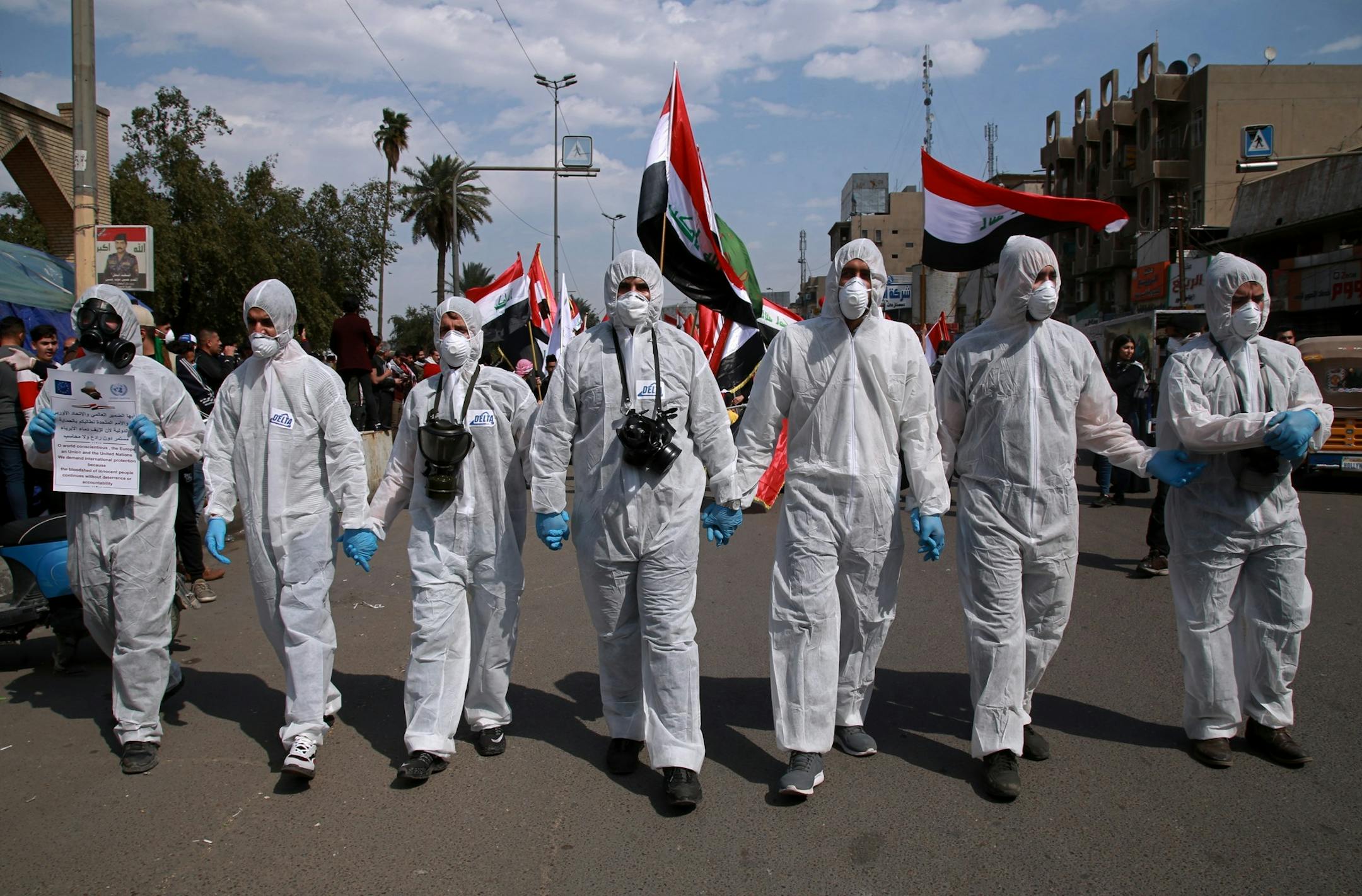
Will the coronavirus crisis do for the Second Arab Spring what the forces of counterrevolution did for the first? Last Friday was the first since October that the public squares of the Middle East and North Africa were quiet.
In Iraq, the antigovernment protests that have wracked the country for nearly six months were called off last week, when organizers bowed to the inevitable consequence of the pandemic. The Iraqis were only a few days behind the Algerian popular movement, known as Hirak, that ended a yearlong streak of Friday protests on March 20. In Lebanon, the virus scare seems to have shut down the anticorruption demonstrations that had previously resisted intimidation from Hezbollah thugs.
The Second Arab Spring was having a good run when the epidemic struck. In Algeria and Sudan, popular protests brought down longtime dictators Abdelaziz Bouteflika and Omar al-Bashir. In Iraq they forced the resignation of one prime minister, Adel Abdul-Mahdi, and headed his successor-designate, Mohammed Tawfik Allawi, off at the pass. Lebanese Prime Minister Saad Hariri was forced to quit, and his replacement, Hassan Diab, was looking shaky within days of taking over.
All this was achieved with comparatively little bloodletting. Attacks on Iraqi protesters left 700 dead, and a bloody crackdown killed more than 100 Sudanese participating in a sit-in; but unlike the cases of Libya, Syria and Yemen, none of the countries that witnessed political upheaval last year descended into civil war.
And yet, in Baghdad, Algiers, Khartoum and Beirut, the sense lingers of a job left unfinished. The political systems in all four countries remain largely intact, in the hands of the elites that enabled the misrule protesters were hoping to end.
That is why Hirak had continued with its Friday demonstrations long after Bouteflika was gone, and a dubious election brought to power one of his former ministers, Abdelmadjid Tebboune. Until last week, Iraqis were keeping up pressure on Mahdi, who is no more effective as a caretaker than he was as a prime minister. The precariousness of Sudanese politics was underlined last week, when Prime Minister Abdalla Hamdok survived an assassination attempt.
As they hunker down to wait out the epidemic, the protesters can't help but worry that the changes they were able to extract from the political elites might yet be undone — that the coronavirus crisis will be used as a cover to restore the old status quo.
In Iraq, for instance, the absence of protests may allow the latest prime minister-designate, Adnan al-Zurfi, to secure the job, even though he has the same failings that made Allawi unacceptable to the protesters: membership in the corrupt establishment and dual nationality. Lebanon's Diab now has breathing room in which to try and wrangle a bailout from the International Monetary Fund. And there are fears Sudan's generals will renege on their power-sharing deal with the civilian opposition.


