
Kashkari: Wells Fargo accounts scandal was just 'bad management'

Leadership, not bank size, was issue, Mpls. chief says.

October 13, 2016 at 3:28PM
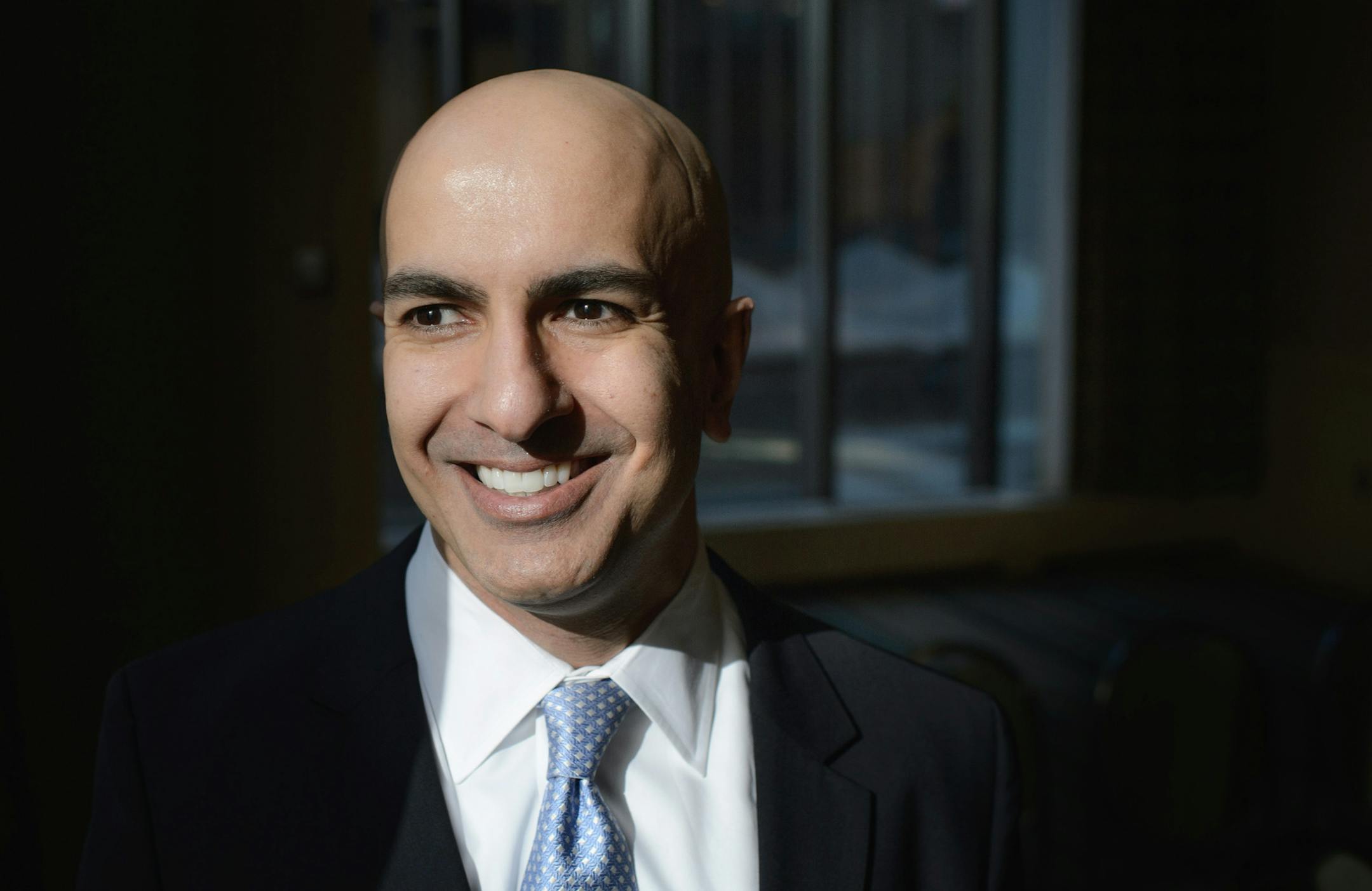
At the Federal Bank building in Minneapolis where a banking symposium on reforms and ending "too big to fail" took place, Minneapolis Fed Bank president Neel Kashkari addressed the audience.] Richard Tsong-Taatarii/rtsong-taatarii@startribune.com ORG XMIT: MIN1604041709030003
Minneapolis Fed Bank President Neel Kashkari (The Minnesota Star Tribune)

The Federal Reserve system's top crusader against banks that are too big to fail doesn't think the latest Wells Fargo scandal is a case of a company that's too large to manage.

"This is just bad management, all the way up to the top, making the wrong decisions when they had this in front of them," Neel Kashkari, president of the Federal Reserve Bank of Minneapolis, said in a town hall discussion at Bethel University.

In his role as leader of the Minneapolis Fed — which oversees banks in six states, but not San Francisco-based Wells Fargo — Kashkari said he worries about problems and mistakes that are buried in the organization, things he might not know about.

But Wells Fargo's mistakes were not hidden from the company's leaders, he said. They have known that employees were creating accounts without customers' knowledge — the bank admitted at least 2 million customer accounts may have been unauthorized — since at least 2011.

"Guess what? The CEO and the board of directors of Wells Fargo were aware of this for four years," Kashkari said. "So this is not an example of too big to manage. This is an example of managers making wrong decisions."

Wells Fargo, meanwhile, is looking for ways to move past the scandal. Some 500 executives at the bank joined a conference call with CEO John Stumpf and other leaders Monday, according to the Wall Street Journal, to map out the bank's next steps.

"It's going to be harder for a while, and we get that," Timothy Sloan, chief operating officer, said on the call, according to the report.

Wells Fargo is Minnesota's largest bank by deposits and its roots are in the Twin Cities.
Asked to respond to Kashkari's comments, Dave Kvamme, chief executive of Wells Fargo Minnesota, said in a statement: "We should have reacted more quickly. We own what has happened. We realize our customers and clients deserve better and we'll prove that we can deliver on that."

Kashkari said even though it doesn't apply to Wells Fargo's struggles, the problem of banks being too big to fail, or manage, is something regulators and policymakers should pay attention to, and he hopes the Minneapolis Fed's research — and eventual recommendations — will help.

In February, he launched a yearlong initiative aimed at ending the phenomenon of too-big-to-fail financial institutions, those that are so large their failure could bring down the global economy. The effort, which has been criticized by some in banking, has included four symposiums at the Minneapolis Fed. Kashkari and his staff will announce some recommendations before the end of the year.

Kashkari, a former Treasury Department official who led the bank industry bailout during the 2008 financial crisis, has floated the prospect of breaking up the biggest banks or imposing stricter capital requirements that would force them to shrink.

In a wide-ranging discussion attended by hundreds of students and moderated by Bethel economics professor Tim Essenburg, Kashkari sounded a hopeful note that the Minneapolis Fed's recommendations will make an impact. Essenburg said he was skeptical that Congress or anyone will act on the recommendations.

"Well, I think there's a very high probability people will pay attention," Kashkari said in response. "Whether it leads current regulators to directly change what they're doing, or to new legislation, I don't know. I can't game it out. Sometimes things take a long time before they take a shortcut."

He compared the evolution of views on bank regulation to how perceptions changed on gay marriage, banned by a ballot measure in California in 2008 but is now legal due to a U.S. Supreme Court ruling. He thinks the public antipathy toward banks could similarly lead to sudden change.

"Things take a long time and move very slowly and there's no action, until all[of a] sudden they move, and things change," he said. "If we don't try, then I can guarantee you that it won't change."

Adam Belz • 612-673-4405 Twitter: @adambelz

Minneapolis Fed President Neel Kashkari
Kashkari (Star Tribune/The Minnesota Star Tribune)
Neel Kashkari spoke to the Economic Club of Minnesota on Monday, May 9, 2016, delivering his first speech on monetary policy. His message: Stop obsessing over interest rates. They arenít the most important thing affecting the economy. ] Adam Belz - Star Tribune Minneapolis, MN 5/9/2016
Kashkari (The Minnesota Star Tribune)
about the writer

about the writer

Adam Belz

Reporter

Adam Belz was the agriculture reporter for the Star Tribune.

See Moreicon

More from Business

See More
card image
Provided by Exact Sciences

The late Dr. David Ahlquist co-invented ColoGuard, which is helping drive Abbott Laboratories’ acquisition of Exact Sciences. After an ALS diagnosis in 2019, Ahlquist wasn’t done inventing.

card image
card image