
Tolkkinen: In rural Minnesota, our horse got sick. We couldn’t find a vet to treat him.

Large-animal vets who make house calls are in short supply in greater Minnesota.

Columnist Icon
The Minnesota Star Tribune
January 19, 2026 at 12:03PM
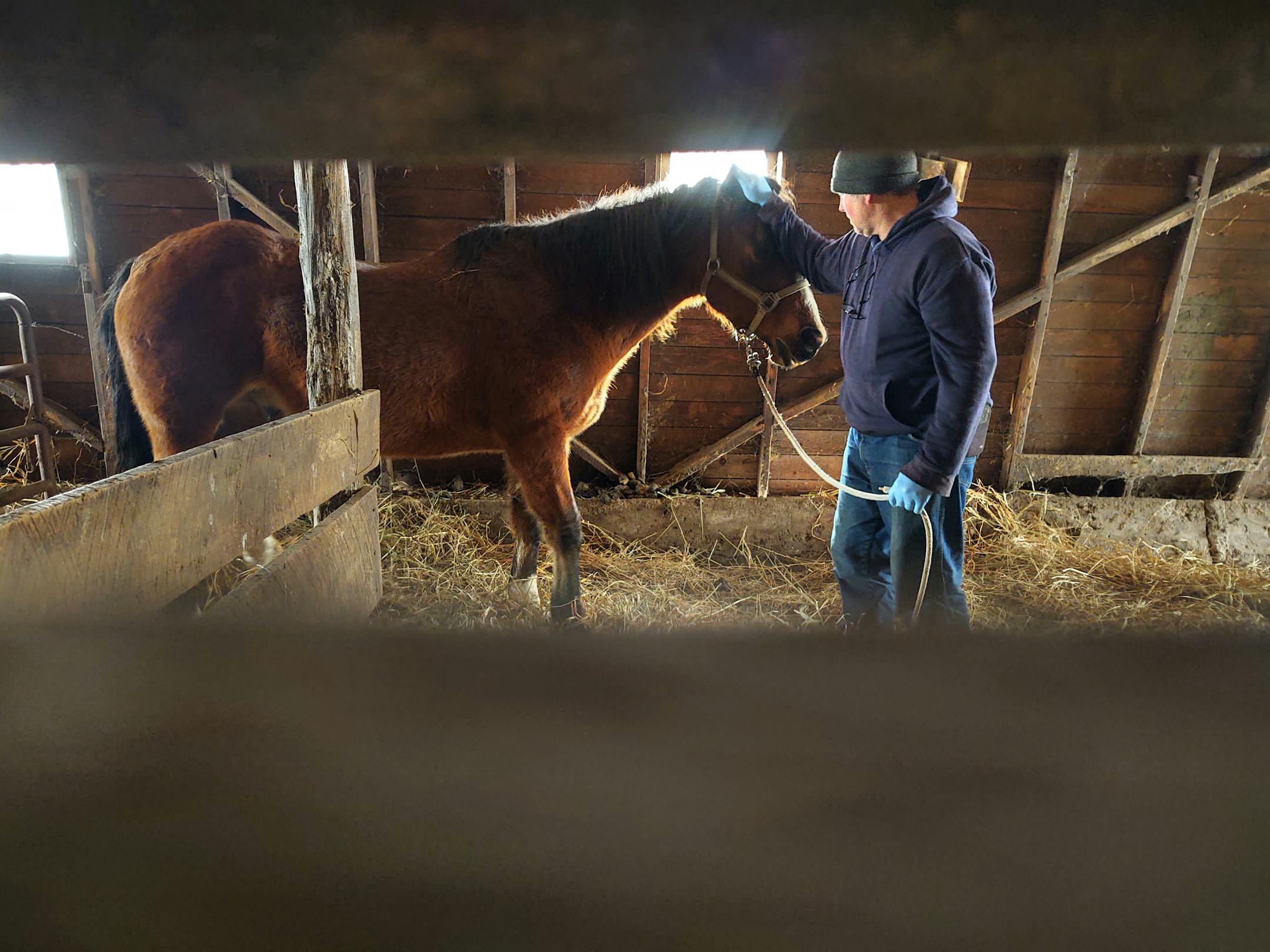
Bud drank but wouldn’t eat. A day later, he felt feverish. It was time to call the vet. (Karen Tolkkinen)

CLITHERALL, MINN. – Our horse, Bud, was upside down in the snow, unable to free himself.

My husband found him in the morning. His side was wet, his legs were in the air, and it was impossible to know how long he’d been like that. Maybe all night.

It wasn’t the first time Bud had been stuck after rolling in dips in the ground. Last year, my husband had rescued him from similar predicaments with the help of ropes and a tractor, or sheer muscle and gravity. And Bud recovered quickly.

This time, after getting up, Bud was sluggish. My husband kept an eye on him, making sure he didn’t roll again, and after a while led him back to the barn. Bud drank, but wouldn’t eat, not even the handful of oats that he would nicker for every morning. A day later, he felt feverish.

It was time to call the vet.

We’d never called the veterinarian for Bud. Even in his mid-20s, he was, well, healthy as a horse, with a shiny coat, ready to dominate any four-legged creature that entered his pasture.

We were in for a surprise. The local clinic, which had once taken care of family beef cattle, didn’t treat horses. They offered some advice and suggested a clinic 65 miles away, but that clinic told us they were booked and couldn’t come out for several days. The Osakis clinic also was closed.

We had run smack dab into an ongoing problem in rural Minnesota: a major shortage of large-animal veterinarians needed to tend cattle herds, dairy cows and horses.

Add it to the list of other shortages facing the countryside. For a whole multitude of reasons, there aren’t enough doctors, dentists or dental hygienists in rural Minnesota, and all these shortages feed on each other along with other factors, said Laura Molgaard, dean of the University of Minnesota’s College of Veterinary Medicine.

It’s hard to get a veterinarian to set up a practice in rural Minnesota. There’s plenty of beauty and outdoor adventures, but practical considerations often take precedence. If they want to start a family, can they give birth nearby or do they have to drive an hour and a half? Can their spouse find work? And how much will they earn? Veterinarians graduate with about $200,000 in student loans, Molgaard said, which often steers them to more lucrative urban settings.

At all levels, people are working to solve the problem, but recent cuts and restrictions to federal and state student loan programs have made the job harder, she said.

“There are no quick fixes to be had,” she said. “If there were, we would have them.”

In rural areas, many horse owners learn to treat their own animals, administering vaccines, cleaning wounds and dosing colic with medications they keep on hand. The problem is that these medications require a prescription. Without a vet visit, we couldn’t get a prescription for Bud.

The Minnesota Board of Animal Health shows 26 vets in our county, which is one of the biggest counties in the state. Ten of them are in their 60s or 70s, and only five are in their 20s or 30s, which tells me the problem will only grow more severe.

And our county isn’t even the most underserved in the state. Every year, the state designates regions with the most critical shortages of large-animal vets, specifically those who dedicate a significant amount of their time working with so-called “food animals” – primarily beef cattle, dairy cows and hogs.

This year, those areas are Pipestone and Murray counties in southwestern Minnesota, Goodhue and Wabasha in the southeast, and Koochiching near the Canadian border. Veterinarians willing to work in these areas can get up to $75,000 of their student loans forgiven.

Koochiching County is where you might run into Donovan Taylor, who became a licensed veterinarian in 2023. Taylor is building his business from scratch and drives his truck through a wide swath from Cook to Baudette, treating small and large animals. He said he could make a lot more money practicing in an urban area, but he gets to live close to where he grew up. He also likes that the varied, challenging work has helped him to grow in his veterinary knowledge.

“It’s one of those things where I’d rather be broke and happy than to be rich and, you know, not confident in myself,” he said.

As Bud suffered in the barn, I ran an errand to Battle Lake. There I discovered that one of the school employees also has had trouble finding an equine veterinarian to come out and had once cleaned and bandaged a gash on her horse’s leg herself. She gave me the names of two possible clinics, and I called both while sitting in the school parking lot.

No luck. One was closed for the day and I left a message for the other. There’s this hollow feeling you get when you don’t know what’s wrong with an animal and you don’t know how to help.

Back at home, I discovered that any veterinary care would have been too late anyway.

Bud had already died.

He lay on the straw in the barn, his great body stilled. My husband and I stood looking down at him. How could it be that this spirited, gorgeous being could die so quickly? Burdock was still tangling his forelock, and his eyes were still partly open. I knelt and touched his face. In life, he wouldn’t let me touch him there. Now I stroked his head, telling him goodbye.

My husband buried him on our farm, in the pasture where he had spent most of his life.

Bud wasn’t a riding horse. Years ago, he’d thrown my husband and destroyed the saddle, and we never had much time to work with him. So he roamed the pasture, accompanied mostly by cattle or other horses. He was the last of the large animals on our farm.

And will we get others?

I’d like to, but without the guarantee of a vet who can make emergency calls, I don’t know that I ever would. I just don’t think it would be fair to the horse.

about the writer

about the writer

Karen Tolkkinen

Columnist

Karen Tolkkinen is a columnist for the Minnesota Star Tribune, focused on the issues and people of greater Minnesota.

See Moreicon