

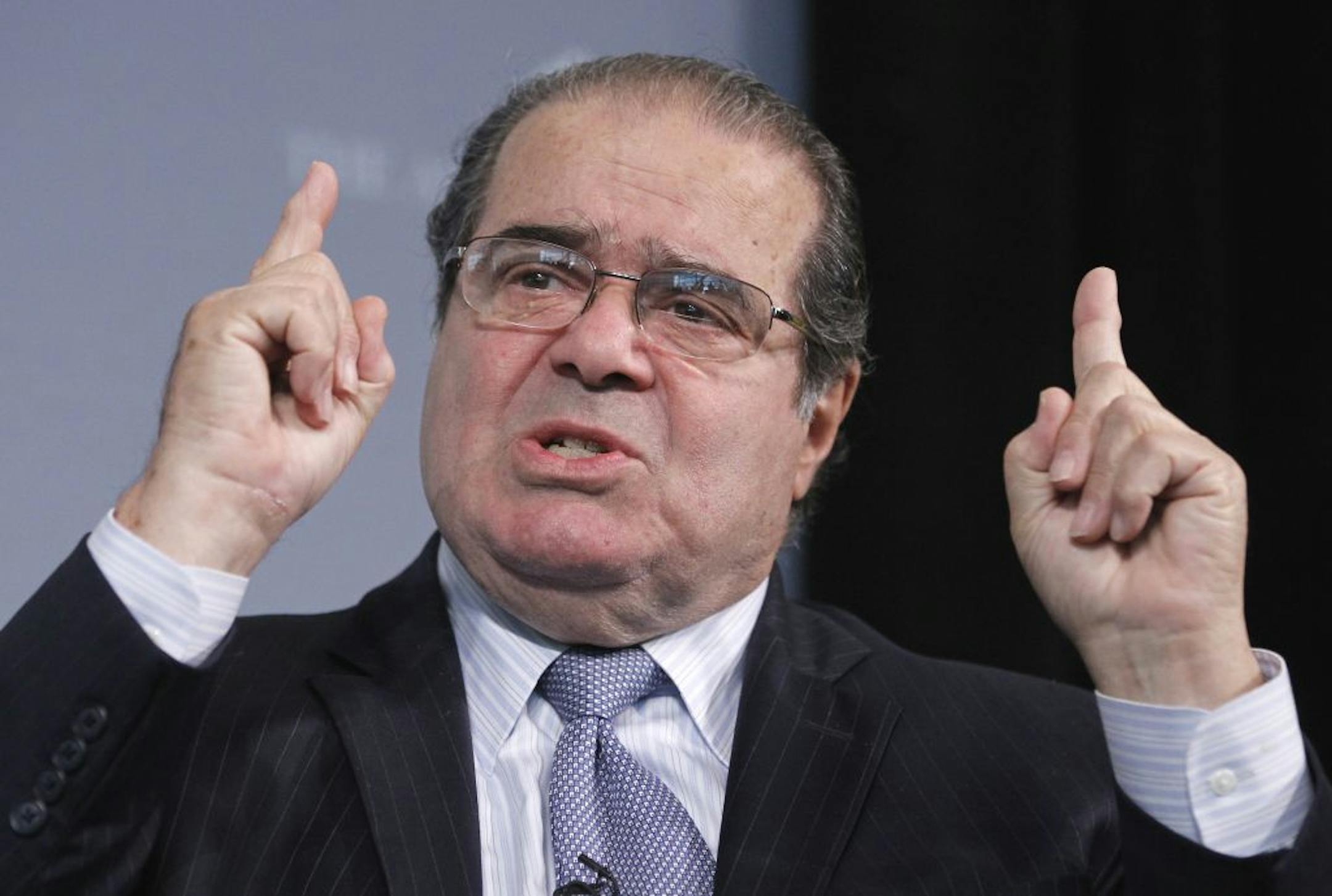
Justice Antonin Scalia calls a key component of the Voting Rights Act at the heart of fierce legal and political skirmishing a "perpetuation of racial entitlement."
But I like law professor Justin Levitt's analogy better. He blogged Tuesday that the law's provision requiring states like Texas to get federal permission for voting rule changes is like a pair of sweatpants.
The law as originally passed in 1965 to tackle blatant racial discrimination might fit baggy today, but it comes with a drawstring to accommodate how covered jurisdictions have changed their ways. Rather than acting like a fashion critic and second-guessing Congress' decision to reauthorize the law in 2006, Levitt argued, the Supreme Court should just decide whether the sweats still fit.
And if Congress wants a change of clothes, it has the constitutional power to make one.
There was no such simplicity to the imagery during Wednesday's arguments in an Alabama case that could yield a Voting Rights Act ruling for the history books.
Justice Stephen Breyer tried, likening illegal discrimination against voters to a plant disease that's gotten better but has not been eradicated.
Using this analogy, Section 5 critics would call the cure worse than the disease.
Section 5 requires nine states — Texas, Alabama, Alaska, Arizona, Georgia, Louisiana, Mississippi, South Carolina and Virginia — and a number of cities and counties in other states to run voting changes by the Justice Department or a federal court for approval. Those changes can be as simple as moving a polling place and as complicated as a redistricting plan.


