
NBA veteran Julius Randle finds an inner peace in his routine with Timberwolves

While recovering from an injury last season, he made great advances in taking care of his mental health and has found a new attitude.

The Minnesota Star Tribune
January 10, 2026 at 5:48AM
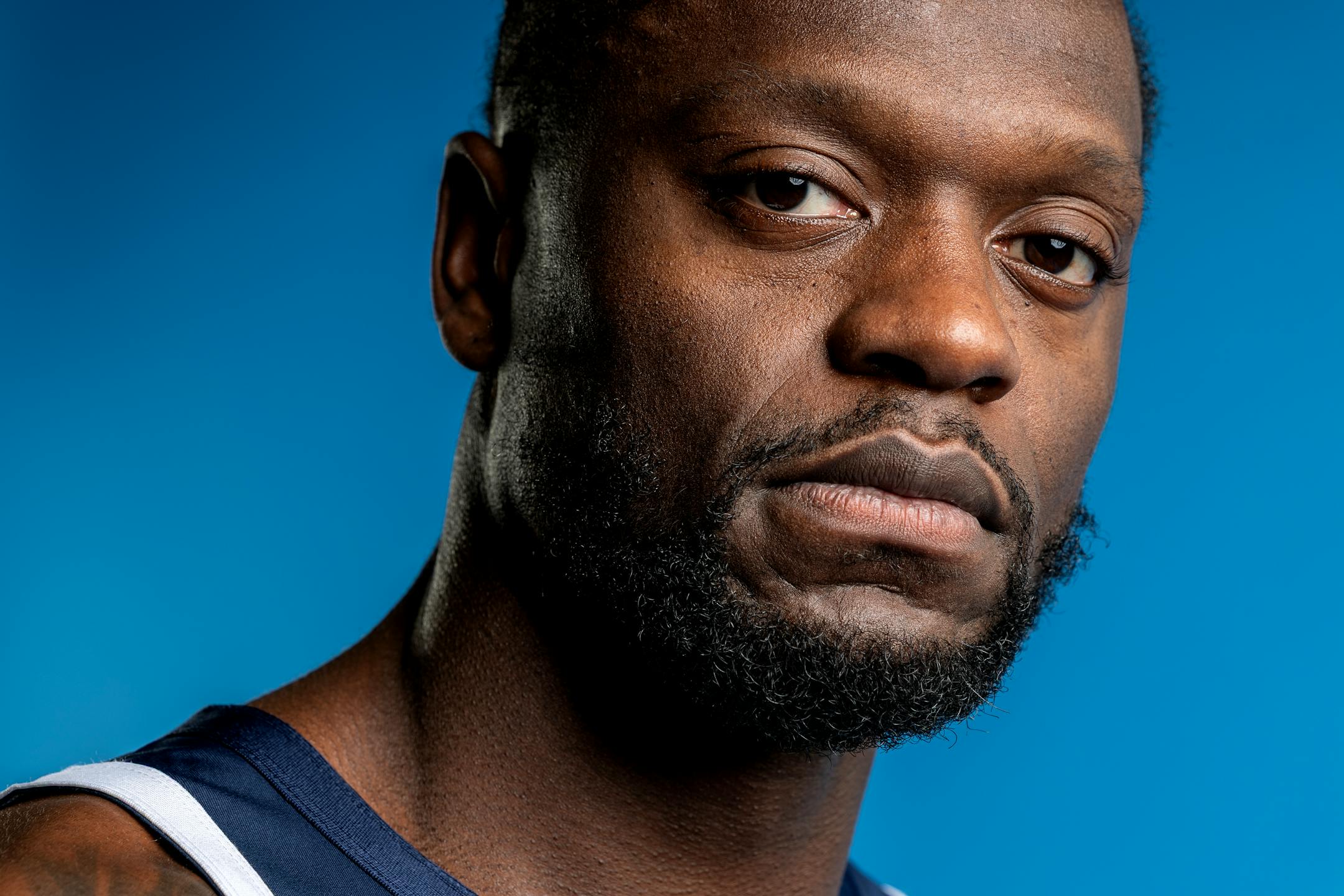
Julius Randle photographed on Timberwolves media day at Target Center on Sept. 29, 2025. (Carlos Gonzalez/The Minnesota Star Tribune)

Julius Randle’s life wasn’t where he wanted it to be.

Late in the summer of 2024, Randle didn’t feel like himself. Then his world was turned upside down when he was packaged off to the Timberwolves in a trade that sent Karl-Anthony Towns to the Knicks.

And now he was moving his family halfway across the country to play for a new team.

More than a year after that uncertainty, Randle can sit back with a smile and proclaim that coming to the Timberwolves has been “the best thing that’s happened to me in my career.”

He enjoys a lot about his new home, specifically the food scene. The basketball fit, after some initial awkwardness last season, has been a good one.

But Minnesota is also where Randle has done the work to improve his mental health.

“I just wake up every day extremely happy, man,” Randle said. “There’s really no price on that.”

Calm before the storm

Before a game in New Orleans in early December, Randle arrived at Smoothie King Center four hours before a 7 p.m. tipoff.

ADVERTISEMENT

For more than an hour, he went through some work to start warming up his body for the night. He arrives 90 minutes before most of his teammates, something he started last season while recovering from a groin injury; he’s never deviated from it.

“Understanding what I felt like I needed to do to get myself ready for a game – get my body feeling right, my mind and all that stuff … [three hours] was the number,” Randle said.

Around 4:15, Randle took the floor for his pregame workout. This used to happen closer to 5:45, but that’s also a time when fans are filing into the arena watching you, and teammates and opponents want to share a quick word.

View post on X

Not at 4:15. The arena is empty.

“Being there early, before anybody gets there, being in a quiet arena — it just mentally felt like I was prepared and I was in the game before it even started,” Randle said. “I didn’t realize that part of it will have a bigger effect than the actual physical part.”

Randle went through a 20-minute workout with Wolves sports physical therapist Lisa Pataky and assistant Chris Hines. They were vibing to some Chaka Khan music Pelicans players were blasting at the other end.

When Randle was done, teammate Anthony Edwards came on the floor, threw some Lil Baby music on a nearby speaker, and Randle sat off to the side, sweating but smiling. Nobody was around him. For those few moments, Randle could just be with himself.

“It’s one of the coolest, most peaceful things that you can do,” he said of those early workouts. “... You hear the way the ball bounces. You hear the way it goes through the nets. You hear just the crisp — like every single thing. It’s like you’re in tune and becoming one with the arena and everything before you even out there.

“So it’s weird out loud saying it, but it is a connection with the game.”

Getting his mind and emotions in tune is something that has taken the 12-year veteran almost his entire NBA career to figure out.

To hear him tell it, only since coming to Minnesota has Randle asked himself some hard questions, dug in with the help of therapy to turn around his mindset and his life. The Randle you can see at that workout, with the smile through the sweat beads, that took more than a decade to happen. And it took some initial discomfort in Minnesota before finally finding his place.

“Every year of my career it took a lot of work,” Randle said. “... Like, if I act this way, or if I’m moody this way or isolate more, it’s just not good. So I can have a better understanding of myself and triggers, and I can recognize the situation. I recognize the situation to say what’s bothering me, rather than, just kind of being to myself.”

Curing moody blues

At age 31, Randle has acquired self-awareness, a trait not everyone has. That’s important when you’re a player who goes through as many moods as he does – and he will be the first to admit he can be a moody player.

When his playing days over, he doesn’t want to become a coach, “because if I had to deal with me every single day, 15 versions of me every day, I would lose my mind,” he said with a smile.

“It’s just like – moodiness. Man, every single day. It can be a good day, it can be a bad day. I try to keep myself even, but it’s like you’re dealing with so many different personalities and dynamics, and different people have different goals or personal things that they want, and then you got to figure out how to fit all that within a team and keep all of these guys motivated. … It’s a headache that I would never wish on myself.”

View post on Instagram
 

That “headache” for the Wolves falls on the shoulders of coach Chris Finch, who coached Randle as an assistant in New Orleans. There are times when Randle plays well, only for him to be in a down mood after the game, which Finch said can be a “head-scratcher.” But at this point, Finch has been around Randle long enough to know he has to roll with it.

“I mean, mood recognizes mood. I’m a pretty moody guy myself,” Finch said. “I take it as a baseline that all these players are in some level of mood when they come into the building, right? That’s why we’re big advocates of our staff having energy and consistent positive energy every single day.”

Earlier in his career, Randle’s groin injury might have caused him to retreat as he was going through the recovery process.

“I’ve had trouble before,” Randle said. “If I’m hurt, mentally, I just check out, take myself out of it. I was like all right, let me be intentional doing the opposite.”

That’s something that came with maturity and time in the league; the work to get back was part of his therapy mentally, as well. When he came back in March, the Wolves’ season really took off: 17-4 to close the season and two playoff series wins, with Randle playing the best postseason basketball of his career.

That led him to keep those early workout routines at the arena. The peace and the relative solitude of those venues were good for him.

“Mentally checking out and isolating myself — that don’t work for me and that don’t work for my team,” Randle saud. “I had trouble being like, ‘All right, man, I can’t play, so obviously they don’t need me, or they don’t need my leadership or whatever.’ That’s just not the case.”

This season, he’s averaging 22.3 points, 7.2 rebounds and 5.8 assists per game, while shooting 49% from the floor as he’s in contention to play in his fourth NBA All-Star Game.

Support is always there

Randle didn’t get this way all by himself, of course. He credits the “village” around him that helped him get to this point: his wife Kendra, with whom he has three children; and his trainer, Tyler who commutes from Texas. There are those around the team like Pataky and Hines. And Finch has been the right head coach for Randle.

View post on X

The seventh pick in the 2014 draft (by the Lakers out of Kentucky) also credits Dr. Daniel Amen, who Randle has spoken to frequently over the past two seasons. Amen nudged Randle to stop smoking marijuana to help clear his mind.

“He changed my life,” Randle said. “I know people are weird with therapy and stuff, and I’ve always been one that’s, ‘Oh, I’m macho, I don’t need help,’ but everybody’s going through something.

“He was able to give me tools in everyday life to be able to deal with things and better myself. It’s unbelievable, because my relationships from work to personal are just better.”

One of the relationships he said he worked on with Amen’s help was with Finch.

“He’s been way more smiley this year, a lot more conversational,” Finch said. “... I like to think that he’s in an environment that completely embraces him, and we love him, we want him here, and he’s been in some places where that wasn’t the experience, certainly by the end. So certainly you’re going to be guarded against that.”

If Randle ended up anywhere else besides Minnesota, who knows where his career might have taken him?

That’s a side to the NBA that fans can take for granted — how the power of relationships in an organization can affect a player’s trajectory. Randle came to a situation with a front office, staff and team that embraced him, flaws and all. By the end of the season, after Randle came back from that groin injury, he was a different player and person.

“I just was stubborn in my determination to make it work, because I knew he was a really good player,” Finch said. “We had also traded a really good player [in Towns], and I’m like, ‘We owe it to ourselves to try to make this thing work.’

“That’s really what it was. So having worked with him in the past, and understanding what he could do, I think it was only a matter of time till we could figure it out, really.”

A foodie’s place to be

Randle couldn’t have predicted he’d find happiness in Minnesota. A big foodie, Randle has taken to the restaurant scene here in his spare time. What are his favorite spots?

“Gai Noi is a big one for me. Then Baja Haus is like a little Mexican restaurant in Wayzata. It’s not even a big restaurant, but I just love Mexican food, and they have great Mexican food,” Randle said. “Billy Sushi is always good. Everyone loves Red Cow, but I love Red Rabbit. Great food there. … I’ve also tried Colita. They got these cacio e pepe tacos. Incredible.“

New Orleans remains his favorite food city, but he ranks Minneapolis at two or three, he said.

But the most fulfilling basketball situation he’s had? That’s in Minnesota.

“It’s been the best thing that’s happened in my career,” Randle said. “Even last year, when things were up and down, I was struggling, trying to figure it out, like it was the most positive work environment I’ve ever been a part of. Just the people around you, they’re never — like if you have a bad day, everybody has a bad day, but they never hold that over your head.”

Now, he is more cognizant of what those triggers are that might put him in one of his moods. Sometimes Randle is in a talkative mood after games. Sometimes he’s not. The season, for everyone, is an 82-game grind.

“I’m not saying there’s not gonna be bad days,” Randle said, “but I genuinely wake up every single day excited, happy to go to work, happy to come home, play with my kids. A lot of that is just my relationships and my understanding of myself is better.

“I guess I didn’t know this was possible.”

about the writer

about the writer

Chris Hine

Sports reporter

Chris Hine is the Timberwolves reporter at the Minnesota Star Tribune.

See Moreicon

More from Wolves

See More
card image
Carlos Gonzalez/The Minnesota Star Tribune

While recovering from an injury last season, he made great advances in taking care of his mental health and has found a new attitude.

Timberwolves rookie Anthony Edwards
card image