

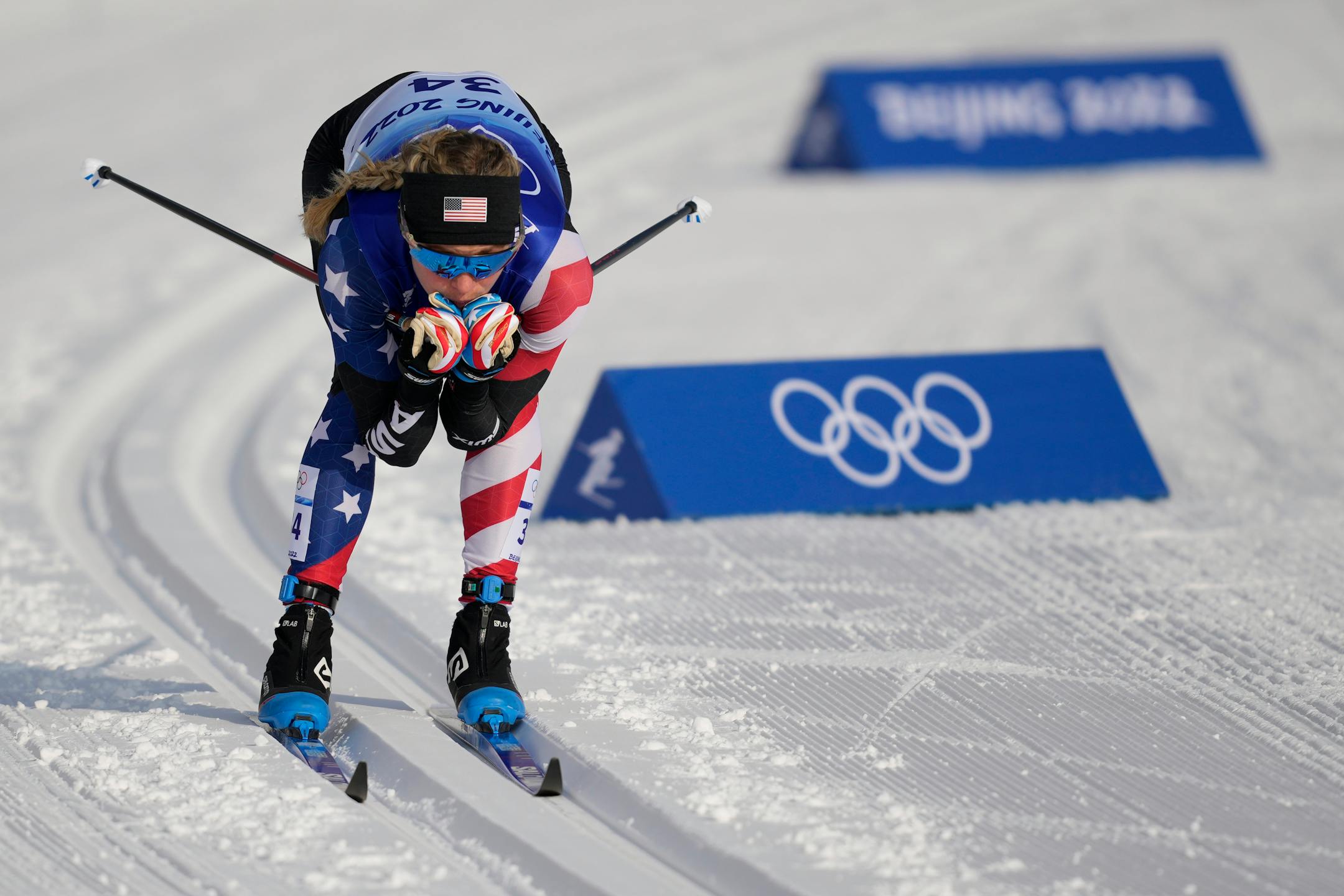
ZHANGJIAKOU, CHINA—Jessie Diggins didn't expect to win a medal Thursday. By her own admission, the 10-kilometer classic is her weakest event.
That was perfectly OK with the Afton native, who actually found it liberating. During her momentary break from the immense pressure of the Beijing Olympics, Diggins dabbed glitter on her teammates' cheeks. She had an emotional rite-of-passage moment with young Novie McCabe, racing for the first time at an Olympic Games.
Though she wasn't among the favorites, Diggins still finished eighth, proving she is in razor-sharp form at the halfway point of her Beijing Games schedule. Norway's Therese Johaug got the victory, winning her second gold of the Games. Finland's Kerttu Niskanen and Krista Parmakoski took silver and bronze.
Diggins now has a bronze medal and two other top-eight finishes in her first three races at Zhangjiakou. Thursday, her goal was to simply savor the racing, and the feeling of competing at her third Winter Games.
"I was really, really happy today,'' said Diggins, who won her bronze Tuesday in the freestyle sprint. "I was just so focused on enjoying it. I was like, 'Great. No pressure. This is just my day to go out there and enjoy racing at the Olympics.' I was just really focused on being in the moment and giving it all I had.''
Diggins led a group of four Americans in the 10km classic. She finished in 29 minutes, 15.1 seconds, a little more than 68 seconds behind Johaug's winning time of 28:06.3. It was a close race for gold, with Niskanen only four-tenths of a second back, and Parmakoski edged Russia's Natalia Nepryaeva by just one-tenth of a second for bronze.
The other U.S. finishers Thursday were Rosie Brennan (13th), McCabe (24th) and Hailey Swirbul (32nd). McCabe, 20, is the youngest member of the U.S. cross-country team in Beijing and made her Olympic debut on another bright, sunny and brisk day in Zhangjiakou.
Before the Olympics, Diggins hoped to start all six women's events at the Winter Games. Her coaches were open to it, but they took a wait-and-see position. They expected the extreme cold would cause athletes to expend even more energy, and they needed to see how Diggins' body recovered from each race.


