

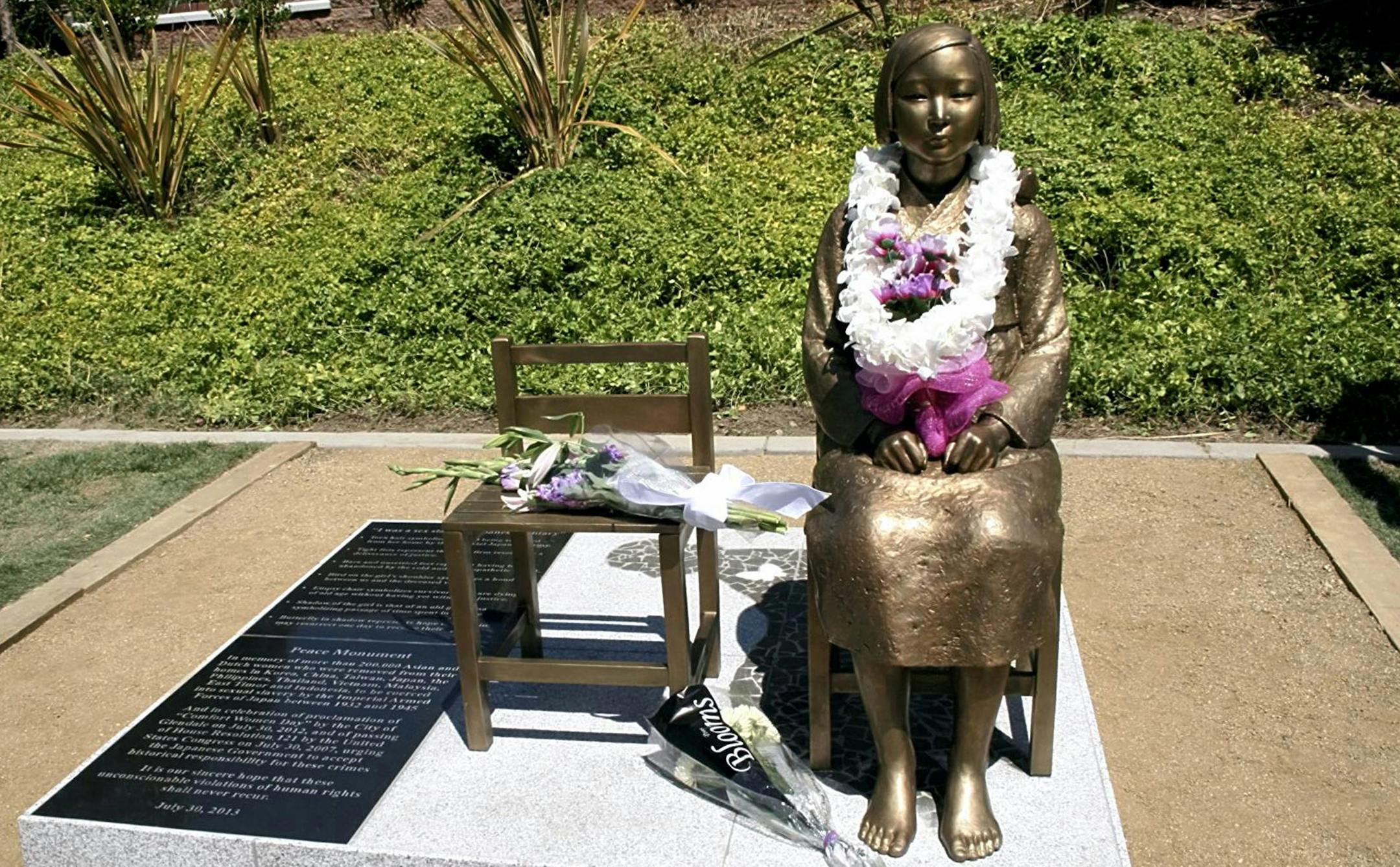
An editorial from the Yomiuri Shimbun that was reprinted on the Opinion Exchange page ("American embrace of 'comfort women' allegations distorts history," Aug. 2) challenged the truth on Imperial Japan's military sexual slavery.
The article was timed to the installation of a statue symbolizing "comfort women" in Glendale, Calif., on July 30, the city having designated that day "Korean Comfort Women Day."
The editorial stated: "[T]he day's origin was July 30, 2007, when the U.S. House of Representatives adopted a resolution [HR121] calling on Japan to apologize over the comfort women issue." It claimed that the distorted and exaggerated phrases "sexual slavery" and "more than 200,000" on the statue's plaque significantly degrade the honor of Japan.
HR121 stated that the government of Japan "should formally acknowledge, apologize, and accept historical responsibility in a clear and unequivocal manner for the Imperial Armed Force's coercion of young women into sexual slavery … during its colonial and wartime occupation of Asia and the Pacific Islands," that this official apology should be given as a public statement presented by the prime minister of Japan, that it "should clearly and publicly refute any claims that the sexual enslavement and trafficking of the 'comfort women' for the Japanese Imperial Armed Forces never occurred," and that it "should educate current and future generations about the horrible crime."
Evidence of Imperial Japan's military sexual slavery has been presented since 1990s. There are many sources:
Since 1993, the Korean Council for Women Drafted for Military Sexual Slavery by Japan has published many books and papers on the issue, using Japanese documents extensively as sources.
In 1995, Yoshimi Yoshiaki, a professor of modern Japanese history of Chuo University in Tokyo, published the book " 'Comfort Women': Sexual Slavery in the Japanese Military during World War II." It details the totality of the military sexual slavery; the involvement of the military police, army elites, the Ministry of War, the Home Ministry, the Governments-General of Korea and of Taiwan, and the participation of police in the rounding up of comfort women.
In 1994, Jan Ruff-O'Herne, a Dutch woman, told her story as a comfort woman in the book "50 Years of Silence." She depicts the first night in Java, Indonesia, in 1944: "The Japanese officer threw me on the bed and tore at my clothes, ripping them off. I lay there naked as he ran his sword slowly up and down, over my body. I could feel the cold steel touching my skin as he moved the sword across my throat and breasts, over my stomach and legs."


