

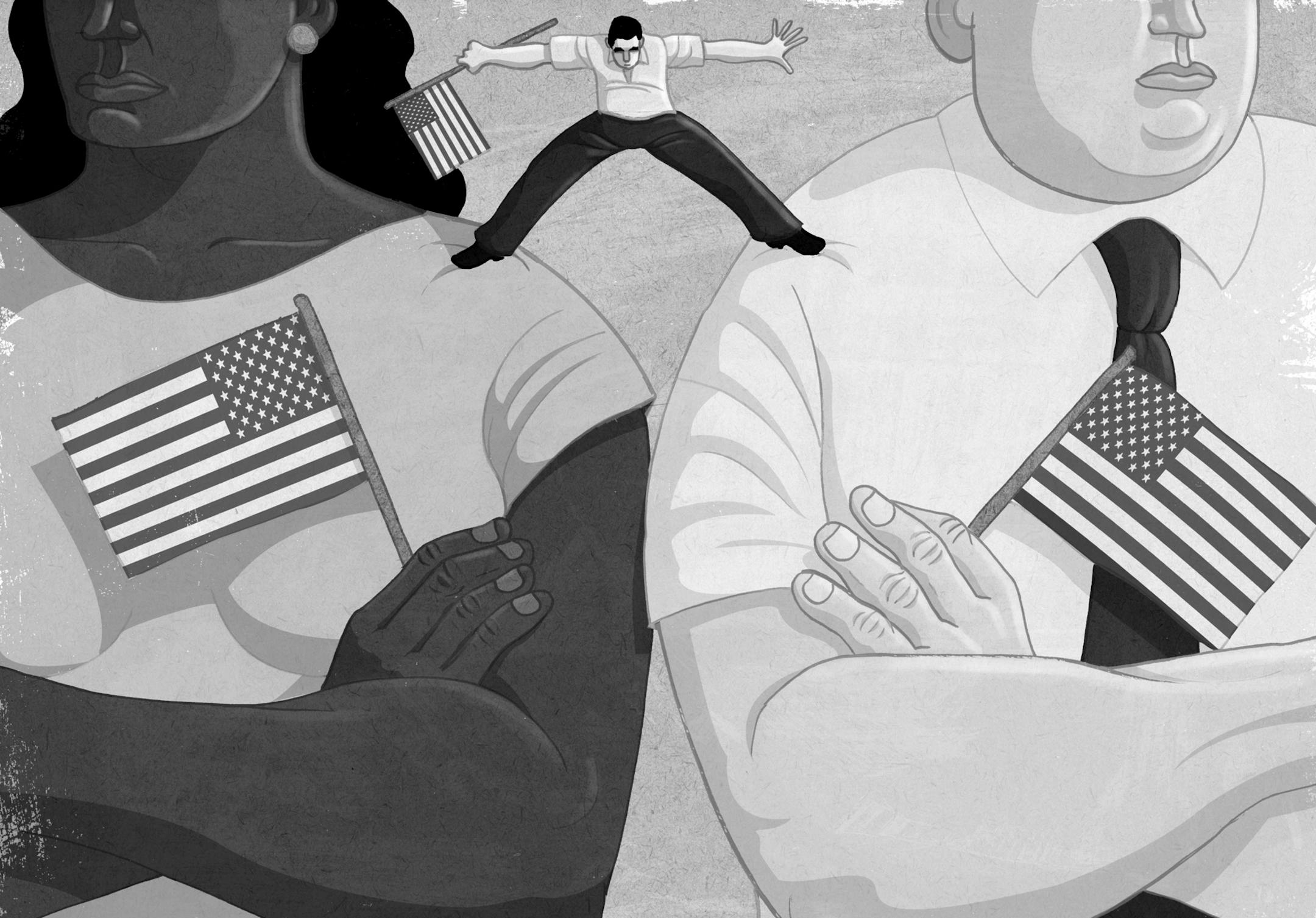
Part of the reason American voters have become more polarized in recent decades is that both sides feel better-informed.
The share of Democrats who had "unfavorable" attitudes about the Republican Party rose from 57 percent in 1994 to 79 percent in 2014, according to a Pew Research Center survey in June called "Political Polarization in the American Public."
Similarly, the percentage of Republicans who had unfavorable feelings about the Democratic Party climbed from 68 percent to 82 percent.
Most of this increase is due to those who have "very unfavorable" views of other party. Among Democrats, 16 percent of Democrats had "very unfavorable" opinions of the Republican Party in 1994, rising to 38 percent by 2014. Among Republicans, 17 percent had a "very unfavorable" view of the Democratic Party in 1994, rising to 43 percent by 2014.
A follow-up poll by Pew in October found that those with more polarized beliefs are more likely to vote. The effort to stir the passions of the ideologically polarized base so that those people turn out to vote explains the tone of many political advertisements.
A common response to this increasing polarization is to call for providing more unbiased facts. But in a phenomenon that psychologists and economists call "confirmation bias," people tend to interpret additional information as additional support for their pre-existing ideas.
One classic study of confirmation bias was published in the Journal of Personality and Social Psychology in 1979 by three Stanford psychologists, Charles G. Lord, Lee Ross and Mark R. Lepper. In that experiment, 151 college undergraduates were surveyed about their beliefs on capital punishment. Everyone was then exposed to two studies, one favoring and one opposing the death penalty. They were also provided details of how these studies were done, along with critiques and rebuttals for each study.
The result of receiving balanced pro-and-con information was not greater intellectual humility — that is, a deeper perception that your own preferred position might have some weaknesses and the other side might have some strengths. Instead, the result was a greater polarization of beliefs. Student subjects on both sides — who had received the same packet of balanced information! — all tended to believe that the information confirmed their previous position.


