

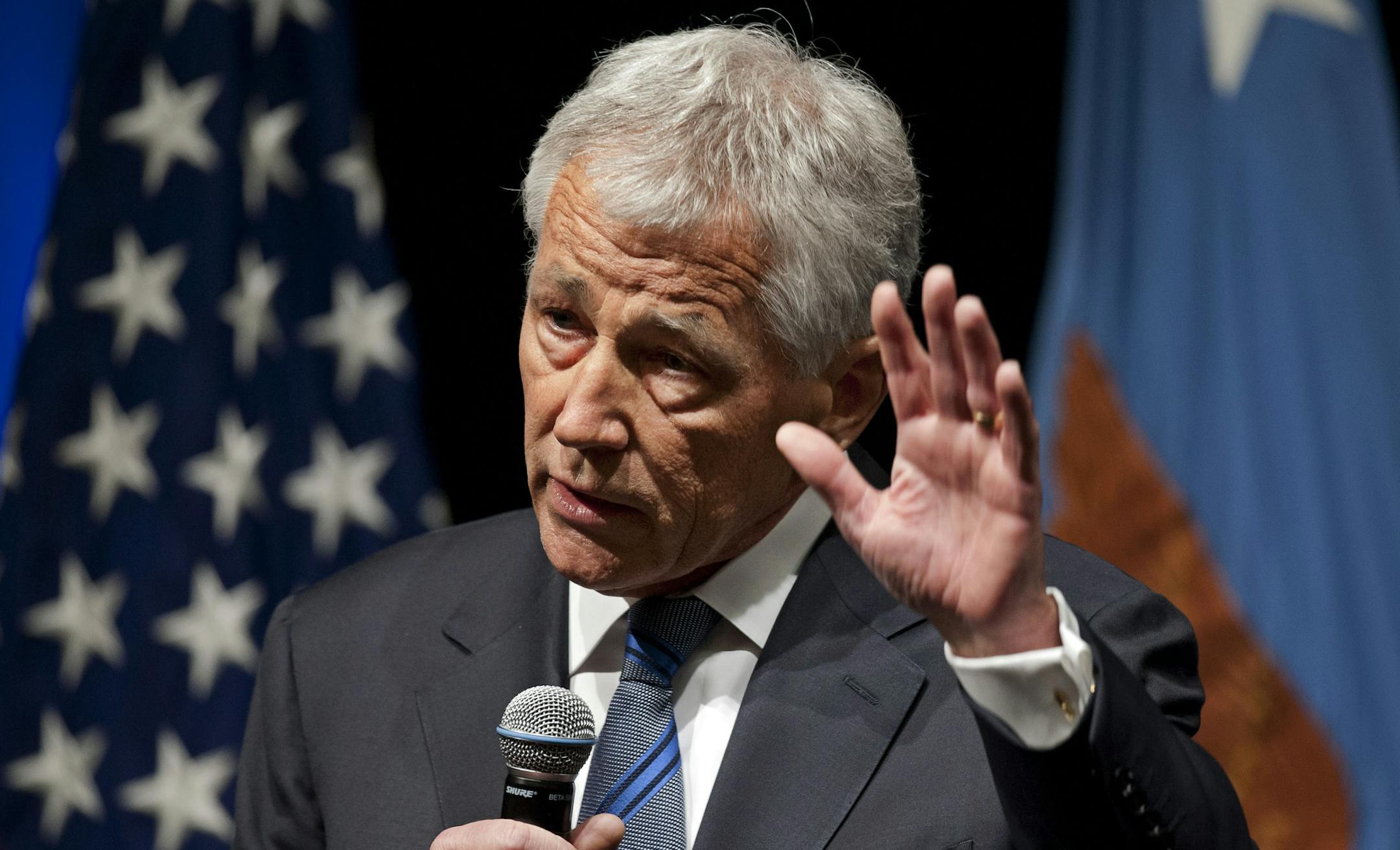
How is it that a cabinet nominee who once renounced his country, threw away his war medals and has been a reliably liberal vote in the U.S. Senate gets broad Republican support and thus breezes to confirmation as secretary of state — while a former GOP senator from Nebraska with two purple hearts from Vietnam and endorsements from an array of national-security officials gets sidetracked by his own party?
Yes, one might think that John Kerry, the Democrat from Massachusetts, would run into more trouble from Lindsey Graham, John McCain and James Inhofe than Chuck Hagel would. Then again, one might think that in the midst of fiscal insolvency, Senate Republicans would not be so fixated on another military adventure in the Middle East.
The problem for Hagel was — and is — that he's fed up with war. Avoiding more needless American bloodshed is paramount for the decorated vet, and that has driven a wedge between Hagel and his GOP colleagues.
To be sure, the nominee was considered something of an apostate for supporting President Obama in 2008, and he sometimes (as his hearings demonstrated) shoots before he aims. But if Hagel's willingness to talk with Iran was the deal-breaker, what to make of the fact that Truman talked with Stalin, Nixon with Mao and Reagan with Gorbachev?
Well, can we be honest? It was Chuck Hagel's criticism of the "Jewish lobby" that required for the first time in history 60 votes to confirm a defense secretary. Had Hagel not uttered, "I am a United States senator, not an Israeli senator," he'd have been easily ensconced as defense secretary in early February.
Which is not to say past statements aren't fair game for any constituency. But by any objective standard, well-financed groups — such as the American Israel Public Affairs Committee (AIPAC), with more than 100,000 members — wield considerable influence in Washington, especially with Republicans.
Unfortunately, when it comes to Israel, the discourse too often breaks down between extremes. It is a false choice pitting the idiocy of the "Holocaust-denying Jewish banker conspiracy type" against an "Israel can do no wrong" crowd that deals in charges of anti-Semitism the way Al Sharpton deals in racism.
In fact, there's a much more vibrant and open debate on Israeli policy in Tel Aviv than there is in Washington. Benjamin Netanyahu, the hawkish prime minister, has now been forced to join hands with dovish rivals to form a coalition that may jump-start negotiations with the Palestinians.


