

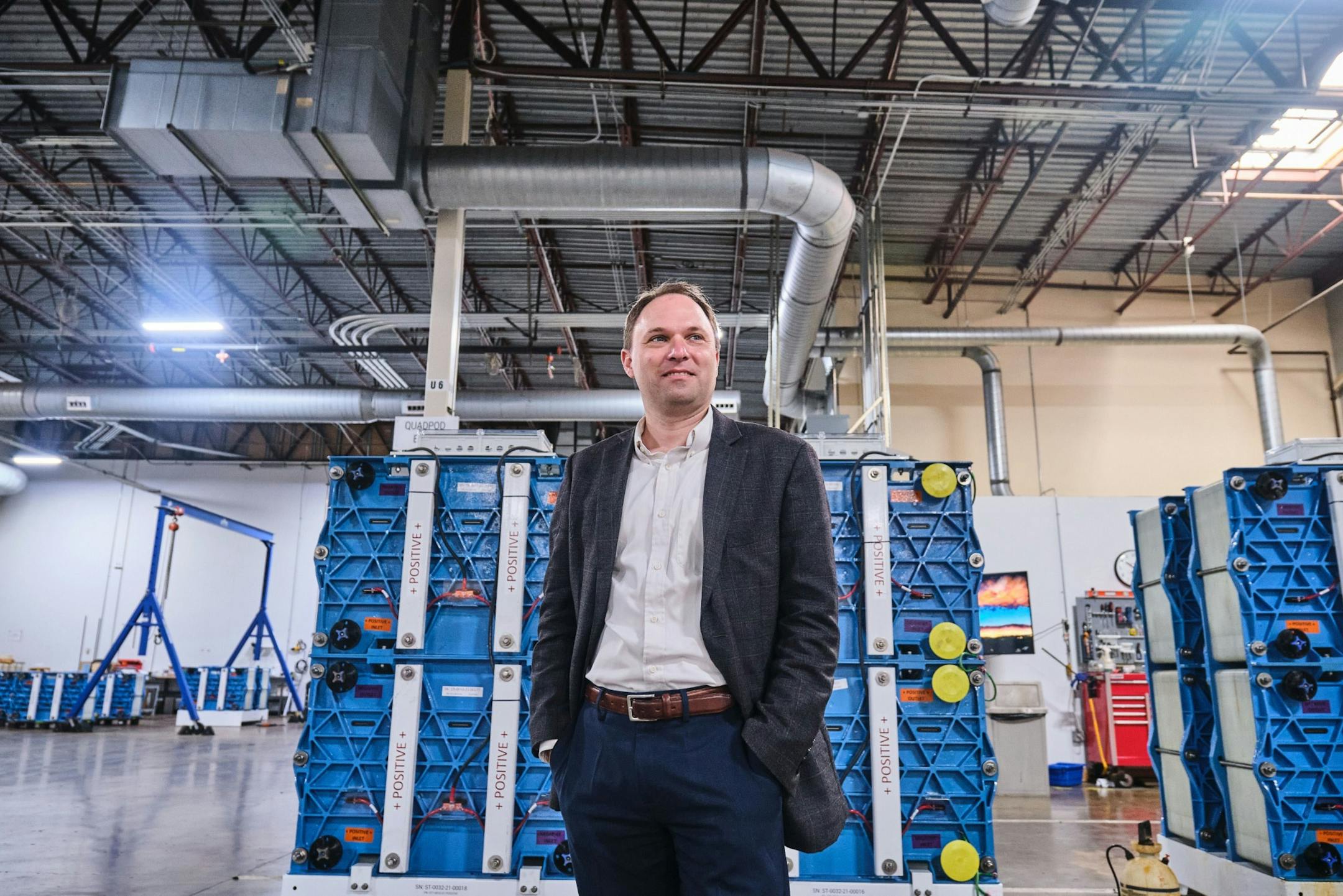
The world's electric grids are creaking under the pressure of volatile fossil-fuel prices and the imperative of weaning the world off polluting energy sources. A solution may be at hand, thanks to an innovative battery that's a cheaper alternative to lithium-ion technology.
SB Energy Corp., a U.S. renewable-energy firm that's an arm of Japan's SoftBank Group Corp., is making a record purchase of the batteries manufactured by ESS Inc. The Oregon company says it has new technology that can store renewable energy for longer and help overcome some of the reliability problems that have caused blackouts in California and record-high energy prices in Europe.
The units, which rely on something called "iron-flow chemistry," will be used in utility-scale solar projects dotted across the U.S., allowing those power plants to provide electricity for hours after the sun sets. SB Energy will buy enough batteries over the next five years to power 50,000 American homes for a day.
"Long-duration energy storage, like this iron-flow battery, are key to adding more renewables to the grid," said Venkat Viswanathan, a battery expert and associate professor of mechanical engineering at Carnegie Mellon University.
ESS was founded in 2011 by Craig Evans, now president, and Julia Song, the chief technology officer. They recognized that while lithium-ion batteries will play a key role in electrification of transportation, longer duration grid-scale energy storage needed a different battery. That's because while the price of lithium-ion batteries has declined 90% over the last decade, their ingredients, which sometimes include expensive metals such as cobalt and nickel, limit how low the price can fall.
The deal for 2 gigawatt-hours of batteries is worth at least $300 million, according to ESS. Rich Hossfeld, chief executive officer of SB Energy, said the genius of the units lies in their simplicity.
"The battery is made of iron salt and water," said Hossfeld. "Unlike lithium-ion batteries, iron flow batteries are really cheap to manufacture."
Every battery has four components: two electrodes between which charged particles shuffle as the battery is charged and discharged, electrolyte that allows the particles to flow smoothly and a separator that prevents the two electrodes from forming a short circuit.



