

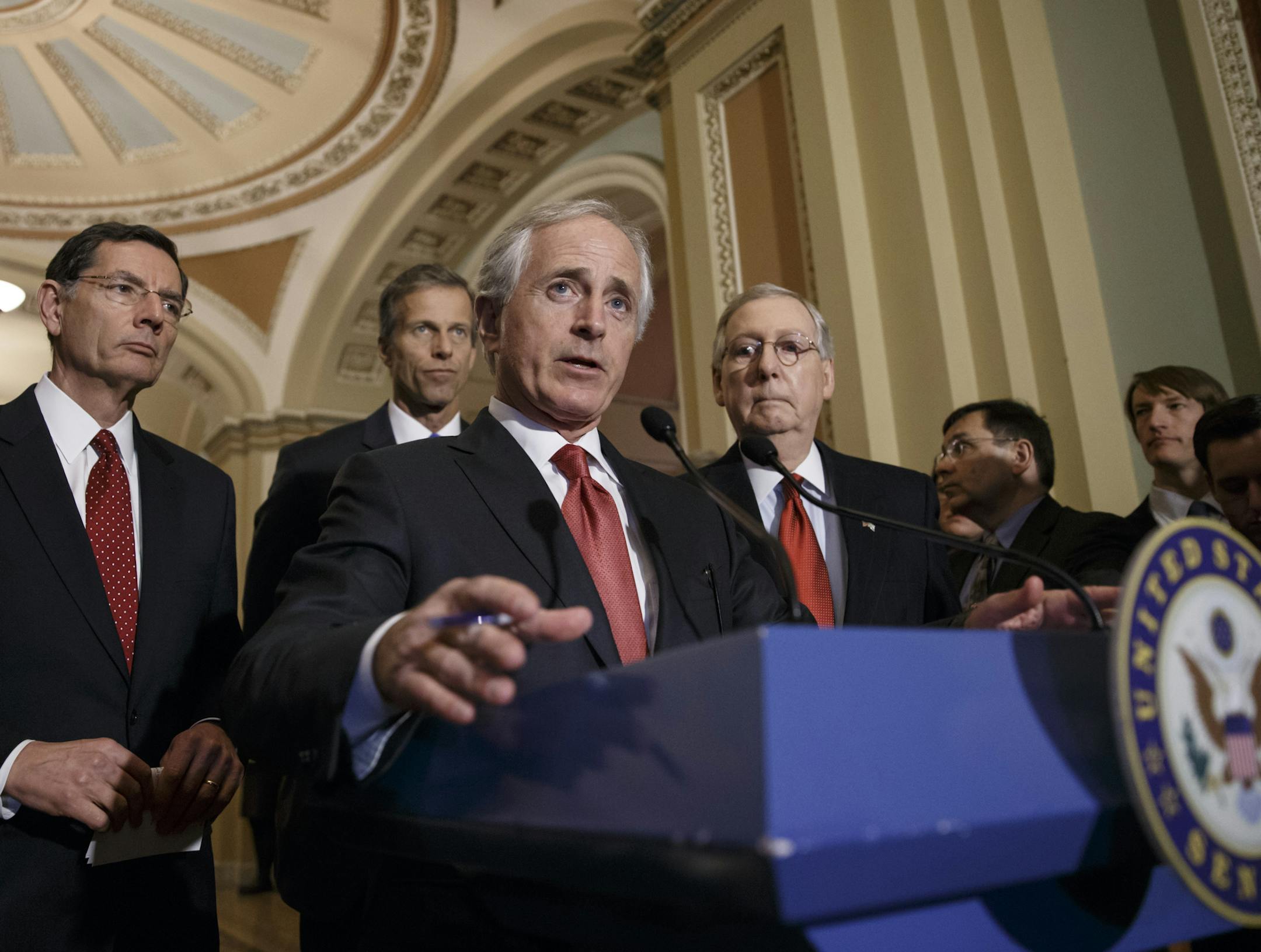
This week brings a constitutional moment illustrating a paradox of Barack Obama's presidency. The catalyst of the drama is legislation proposed by Sen. Bob Corker, chairman of the Foreign Relations Committee, asserting Congress' foreign-policy responsibilities and prerogatives. The paradox is this:
Obama's disdain for constitutional etiquette — his contempt for the institutional self-restraint that enables equilibrium under the separation of powers — has been primarily in domestic policy. His anti-constitutional actions have involved the Affordable Care Act, environmental, education, welfare and immigration policies, Internet regulation and judicially rebuked recess appointments, among other matters. Now, however, Congress' revival comes regarding foreign policy, where constitutional logic and historical precedents are most supportive of presidential discretion.
Corker proposes legislation to prevent Obama from unilaterally ending sanctions that Congress wrote into law. If all 54 Republicans and 13 Democrats agree on this point of constitutional integrity and institutional dignity, Obama's promised veto of Corker's legislation will be overridden.
Some who partake of Obama's condescension say it is unseemly for the president to have to accommodate Chairman Corker, a former mayor (of Chattanooga). But one of the committee's best chairmen since 1945 was a former mayor (of Indianapolis), Richard Lugar. And the chairman who in the 1940s tugged Republicans toward internationalism, Michigan's Arthur Vandenberg, was a former publisher of a newspaper in Grand Rapids. For those who have forgotten the phenomenon, Corker's patient bipartisanship is what a senator behaving senatorially looks like.
Iran surely construes Obama's veto threat as evidence that, such is his hunger for an agreement, he will make concessions (about Iran's nuclear infrastructure, the modalities of inspections and the removal of sanctions) that are unacceptable to Congress. The negotiations about such issues already have reflected asymmetries of desire.
Obama wants to prevent Iran from becoming a nuclear power, but more ardently wants, in the process of trying to do this, to encourage dynamics that will domesticate Iran's regime and validate his claim to greatness. Iran desires relief from sanctions, but more ardently desires a nuclear capability.
Obama's aspiration may be fanciful, but Iran's regime is unlikely to be the first in world history to last forever. Iran's aspiration may be sinister, but U.S. wars of regime change in Iraq and Libya have shown other nations the advantages of possessing nuclear weapons.
Obama's obnoxious air of entitlement to unearned immunity from oversight should not blind us to this fact that has been obvious for some time: Iran is going to be a nuclear power if it intensely wants to be, and it does; no practicable sanctions can be severe and durable enough to defeat this determination.


