

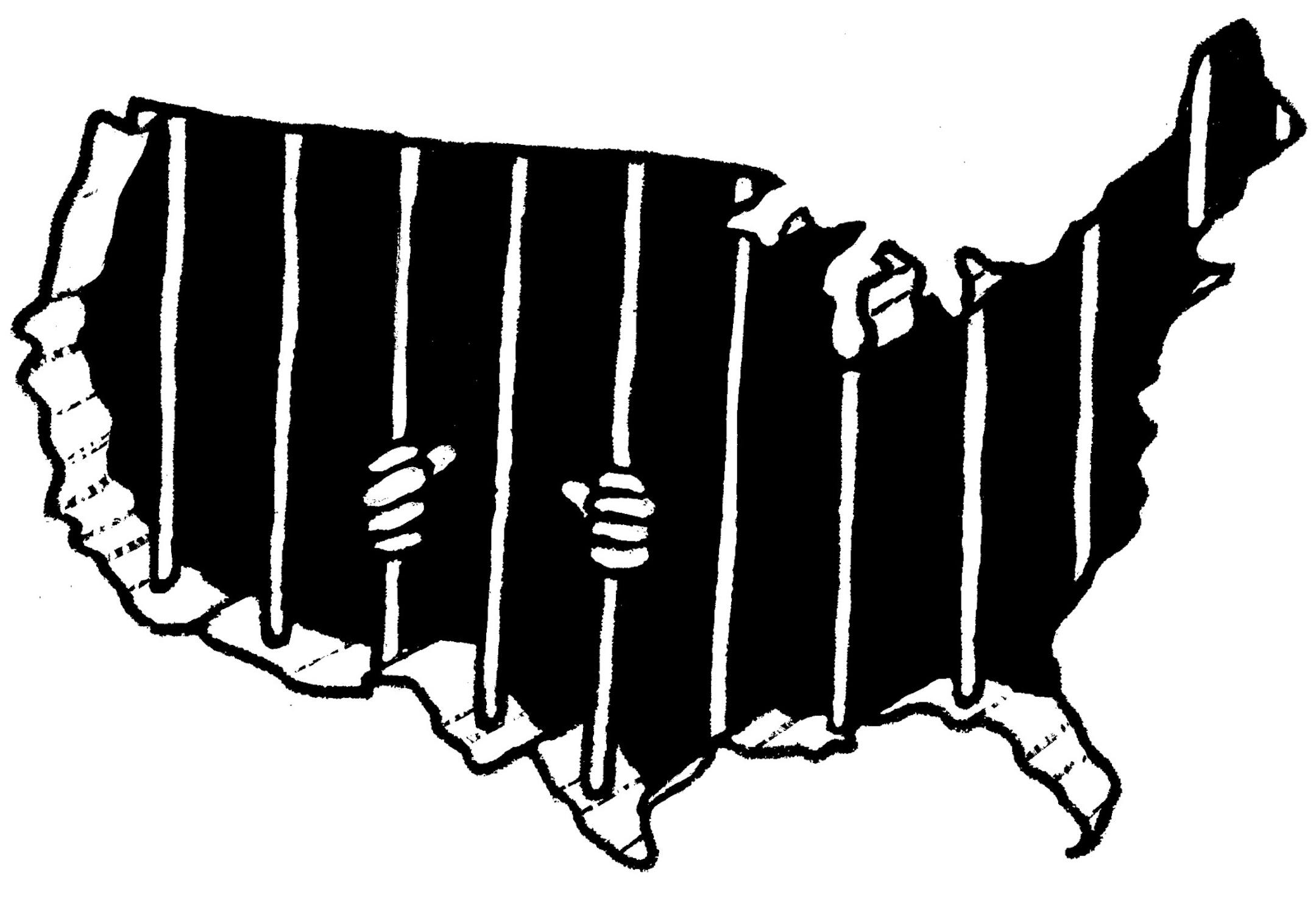
You already know that the United States locks up a higher percentage of its population than any other country. If you look at local, state and federal prison and jail populations, the United States currently incarcerates more than 2.4 million people, roughly 25 percent of the total incarcerated population of the entire world.
A population of 2.4 million is enough to fill up a good-sized country. In the past, the British Empire decided to convert a good chunk of its prison population into a country, sending some 165,000 convicts off to Australia. This isn't an option for the United States, but it suggests an interesting thought experiment: If the incarcerated population of the United States constituted a nation-state, what kind of country would it be?
Here's a profile of Incarceration Nation:
• Population: As a country — as opposed to a prison system — Incarceration Nation is on the small side. Nonetheless, it has a larger population than about 50 other countries, including Namibia, Qatar, Gambia, Slovenia, Bahrain and Iceland. And though the population of Incarceration Nation has dipped a bit in the last couple of years, the overall trend is toward growth: Over the last 30 years, the incarcerated population of the United States has gone up by a factor of four, making Incarceration Nation's population growth rate more than double that of India.
• Geographic area: We have to do some educated guessing here. There are more than 4,500 prisons in the United States. Let's assume that each of those prisons takes up about half a square mile of land — a reasonable estimate given that most prisons are, for security reasons, surrounded by some empty space. That gives Incarceration Nation an estimated land area of about 2,250 square miles: small, but still larger than Brunei, Trinidad and Tobago, Luxembourg, Bahrain and Singapore.
• Population density: Incarceration Nation is a crowded place. If we assume a land area of 2,250 square miles, it has a population density of roughly 1,067 people per square mile, a little higher than that of India. Of course, the residents of Incarceration Nation don't have access to the full land area constituting their nation: most spend their days in small cells, often sharing cells built for one or two prisoners with two or three times that many. In 2011, federal prisons were operating 39 percent above capacity; in many state systems, overcrowding was much worse. (In 2011, the U.S. Supreme Court found that overcrowding in California prisons was so severe it constituted "cruel and unusual punishment.")
• Demographics: It's a nation of immigrants. Like many of the smaller Gulf States, Incarceration Nation relies almost entirely on immigration to maintain its population. You might even say that Incarceration Nation is a nation of displaced persons: Most of its residents were born far away from Incarceration Nation, which has a nasty habit of involuntarily transporting people hundreds and sometimes thousands of miles away from their home communities, making it extraordinarily difficult for residents to maintain ties with their families.
• Birthright citizenship: Though most residents are immigrants and displaced persons, an estimated 10,000 babies are born each year in Incarceration Nation. Most are deported within months, generally landing with foster families. But Incarceration Nation does have its own form of birthright citizenship: As many as 70 percent of children with an incarcerated parent end up incarcerated themselves at some point.


