
In Rio, construction jobs give women a way out

Rather than accept being trapped in poverty, women sign up for free training in highly paid building trades.

June 26, 2012 at 12:13AM
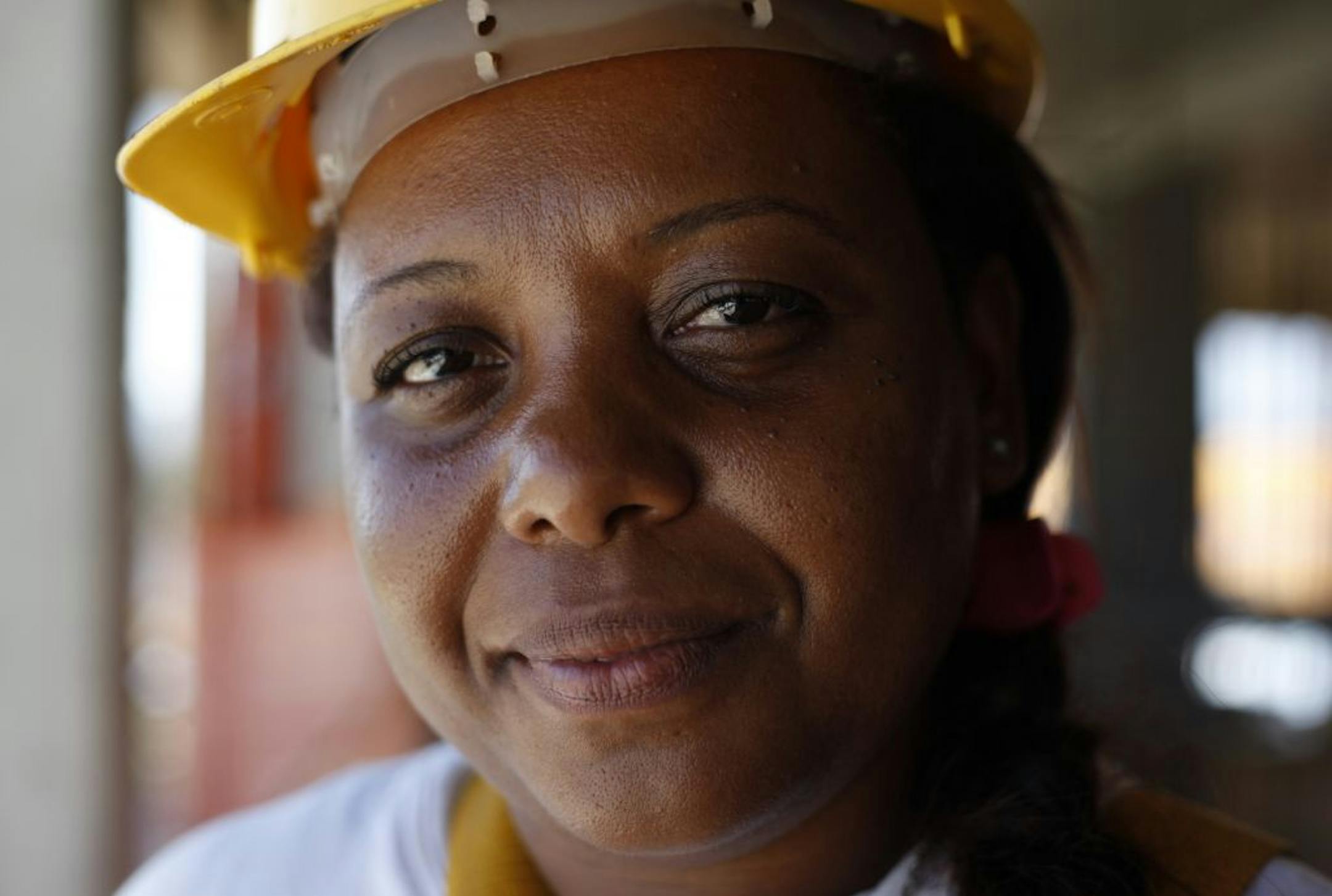
Fl�via Paula dos Santos, is employed a work site in in the Barra da Tijuca neighborhood in Rio De Janeiro, Brazil, Thursday March 8, 2012.
Fl�via Paula dos Santos, is employed a work site in in the Barra da Tijuca neighborhood in Rio De Janeiro, Brazil, Thursday March 8, 2012. (Mct/The Minnesota Star Tribune)

RIO DE JANEIRO - When 19-year-old Paloma Cristina Terra's boyfriend, Felipe, left her, she was terrified. Five months pregnant at the time, she had no idea how she'd support herself. Like many young women from Rio de Janeiro's slums, she'd quit school in sixth grade and never held a job.

Milena Vicente Silva de Santa Rita, 25, found herself in a similar predicament. A single mother of two from Nova Iguacu, a poverty-stricken city just outside Rio, she hadn't held a steady job in five months. Occasionally, she'd find temporary work cleaning, earning the equivalent of about $53 a month -- hardly enough to support a family of three.

Both could have done what many poor women in Brazil do and take full-time jobs as maids. But a typical maid's salary -- equal to $265 a month -- would have left them in poverty. So they decided to try something different.

In February, Terra and Silva de Santa Rita joined 58 other participants in Projeto Mao na Massa, or the Hands-On Project, which trains and certifies women in construction jobs. Now in its fifth year, the program offers free training in masonry, carpentry, plumbing, painting and electrical work, as well as basic language and math skills.

When the women graduate, they typically earn more than three times what maids make.

For Terra, the prospects of a career in construction are promising.

"The Mao na Massa Project provides women with a unique opportunity to become independent, and I really want to achieve that," she said.

Silva de Santa Rita has been fascinated with construction since she was a girl, and long dreamed of becoming an architect.

The project targets those on the bottom rung of Brazilian society: battered women, school dropouts, single mothers in their teens and residents of Rio's poorest slums, shantytowns that often lack electricity and running water and are centers of drug trafficking.

It hasn't been an easy road for some graduates who enter the male-dominated field.

Flavia Paula dos Santos, a 2008 graduate of the program, works for COFIX, a large construction company based in Rio. She's helping to build a new high-rise in Barra da Tijuca, an upper-income suburb near the beach with breathtaking views of the downtown skyline.

"At first, men would frown at me," she said, raising her voice against the loud stutter of jackhammers and other machinery in the background. "They would say, 'Oh, you can't even handle a hammer.' "

Paula dos Santos said her family had a harder time coming to terms with her choice of profession than her co-workers did. Her father, who died in January, "never accepted the fact that I work in civil construction," she said.

Said Norma Sa, the project's coordinator: "Not all companies are willing to hire women. We are trying to break this resistance over time."

Jen Swales, a student at Penn State University, reported this story for a class in international journalism.

about the writer

about the writer

JEN SWALES, McClatchy Newspapers

More from Business

See More
card image
Blaze Credit Union

Blaze Credit Union is Minnesota’s fourth-largest by assets. First notices of the Aug. 14 cybersecurity incident went out in early December.

card image
card image