

Shadows of silhouetted hands arrange a cacophony of fragmented, colorful transparencies on top of a projector plate. In one image, a leafless tree stands tall against a golden sunset. At times, blurred colors create kaleidoscopic whirls. Pictures of friends at band practice alternate with the dreamy imagery.
The obscured hands belong to artist Sky Hopinka. This is his 10-minute film "Lore," about the process of sharing memory and knowledge in a way that avoids nostalgia. It's a technique Hopinka uses in two films and a series of two-dimensional prints on view in a solo exhibition opening Thursday at the Minneapolis Institute of Art.
Hopinka, a member of the Ho-Chunk Nation and a descendant of the Pechanga Band of Luiseño Indians, is interested in telling Indigenous stories from an Indigenous perspective "without going into usual tropes around it, and using other means to express these stories that are reflective of the culture itself rather than through a Western gaze," he said in an interview.
His films are often non-narrative. The show's title, "Disfluencies," points to breaks in conversation, when someone interjects an "uh," "um" or "you know," or stutters or pauses.
"The films, videos and photographs are all embarking on sort of a desire or path toward fluency, but not about achieving fluency," he said. "It's a way to meander or wander through what makes up a culture and what makes up survival in the 21st century."
Language revitalization factors into Hopinka's practice. While living in the Pacific Northwest, he learned the Indigenous language Chinuk Wawa. In 2013, he relocated from Washington state to the Milwaukee area to be closer to his family, and to learn the Ho-Chunk language. "Every Indigenous language has a way of relating to the land and how it has evolved," he added.
Hopinka made the second film in the show, "Cloudless Blue Egress of Summer," while an artist-in-residence at the Crisp-Ellert Art Museum in St. Augustine, Fla. There he learned about Castillo de San Marcos, the oldest masonry fort in the United States, built by the Spanish more than 300 years ago.
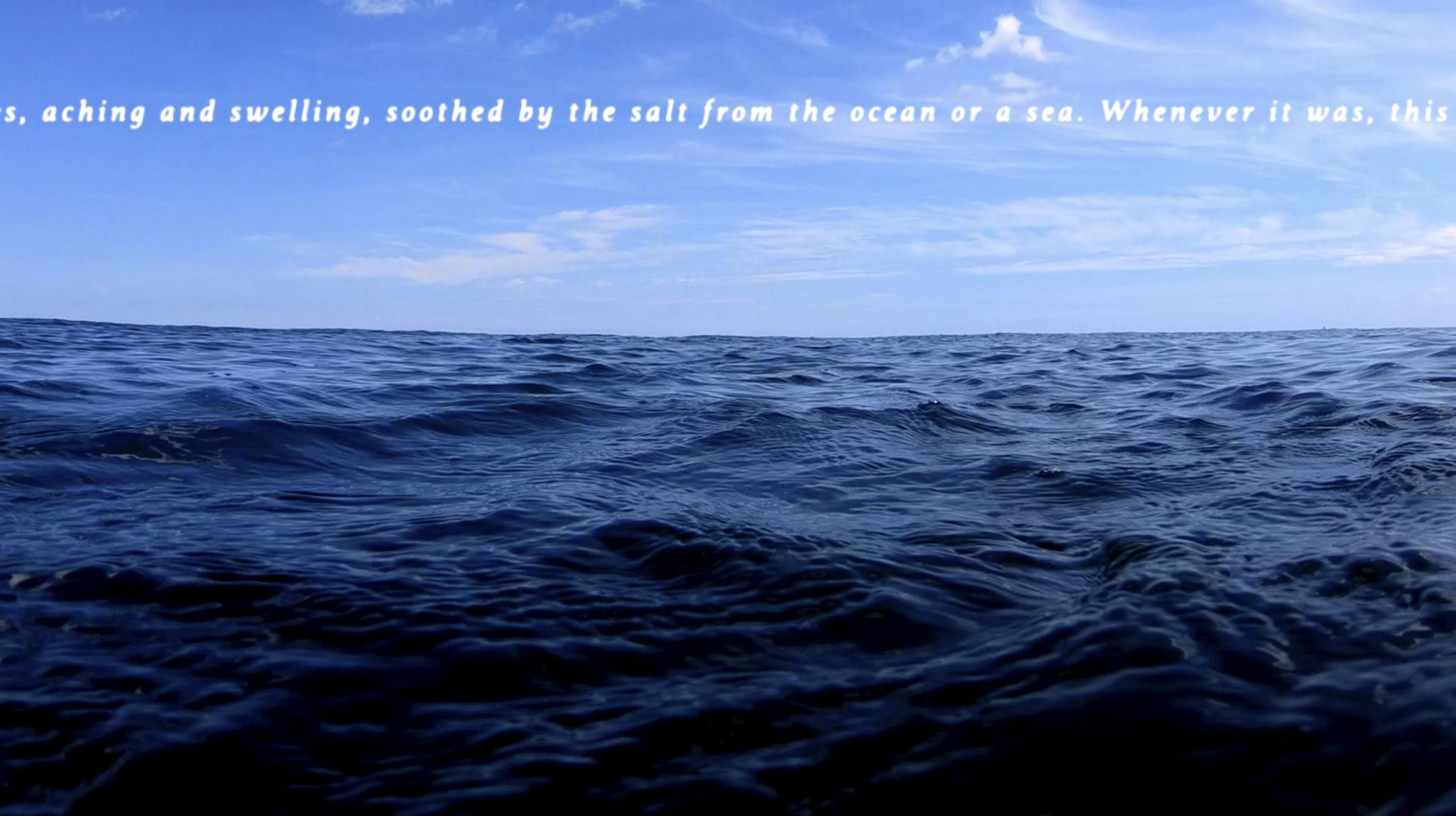
His two-channel film follows the story of Seminole Chieftain Coacoochee (Wild Cat), who was imprisoned at the fort during the Second Seminole War (1835-42). While a gentle song is strummed on guitar, Hopinka shows images of the ocean meeting the horizon line with scrolling text above; a journey through the interior of the fort (also known as Fort Marion), and archival drawings made by prisoners there. A distorted voice narrates the chief's escape, with details like, "For some weeks we watched the moon, in order that the night of our attempt it should be as dark as possible ... "


