

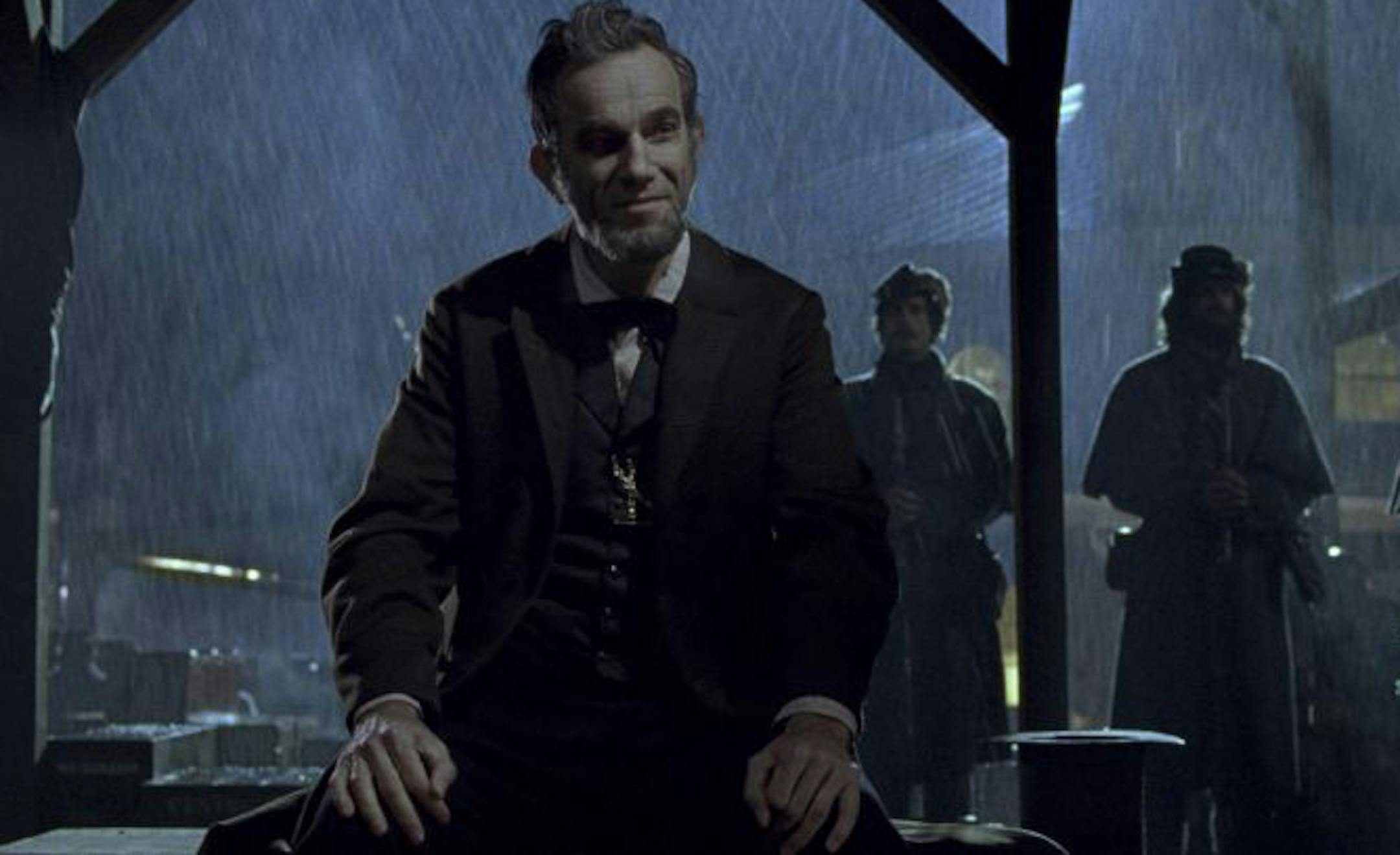
If this year's presidential campaign had a polarizing effect on the populace -- and by all accounts we're more divided than at any time since the Civil War -- then Steven Spielberg's "Lincoln" has arrived not a moment too soon.
The film makes us think about thinking. Lincoln's contemporary Karl Marx, a genius first and the father of communism second, marveled at the American president, describing him as that rare individual who is able to "succeed in becoming great without ceasing to be good." Kindness, fairness and clarity of thought were all wrapped up together in the character of Abe Lincoln.
Based partly on Doris Kearns Goodwin's book "Team of Rivals," "Lincoln" tells how the president masterminded passage of the 13th Amendment, which abolished slavery but fell short of granting blacks full equality. Its climax is Lincoln's eleventh-hour decision to delay peace talks with willing Confederate leaders until after the amendment had passed, a delay that implicitly sanctioned more misery and bloodshed.
In a darkened telegraph office, Lincoln weighs his decision to summon the Confederates or let them wait. He is bedeviled by two self-evident truths: the South's surrender would doom the amendment (its repatriated politicians would all vote "no"), and without slavery's abolition, the war would have been fought in vain.
Buying time, Lincoln engages in conversation with a telegraph operator trained in engineering. Surely the young man knows Euclid's "first common notion ... a rule of mathematical reasoning" that is "true because it works. Has done and always will do." Lincoln goes on in his slow, deliberate drawl: "It is a self-evident truth that things that are equal to the same thing are equal to each other."
The notion of equality had been as sacred as scripture to the founders. They considered it mathematically proven every time there was a fresh breakthrough in science because science itself was based on Euclid up to and including Newton's law of gravity. Proven also through engineering and architecture. Proven through courts of law. And proven through this American experiment with freedom.
Looked at this way, the choice was easy. "We began with equality -- that's the origin, isn't it?" Lincoln asks the operator. "That's justice."
Hilary Mantel's prize-winning novel "Wolf Hall," which chronicles the life of Thomas Cromwell, adviser to King Henry VIII, contains a strikingly similar moment. Like Lincoln, Cromwell (not to be confused with the Puritan revolutionary Oliver Cromwell) was an improbable leader, a homely man born to a blacksmith, slow-talking, self-taught in law and accounting, a consummate flip-flopper who deftly maneuvered between extreme poles of opinion for the sake of a greater good.


