

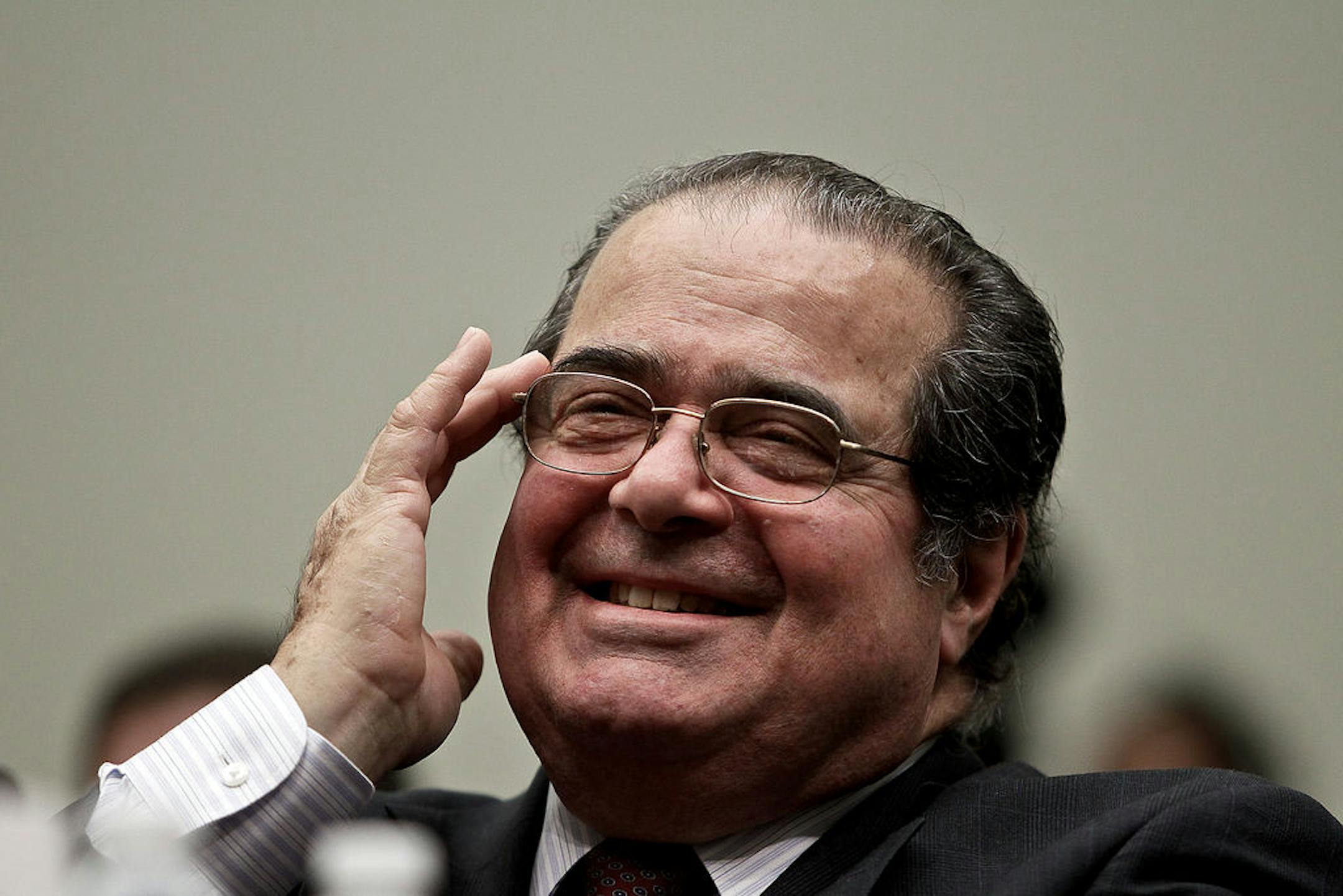
If there were to be a legal man of the year for 2016, it would have to be Antonin Scalia. The justice died in February and has cast a long shadow over the whole year. His seat remains unfilled. His jurisprudence seems likely to be the touchstone for Donald Trump's nominee.
Indeed, if Trump gets two or more Supreme Court picks, Scalia's judicial legacy stands a chance of being vindicated rather than forgotten — which seemed almost unthinkable when he died. Scalia's legacy is therefore poised to set the tone for future constitutional battles in a way not seen since the 1935 death of Oliver Wendell Holmes, another great dissenter.
When Scalia died, many commentators, myself included, noted that his originalist constitutional legacy consisted mostly of dissents. (His textualist statutory interpretation legacy was another matter. There Scalia wrote plenty of majority opinions and significantly influenced even liberal justices.)
At the time, Scalia's passing also appeared to herald the end to originalism as a dominant constitutional doctrine. With nearly a year to go in the presidency of Barack Obama, it was assumed that Scalia would be replaced by a liberal or at least a moderate justice. The appointment would change the balance of the court to decisively liberal for the first time in more than a generation.
And if Hillary Clinton had been elected, as polls suggested she probably would be, the liberal court could have been assured for a generation to come with the replacement of as many as three more justices, all of Scalia's approximate age.
What a difference 10 months can make. By blocking Judge Merrick Garland, the Republican Senate changed the rules of the confirmation game. The election of Trump means that Scalia will almost certainly be replaced by a justice who espouses some form of his originalism — and probably cites him as a judicial model, in the way Trump has done and probably all the judges on Trump's list would.
And if one or more of Justices Ruth Bader Ginsburg, Anthony Kennedy or Stephen Breyer steps down while Trump is president and Republicans control the Senate, the generational transition on the court may be toward greater conservatism, not liberalism or stasis.
The consequences for Scalia's legacy are enormous. Great judicial dissenters don't just write to make a historical record of their beliefs. They hope for their dissenting opinions to be redeemed by later judicial majorities, to use a term coined by the legal scholar Richard Primus in a seminal 1998 article.


