

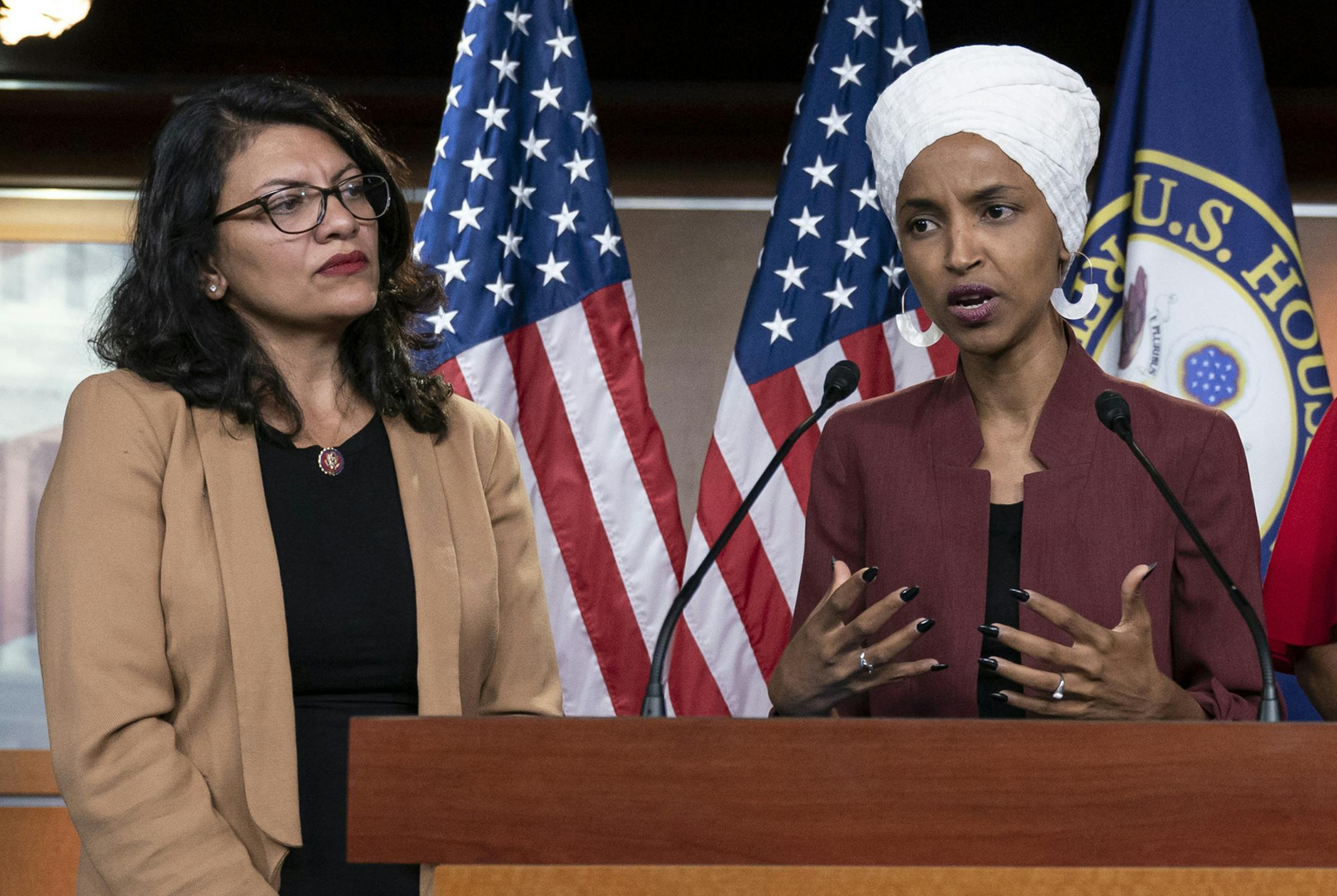
Citing a law against "boycott activities," Israel said Thursday that it would block Democratic U.S. Reps. Ilhan Omar of Minnesota and Rashida Tlaib of Michigan from making a private visit to the Israel-occupied West Bank. Both congresswomen are Muslims who have been critical of Israel's influence in Washington, not always in the most diplomatic ways, and both have supported Palestinians and the "BDS" movement proposing boycotts, divestment and sanctions against Israel.
The Associated Press reported that the congresswomen "had planned to visit Jerusalem and the West Bank on a tour organized by a Palestinian organization aimed at highlighting the plight of the Palestinians." In a statement released after the announcement, Omar said that "denying entry into Israel not only limits our ability to learn from Israelis, but also to enter the Palestinian territories."
The decision is easy enough to understand politically. Benjamin Netanyahu, now the longest-serving of any Israeli prime minister, wants to extend his leadership, but the effort is requiring more elections than he'd hoped. (The first, in April, failed to produce a result sufficient for him to form a coalition government; the next try is Sept. 17.) He's made himself an ally of President Donald Trump and probably felt he had less to lose by snubbing Democrats than by angering the president, who has found the congresswomen to be convenient political targets.
Indeed, shortly before the announcement Trump could be witnessed on Twitter leading the cheer:
"It would show great weakness if Israel allowed Rep. Omar and Rep.Tlaib to visit. They hate Israel & all Jewish people, & there is nothing that can be said or done to change their minds. Minnesota and Michigan will have a hard time putting them back in office. They are a disgrace!"
Yet, beyond the circus politics, Israel's move is an affront to the hope of serious governance.
First, Omar is the duly elected representative of the Fifth Congressional District. Whether or not you thought her the best candidate — I did not — she was selected by an 18-point margin in the Democratic primary in 2018 and by a 56-point margin in the general election. If she's getting shut out, so are the people of her district.
Second, any visit to the region can broaden the context in which the congresswoman (a member of the House Committee on Foreign Affairs, as she points out in her statement) understands the world's issues. It would rely on her taking in everything she sees with an critical eye and a curious mind — as her constituents would expect — but for that, she needs to be given the opportunity.


