How to build a better beach house

Building a solid sand castle takes the right mix of sand, water, tools - and patience.

July 19, 2012 at 2:44PM
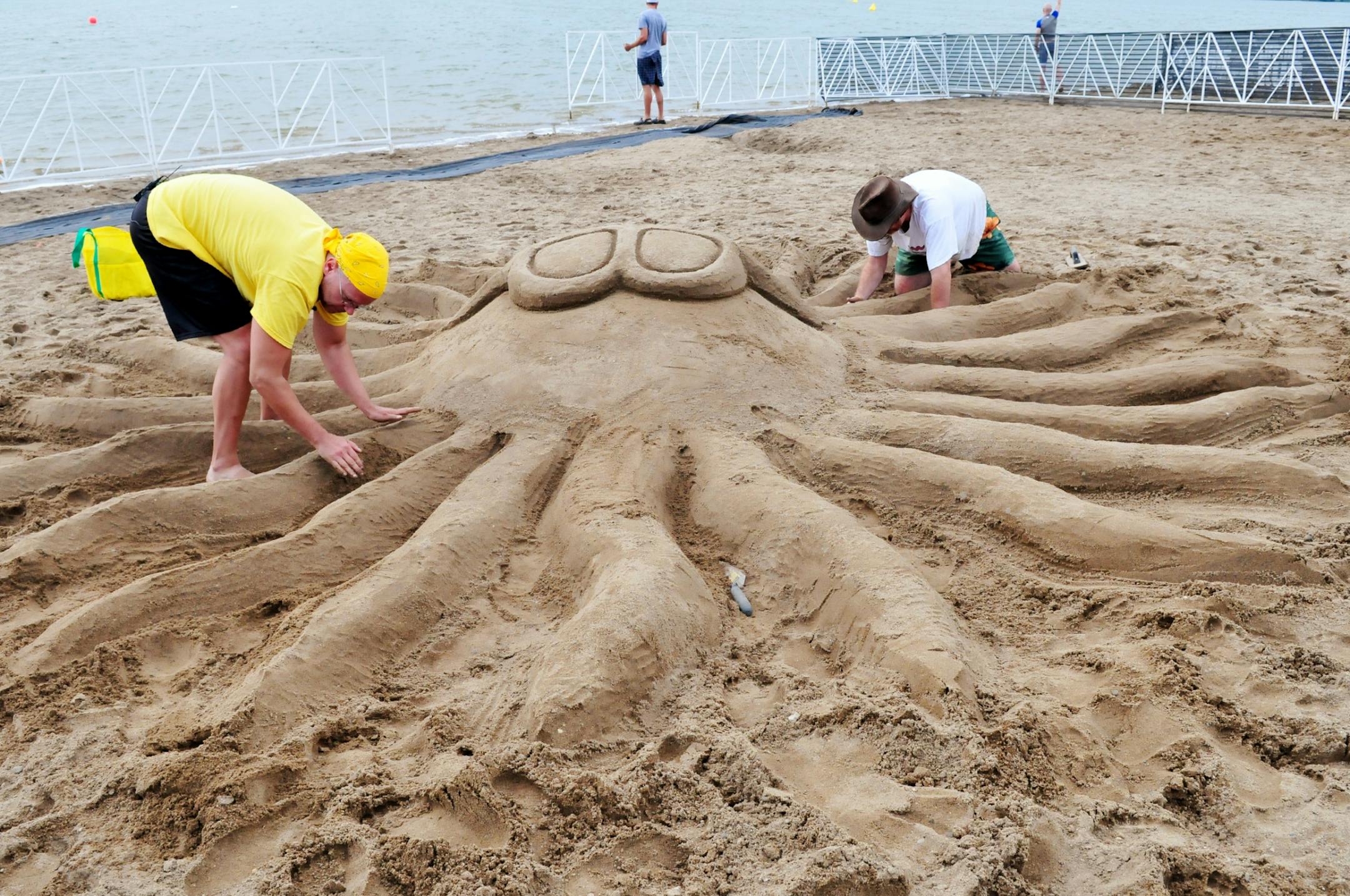
Kendall Bohn, left, and Erik Jorgensen worked on a sun ray sand sculpture at Lake Nokomis.
Kendall Bohn, left, and Erik Jorgensen worked on a sun ray sand sculpture at Lake Nokomis. (Special to the Star Tribune/The Minnesota Star Tribune)

Who hasn't set out to build the Taj Mahal of sand castles, only to be faced with a sagging, soggy, malformed architectural disappointment?

Not you, not this summer.

Crafting an eye-catching, artistically intricate sand castle goes far beyond the plastic pail creations of childhood.

You need to make a plan, find the right consistency of sand and water, and bring a well stocked tool kit to the beach. Surprisingly, those tools can be as common as a credit card -- although it might not run so easily through the cash register later.

Using equipment found around the house and with tips from the masters, anyone can sculpt a work of genius out of minuscule rock granules. We spoke to three experts about how to build a championship -- or at least a standing, recognizable -- sand castle.

Erik Jorgensen, a St. Paul landscape designer and award-winning sand sculptor (including in the Aquatennial), has one bit of advice: Get used to the mess.

"When you're all done, there's still sand on your feet," said Jorgensen. "Your car is destroyed for like a week."

But you will have a castle.

Evaluate the sandHow tall you make your castle depends on the type of sand you're working with, said Ed Jarrett, the Guinness World Records holder for the tallest sand castle, at 37 feet, 10 inches. Beach sand has been rounded out over centuries of water rushing over it or beach bums sunbathing on it. But "fresh virgin sand, untouched since the glaciers went through," is sharp, said Jarrett. "It interlocks like Velcro," allowing for more height. Virgin sand is usually trucked in to professional competitions, so if you're using beach sand, like the vast majority of builders, "stick to 2 feet," said Jarrett. "Three feet is pushing it."

Make a planTwo days before the Aquatennial's Sandcastle Competition, Jorgensen meets with his five-man team, Wild & Loose Coma, to throw out ideas. Jorgensen likes crafting scenes rather than castles, and some of his favorites in recent years were depictions of a scorpion water-skiing behind a frog, and Icarus -- the flying piggy bank. "We always try to have some kind of off-the-wall humor," said Jorgensen, who has nabbed the top prize in six out of the past 12 years. (He placed second this week.)

Jarrett, however, warns not to become too attached to your design. "Don't plan it out," he said. Instead, just sketch your scene and be flexible. "I've never done a complete 'this turret is going to connect to that turret,' because you might find a crack, so you don't want to put an arch under a crack. Go where you go, see what's happening with the sand."

Water your sand"A lot of people just pile up sand and they think they have it wet, and it's usually not as wet as it can get," said Ted Siebert, author of "The Art of Sandcastling" and lead sculptor of the Sand Sculpture Co., a group of artists who contract to build sand castles worldwide. He said it took 1,000 gallons of water to reach the proper consistency for one of his monumental 30-ton sculptures.

Jorgensen always keeps a spray bottle at the ready to keep the surface of the sculpture moist. Added Siebert, "You always want to add wet to wet, because if you get a dry layer of sand in between, you're asking for trouble."

Check the consistencyHow to describe the right texture is a matter of debate among sand castle experts. Cookie dough, pancake batter, patty cakes, muffins, cookies -- all delicious and all the ideal consistency for castle-ready sand. Another comparison is a snowball. "It's still wet, and when you tap on it, water comes out of it," said Jarrett. "Call it a sandball."


A thin, watery mixture called "drizzle" is too soft to make walls, but perfect for designer elements like shingles. "Mix the sand and water to where it runs through your fingers and run it over the top of the turrets," said Jarrett.

Build first, carve laterWhether it's a kiddie pail, a garbage can or even a sleeve made of duct-taped tar paper, "forms" are your friends. Pour in sand, add lots of water, and pound the mixture down with your hands to get the air out. When it can't possibly hold another drop, remove the form.

Siebert recommends cutting the bottom off a 5-gallon bucket and a 32-gallon garbage can, both of which need a few taps of a hammer to pry away from the heavy mix inside. Jarrett suggests cutting a seam down the side of a bucket and holding it together with tape. When the form is full, remove the tape and simply unwrap the sand cylinder.

Just don't flip a bucket of wet sand onto other parts of the structure; it's cumbersome and hard to control. "Stop the flipping," Jarrett said.

If you don't have a form, "just stack wet sand on top of wet sand," said Siebert. "It'll be a Hershey's kiss."

Start at the topOnce your structure is in place and you're ready to begin carving, don't start on the moat. "With the world's tallest castle, I started at the top and worked my way down," said Jarrett. "Otherwise if you make windows at the top, you're crumbling all over what you worked on at the bottom."

Tools of the tradeCastles are trickier than other sculptures because of the architectural aspect, so use a level and ruler for sharp corners and straight windows. But you don't need a carpenter's belt-worth of supplies to sculpt a beautiful sand design.

"You could carve sand with a credit card, it carves so easily," said Siebert, who sculpted a sand-based Mickey Mouse at Disney World using little more than plastic utensils from a fast-food joint. Jorgensen's secret weapon in his Aquatennial wins? A plastic straw. One item Jarrett can't live without is an offset spatula, which bakers use to frost cakes without getting icing on their knuckles.

When it comes to tools, imagination is the only limit. Other expert-recommended tools for making a great sand castle include a garden trowel, a rake, a dough scraper, an oil paint palette knife, a concrete float and a melon baller. If all else fails, nothing beats a good, old-fashioned plastic pail and shovel.

Sharyn Jackson • 612-673-4260

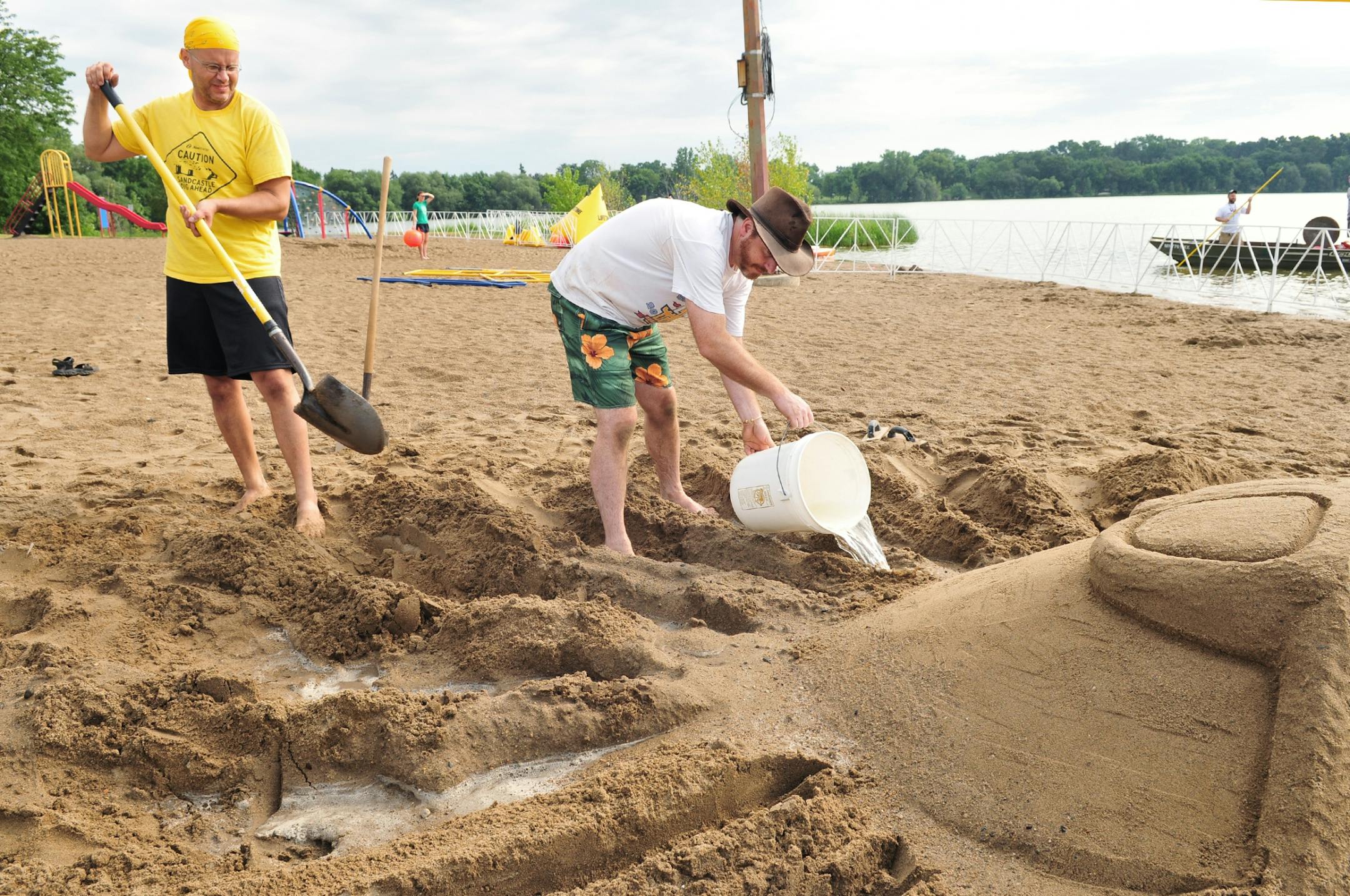
Erik Jorgenson pours water from Lake Nokomis on to an unfinished portion of a sand sculpture to keep it moist enough to continue working. Kendall Bohn uses a shovel to carve the general shape of the sun sculpture's rays.
Erik Jorgenson pours water from Lake Nokomis on to an unfinished portion of a sand sculpture to keep it moist enough to continue working. Kendall Bohn uses a shovel to carve the general shape of the sun sculpture's rays. (Bre Mcgee — Star Tribune/The Minnesota Star Tribune)
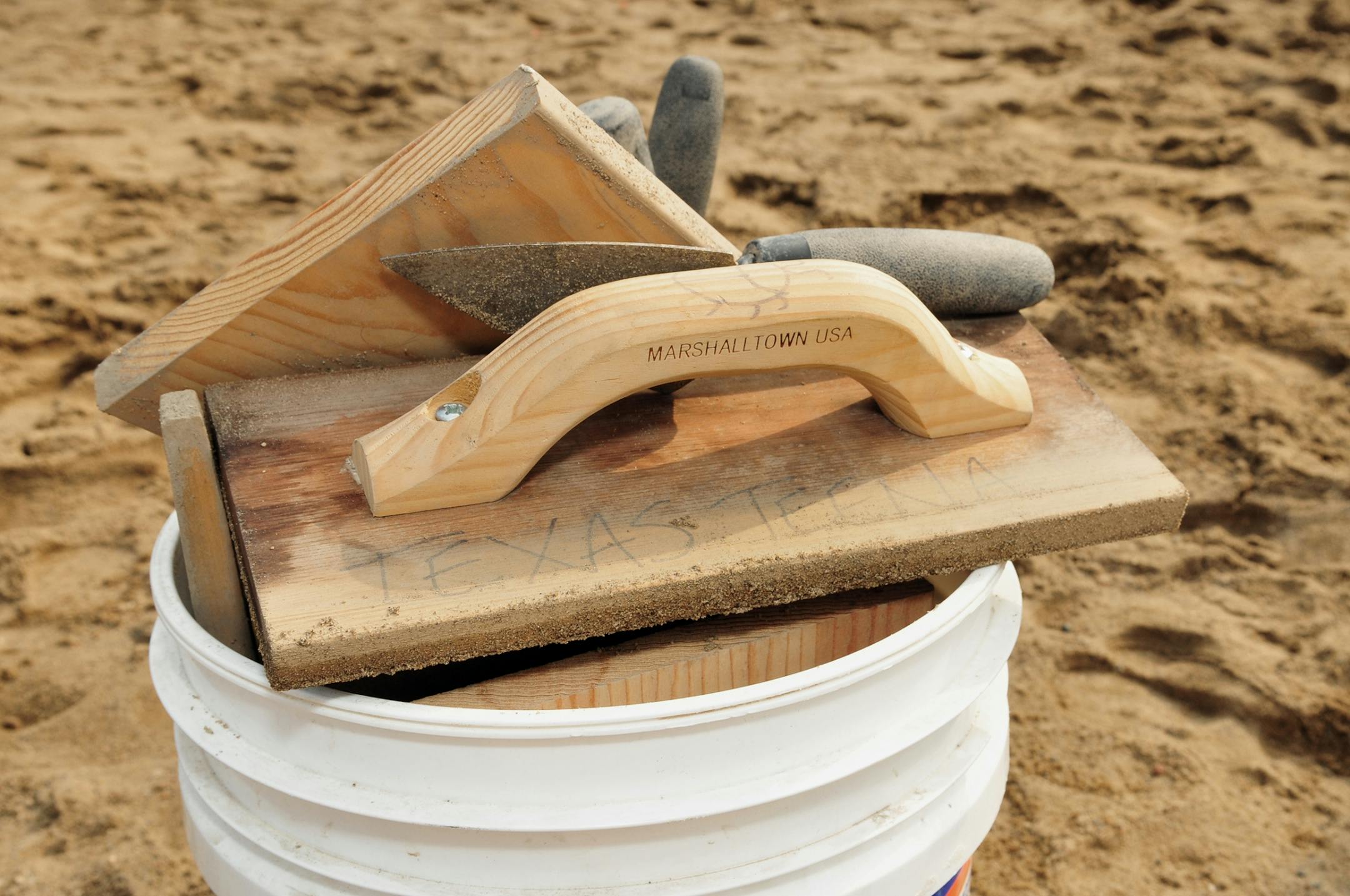
Erik Jorgenson and Kendall Bohn uses various tools to create their sand sculptures, including concrete floats for smoothing the sand. They also uses shovels, buckets, and sprayers, as well as trowels to carve details. .
Erik Jorgenson and Kendall Bohn uses various tools to create their sand sculptures, including concrete floats for smoothing the sand. They also uses shovels, buckets, and sprayers, as well as trowels to carve details. . (Star Tribune/The Minnesota Star Tribune)
about the writer

about the writer

Sharyn Jackson

Reporter

Sharyn Jackson is a features reporter covering the Twin Cities' vibrant food and drink scene.

See Moreicon