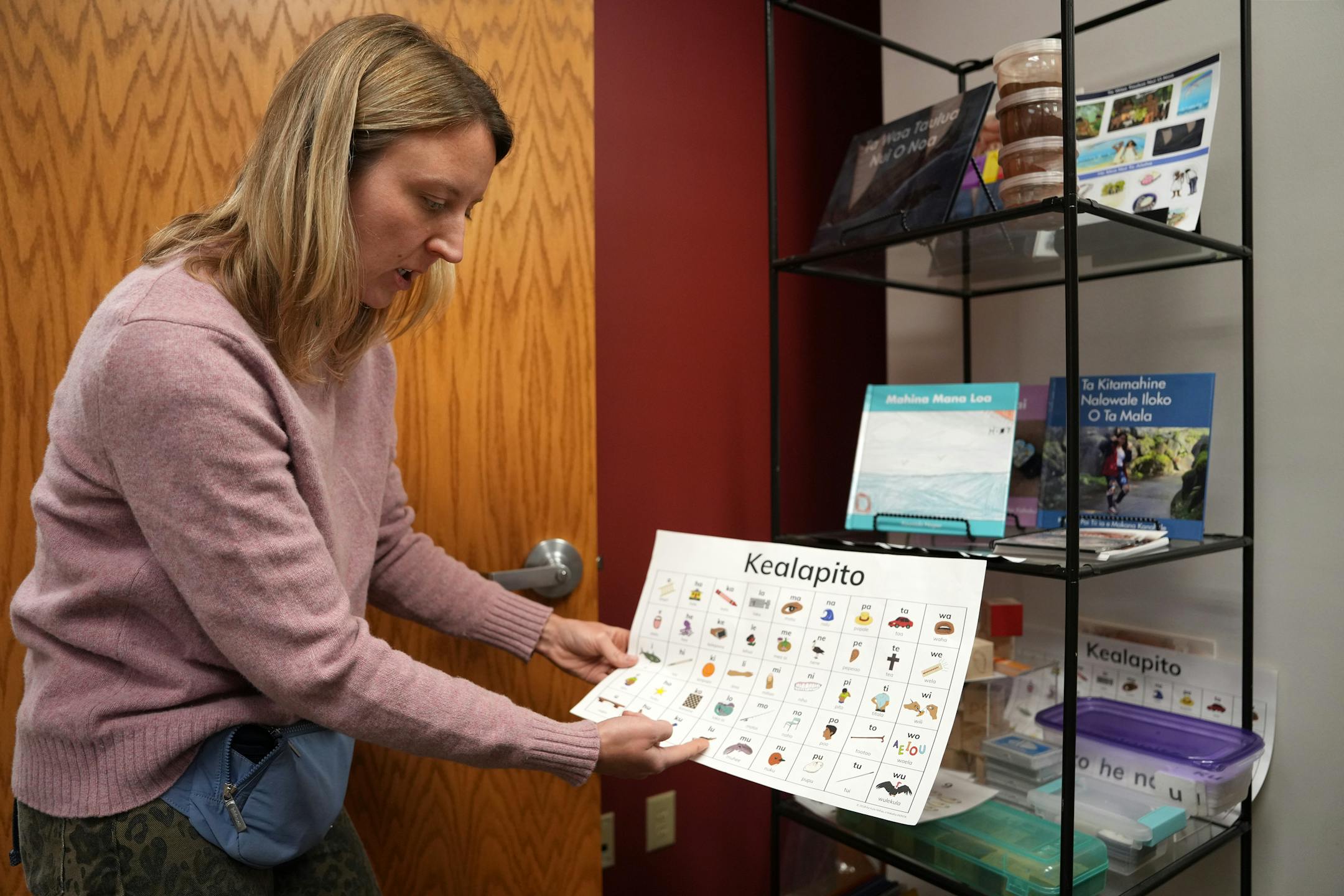
Tia Koerte grew up speaking Olelo Niihau, a dialect specific to the Niihau Hawaiian island, and knew she wanted to help preserve it.
Niihau has fewer than 500 native speakers in the world, including 70 students at the Ke Kula Niihau O Kekaha immersion school, where the language is taught alongside English. It wasn’t until Koerte became principal at the school that she realized she could seek funding to start building a library for her endangered native tongue.
“Up until that point, our language had been transferred orally only, and so there was no written forms of our language,” she said.
In 2016, she applied for a federal grant and reconnected with Tracy Fredin, director of Hamline University’s Center for Global Environmental Education. The two met years earlier and had stayed in touch. Fredin looked over the application and said the center could do everything Koerte needed.
“Tracy came back with practically the entire thing highlighted, and said he could do all of this,” Koerte said. Hamline University had access to curriculum developers and publishing software.
Since then, Hamline University has published more than 400 Olelo Niihau books with Ke Kula Niihau O Kekaha. Students write and create the art for picture books annually, with a new genre each year. The two schools hope to create 1,000 books.
Taylor Fredin, associate multimedia producer for Hamline’s Center for Global Environmental Education, visits the Hawaiian school a few times a year to facilitate the program.
Each student receives a personal copy of their own book annually, she said, and the school’s library has copies of every book. Educators at the school also write an annual book together called “legacy books.”