
How cold does it have to be for Minnesota schools to close?

St. Paul Public Schools to close Friday. Many districts use windchills of minus 35 degrees as the threshold to call off classes.

The Minnesota Star Tribune
January 22, 2026 at 5:07PM
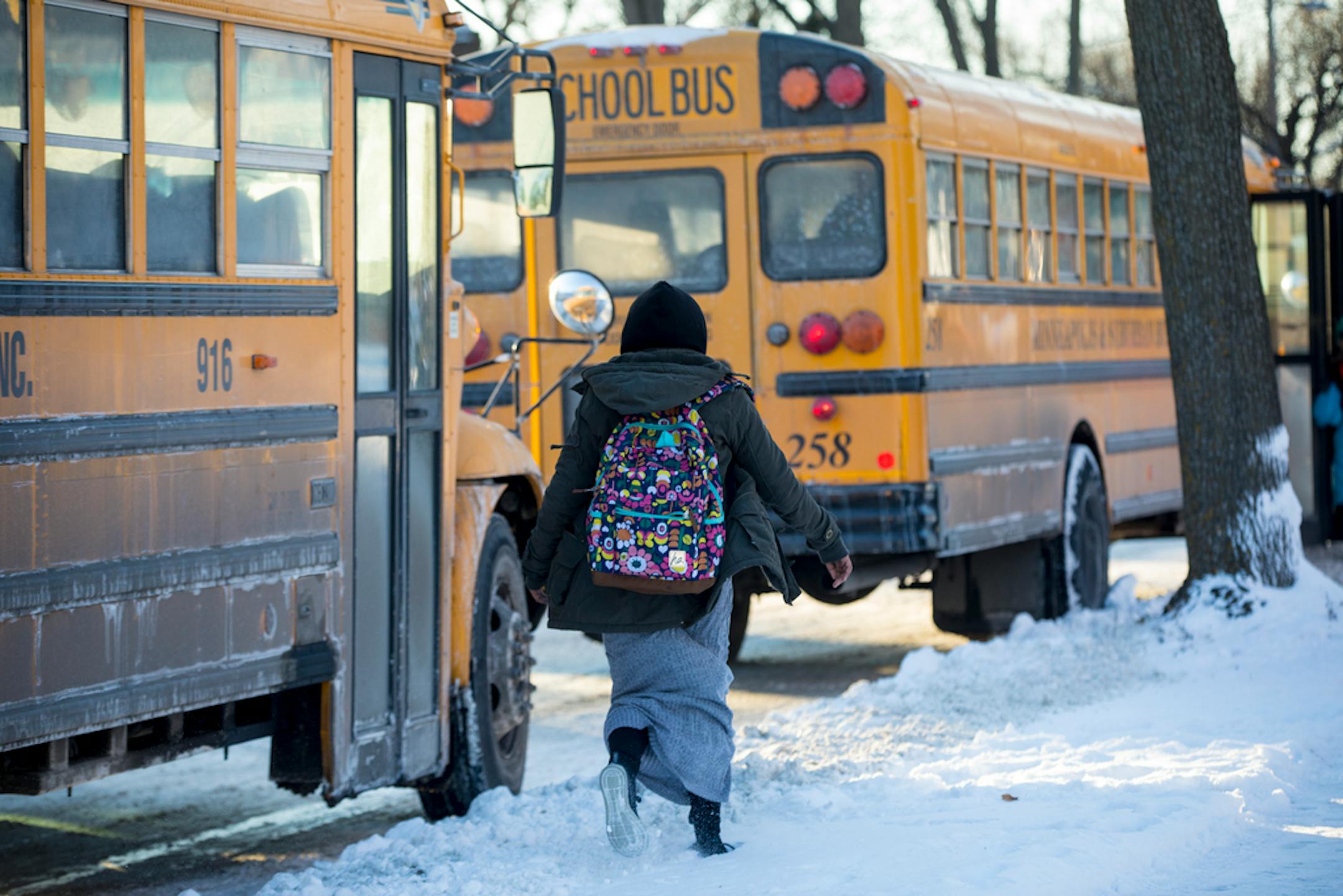
A student ran to her bus in the bitter cold after school at Sanford Middle School on in January 2018 in Minneapolis. (Renée Jones Schneider/The Minnesota Star Tribune)

Just a handful of Minnesota schools have announced closures related to extreme cold moving into the state Thursday, Jan. 22, but the list is likely to grow.

Blackduck schools in northern Minnesota will dismiss at 1:20 p.m. Thursday due to frigid conditions. St. Paul and Roseville have joined the Clearbrook-Gonvick School District and the International School of Minnesota in Eden Prairie in calling off off classes Friday.

All activites in St. Paul for Thursday night have also been cancelled.

Other schools may move classes online as temperatures sink well below zero and strong winds will make it feel even colder.

But just how cold does it have to be before in-person school is canceled or switched to an e-learning day?

While there is no state law setting the threshold requiring school districts to close, many “follow the ‘law of nature,’” Jim Skelly, a spokesman with the Anoka-Hennepin School District, the state’s largest with about 38,000 students, told the Star Tribune in February 2025. “That is when temperatures reach minus 35 degrees, that is the time to consider action.”

That’s almost a certainty as an Extreme Cold Warning covering the entire state will go into effect at noon in northern Minnesota and Thursday afternoon and evening in the Twin Cities and southern Minnesota.

Extreme cold warning is the term for what used to be known as a windchill warning.

“The dangerously cold wind chills as low as 50 below zero could cause frostbite on exposed skin in as little as 10 minutes,” the National Weather Service said.

The warning will remain in effect until noon on Friday in the metro and southern Minnesota and a watch through Sunday morning. Warnings and watches also cover the northern part of the state, the Weather Service said.

“Dress in layers including a hat, face mask, and gloves if you must go outside,” the Weather Service said.

Skelly said one factor in whether to call off in-person classes has to do with transportation.

In St. Paul Public Schools, district policy, classes and activities will be canceled if windchills are forecast to be minus 35 degrees or colder at 6 a.m. or snow makes it too difficult for students and staff to get to school safely, the district’s website says.

The Rosemount-Apple Valley-Eagan school district will close for cold weather if the National Weather Service forecast for 6 a.m. the next day calls for air temperatures of 25 degrees below zero or a windchill of minus 35 or lower, the district’s website said.

Though districts set and control when to close or start late, there have been times the state’s governor made a unilateral decision. That happened when DFL Gov. Mark Dayton ordered public schools closed on Jan. 6, 2014, as the mercury fell into the minus 20s in the metro with a minus 48-degree windchill, according to the Minnesota Department of Natural Resources.

Republican Gov. Arne Carlson also ordered public schools closed on Jan. 16, 1997, Feb. 2, 1996, and Jan. 18, 1994, because of below-zero temperatures and windchill readings even lower.

about the writer

about the writer

Tim Harlow

Reporter

Tim Harlow covers traffic and transportation issues in the Minneapolis-St. Paul area, and likes to get out of the office, even during rush hour. He also covers the suburbs in northern Hennepin and all of Anoka counties, plus breaking news and weather.

See Moreicon

More from News & Politics

See More
card image
Alex Kormann/The Minnesota Star Tribune

Rep. Kelly Morrison toured the facility twice this week. The Department of Homeland Security has defended its detention standards.

card image
card image